• TalkBass has been independent since 1998. Add your voice.
    Create a free account to reply to discussions, view embedded media, and browse with fewer display ads.
    Join freeLog in
    Want zero display ads or expanded classifieds tools? Compare plans.

Mods that make no discernable difference in your sound.

But dies it improve the tone of the bass or does it just do the job of the bridge?

It does neither. You can set the intonation at the bridge and some notes will still be off due to the positioning of the frets. The fret positions are a compromise and should actually be different for each string for every note to play in perfect tune. A compensated nut corrects for this.

It is more important for a guitar than a bass. If you play an open A chord on a guitar with each string tuned perfectly on the open string the 3rd (C#) will sound a little sharp. You can tune flat a hair to make the chord sound right, but then other notes are out. This is what a compensated nut corrects. It doesn't bother some people, but some are really sensitive to it.
 
Showdown said:
It does neither. You can set the intonation at the bridge and some notes will still be off due to the positioning of the frets. The fret positions are a compromise and should actually be different for each string for every note to play in perfect tune. A compensated nut corrects for this.

I see! So it's like a regular/multiscale hybrid.
 
I see! So it's like a regular/multiscale hybrid.

Not really. I added this to my previous post:

It is more important for a guitar than a bass. If you play an open A chord on a guitar with each string tuned perfectly on the open string the 3rd (C#) will sound a little sharp. You can tune flat a hair to make the chord sound right, but then other notes are out. This is what a compensated nut corrects. It doesn't bother some people, but some are really sensitive to it.

You hear it more on a guitar with a little distortion on certain chords like the open A. The distortion adds a little dissonance that is easy to hear when the one note is off. You can then tune that string so that dissonance goes away but then other notes will be wrong.

It affects bass too, but you need a sensitive ear to hear it.
 
Showdown said:
Not really. I added this to my previous post:

It is more important for a guitar than a bass. If you play an open A chord on a guitar with each string tuned perfectly on the open string the 3rd (C#) will sound a little sharp. You can tune flat a hair to make the chord sound right, but then other notes are out. This is what a compensated nut corrects. It doesn't bother some people, but some are really sensitive to it.

I gotcha now. Thanks!
 
I giggle when people say a new nut made the whole bass sound better.

Me too...until I just replaced a bunch of my nuts with graphtech Black Tusq ones. First off, I have to say that the idea that mods make no difference is just plain wrong. For example take nuts.

You'd think they only make a difference on open strings, but that's not totally correct. For example, the actual REASON I got the TUSQ nuts was I got tired of strings being hard to tune because of nuts being all sticky. You'd tune and then pull on strings to try to "seat" them and so on. The lubed Tusq nuts fixed that problem. So right there was A reason for the mod. Period.

But then after installing the nuts much to my surprise, I found that the Tusq claims of better tone etc. actually seemed to be true! Intonation was better able to be set precise. And that made the over all tone better and the way they gripped the strings seemed to make a general difference somehow. And you need to remember that before I got these nuts I was convinced that the claims of tone changes were nothing but pure sales pitch. I swear it makes a difference in at least the feel of the bass if not the actual tone. But it SEEMS like the tone has change. Nevertheless the REAL reason for the new nuts was just to make strings slide better on tuning AND THEY DO.

And the same thing goes for bridges. Does a bridge make tone change? I've never heard it. But a new bridge (especially compared to a bent metal one with saddles that slide all over the place) can sure be a big improvement in setup and stability. Like the nuts above. You don't do it for tone, you do it for other mechanical reasons. And if you think it sounds better. Well fine.

And finally the Fat finger. Is it a real thing? YES IS IS! Does it change your tone? Well that depends on which note you are playing. If it's that DEAD one on the G string, YOU BET it changes it! Of course it only moves it to another note, but thats the purpose of the mod. You want to have a note you rarely use be dead rather than one you use all the time! So is it a "worthless" mod? Hardly. All it takes is a bass with a bad dead spot to see the utility of the fat finger.
 
Kwesi said:
Somehow I get the feeling that attaching Pacman or Major Metal to my bass really wouldn't really change how it sounds but, you know, it's not like I would know first hand or anything...
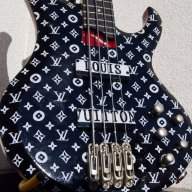
If I had the option. It put a John turner on my extended range bass, I hear it helps with clarity and neck dive. Still trying to figure out how though...
 
Stickers.

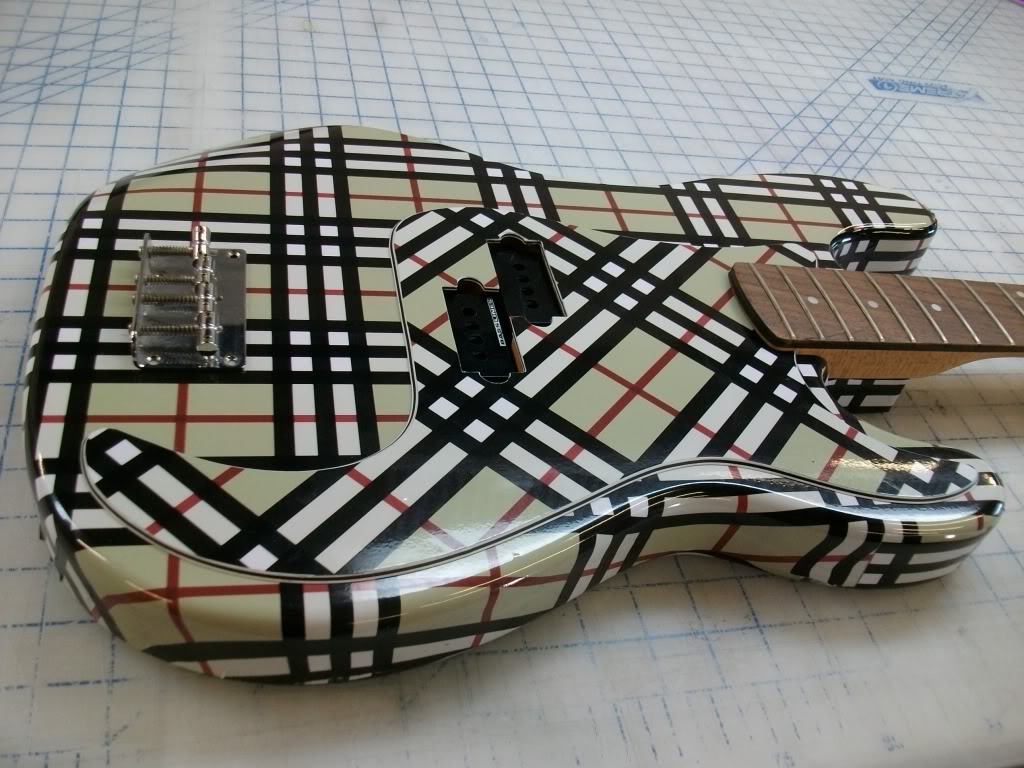
If you don't think your sticker makes a tonal difference, try a bigger sticker, one that's wrapped around the whole body.

17.jpg
 
bassbenj said:
Me too...until I just replaced a bunch of my nuts with graphtech Black Tusq ones. First off, I have to say that the idea that mods make no difference is just plain wrong. For example take nuts.

You'd think they only make a difference on open strings, but that's not totally correct. For example, the actual REASON I got the TUSQ nuts was I got tired of strings being hard to tune because of nuts being all sticky. You'd tune and then pull on strings to try to "seat" them and so on. The lubed Tusq nuts fixed that problem. So right there was A reason for the mod. Period.

But then after installing the nuts much to my surprise, I found that the Tusq claims of better tone etc. actually seemed to be true! Intonation was better able to be set precise. And that made the over all tone better and the way they gripped the strings seemed to make a general difference somehow. And you need to remember that before I got these nuts I was convinced that the claims of tone changes were nothing but pure sales pitch. I swear it makes a difference in at least the feel of the bass if not the actual tone. But it SEEMS like the tone has change. Nevertheless the REAL reason for the new nuts was just to make strings slide better on tuning AND THEY DO.

And the same thing goes for bridges. Does a bridge make tone change? I've never heard it. But a new bridge (especially compared to a bent metal one with saddles that slide all over the place) can sure be a big improvement in setup and stability. Like the nuts above. You don't do it for tone, you do it for other mechanical reasons. And if you think it sounds better. Well fine.

And finally the Fat finger. Is it a real thing? YES IS IS! Does it change your tone? Well that depends on which note you are playing. If it's that DEAD one on the G string, YOU BET it changes it! Of course it only moves it to another note, but thats the purpose of the mod. You want to have a note you rarely use be dead rather than one you use all the time! So is it a "worthless" mod? Hardly. All it takes is a bass with a bad dead spot to see the utility of the fat finger.
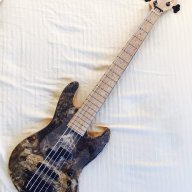
That's pretty cool!
 
Somehow I get the feeling that attaching Pacman or Major Metal to my bass really wouldn't really change how it sounds but, you know, it's not like I would know first hand or anything...
I've never installed my day-job mod to my bass before (too much tone suck or so I've heard), but I've been browsing through the Bass Legend Mods section lately, and I have it on pretty good authority that the Pino mod is the bee's knees. I dare not attempt to install the Pino mod on my fretless though...that's just not playing fair...
 
Science disagrees.

Longer cables introduce greater impedance, which does affect tone but can be battled with a buffer. That's not related to brand, though; just length.

However, all cables, jacks, switches, pots, etc., etc. have capacitance. That means that frequencies are being filtered from your sound no matter what you try to do to counter it. This is not dependent on brand, quality, etc, nor is it a good or bad thing, it's just an electrical (i.e. scientific) reality.

In a way, I guess I'm agreeing with you. Doesn't matter if you're going cheap or expensive... you'll experience the same phenomenon (albeit affecting slightly different frequencies). I'm not particular to any cable brand other than anything that will last longer.
 
The thing is that in A/B'ing cables and mods, there is usually no science used. Just "I recall it sounding one way, and now I perceive something else".

First, most people don't understand how many variables may have changed, nor even which variables exist. For example when changing cables, how often do people have and use either a scope or a sensitive-enough LCR meter to determine the total capacitance of each cable they're using? Almost never. Fine, they say, my ears tell me there are more lows with this cable than that one; but is it really more lows, or is it less highs? Did the resonant LCR peak shift up or down? In the case of changing a nut or bridge, what else may have changed in the setup, tightness, or alignment of all the parts of the system, when it was disassembled and reassembled?

Secondly, our perceptions are massively filtered by our expectations. Our senses do not connect straight to our conscious thoughts--first our brains fit the sensory input against known patterns, and then the adjusted result goes to our consciousness.

Third, when there is a gap of more than a second or so between hearing A and then B, our recollections become extremely unreliable. The old bridge didn't have as much sustain, did it? Surely not! There's lots of sustain now, so "obviously" there was an improvement. But sustain and tone are awfully hard to pin down in our recollections. Sustain and tone change drastically up and down the fretboard, and with harder or softer fingertip attack--and that's without changing the bridge or other parts. So then when you do change a part, and then compare against your recollection from a few minutes before, are you sure absolutely nothing varied between the sessions of playing and listening? Are you sure it's not just the fact that you've got a nice new part on there, giving you a sense of satisfaction?

See "confirmation bias", "expectation bias", "ear fatigue", "abx testing", etc.

It's not that cables, nuts, etc. "can't" sound different; it's just that when they DO, the listener almost never knows WHY--and that's where they run up against the critical wall of science.