Having owned a Modulus Q4 for a while (which was subsequently traded to fund my Spector), and having played numerous Roscoes over the years, I will back up those statements about both being great instruments, but very different animals. The single biggest thing both had in common, IMO, is their inate ability to produce incredibly clear, harmonic-rich tones.
Harmonic-rich tones that sing with incredibly clear notes is great, if you are looking for that modern, hi-fi sound, and neither bass is a bad choice for that. What I couldn't get past, with the Modulus, was the fact that it always had a certain unnatural sound in the attack and decay. The attack always seemed to overpower the fundamental, in a way that reminds me of someone hitting a bell with a metal hammer. Those Moduli I've played that had Barts had less of this attack, but the harmonics and fundamental still had a strange quality to my ear. I could see why people love them, but the tone just wasn't for me.
The Roscoes I've played had the same clarity, as I stated above, but had a more organic quality to the tone (which will vary greatly, depending on the wood choices). There was also a certain quality to their attack that seemed to blend more with the fundamental, as opposed to fight the fundamental. That may be why I perceived Roscoes to have more warmth and not sound as "sterile". Also, because of the perceived advantage Roscoe has in this department, the pickups allow better variations in tones.
Interestingly, however, as many Roscoes I've played, there always seemed to be slight differences from one-to-another that made some play well, others play like butter...I can't explain it. And, not to take away from Roscoe, I've also found the same "issues" in MTDs (which I'm an enormous fan of), Laklands, Spectors, Alembics, and even (perish the thought) Jerzy Drozd. These wood basses all have a human element to them that explains these slight variations.
OTOH, Modulus necks are molded, and are more consistent from one to the next. As a result, no Modulus ever played even the slightest bit differently from the next (with the exception of adjustable factors, such as string height or string gauge).

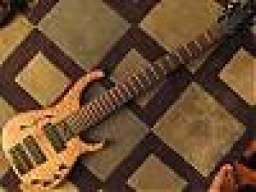


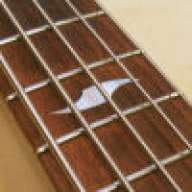
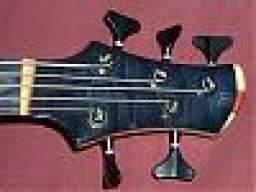



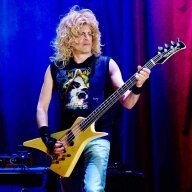
 I've always loved the sound of Roscoes that I've heard recorded, everything from Ten Shekel Shirt (Christian pop/rock) to ;ofcourse; Mr.Jimmy Haslip whose Roscoe tone has almost and a very close almost caused me some financial ruin