
Enjoy the benefits of a premium membership!
Upgrade Account
-
TalkBass has been independent since 1998. Add your voice.
Create a free account to reply to discussions, view embedded media, and browse with fewer display ads.
Join free Log in
Want zero display ads or expanded classifieds tools? Compare plans.
You are using an out of date browser. It may not display this or other websites correctly.
You should upgrade or use an alternative browser.
You should upgrade or use an alternative browser.
Most Effective Notation Method...
- Thread starter rios365
- Start date
More options
Who Replied?

Standard western notation, like the bit you posted. It's not necessarily easy to learn but it's easier when you're learning an instrument at the same time. You only have to learn it once and it'll be applicable to classical, rock, jazz,and so on. It's more versatile than any other method for notating western music styles, millions of people use it every day, it's the easiest way to transcribe a performed piece, and since it's been in use for a few centuries most music is written using it.
if you decide to study music you will have to learn standard notation anyway, may as well start now.
if you decide to study music you will have to learn standard notation anyway, may as well start now.

I think OP is asking for the best learning method , not the best notation method
isolating rhythm practice has paid off big for me
also I always recommend Cuban /"Salsa " music like Oscar Stangoro's Latin Bass Book,
for intermediate reading practice. The note choices and rhythms are simple yet challenging due to syncopation, and it's fun.
The Hal Leonard Bass Method book by Ed Frieland gets high praise around here.
Disclaimer: I do not consider my self to be a fluent sight reader by any stretch.
But I have developed my literacy enough to benefit greatly, even so.
isolating rhythm practice has paid off big for me
also I always recommend Cuban /"Salsa " music like Oscar Stangoro's Latin Bass Book,
for intermediate reading practice. The note choices and rhythms are simple yet challenging due to syncopation, and it's fun.
The Hal Leonard Bass Method book by Ed Frieland gets high praise around here.
Disclaimer: I do not consider my self to be a fluent sight reader by any stretch.
But I have developed my literacy enough to benefit greatly, even so.
Last edited:

What the most effective music notation learning method out there - an easy to understand method that works?
THNX!!
View attachment 7305927
The best way is being taught to play an instrument using written notation. Trying to learn without an instrument (which includes your voice) would be like trying to learn a spoken language from books without ever hearing it spoken and without ever practicing in conversation.I think OP is asking for the best learning method , not the best notation method
Try any “elementary book for double bass “ . The first excercises are open strings (with notation) and they progressively introduce new notes. It’s easier than you think , and I mean much easier.

Essential Elements for Band - Book 1 (2025) | Schmitt Music This is what I used with my beginning band students. I think it comes with a "play along" CD. Make sure you select BASS GUITAR when ordering.What the most effective music notation learning method out there - an easy to understand method that works?
THNX!!
View attachment 7305927


As with language, there are no methods other than doing, and no shortcuts. Start with easy stuff and work more complex - you should be tolerably good at sight-reading in about a year with daily practice.What the most effective music notation learning method out there - an easy to understand method that works?
THNX!!
View attachment 7305927
Amazon has it, too. $2 cheaper. Put it in my cart, I need to start my reading odessey - again!Essential Elements for Band - Book 1 (2025) | Schmitt Music This is what I used with my beginning band students. I think it comes with a "play along" CD. Make sure you select BASS GUITAR when ordering.

What about transcribing? Is that an effective method of leaning notation? Asking for a friend. ;-)
Tolerably good is about the best I’ve ever achieved!you should be tolerably good at sight-reading in about a year with daily practice.

Absolutely! It’s not enough on its own but it’s very, very helpful.What about transcribing? Is that an effective method of leaning notation? Asking for a friend. ;-)
This would be my recommendation for learning notation as well. Once more advanced, then something like Alan Raph's "Dance Band Reading and Interpretation". Since I began on trombone, I'm a big fan of the Arban's Method as well.Jeff Berlin's reading book are quite good

For learning? All have their pluses and minuses. I use a combination of notations live so I can assess and execute parts quickly, repeatedly and accurately.
Most important for me is notating rhythm. As important as playing the right notes is playing then at the right time. So I do a lot of chord charts with measures, lining the chord up in the measure, or, actually writing out the rhythm as slashes.
I also have no problem with tabs BUT I have found most tabs are inaccurate and write them out myself. Yeah, a lot of people think they’re a cheat method. I disagree. There are several places on a bass where you can play the same note and standard notation doesn’t help me quickly assess where to play a specific note. Tab puts my hand right where it needs to go.
I have, in almost 40 years of playing and teaching, almost never used standard notation. Others may have had other situations. But in rock, pop, party bands, weddings… even jazz, chord charts are sufficient. I never found the time investment to quickly read standard notation was worth the time in what I’m doing. Maybe if I played classical professionally I’d change my mind. But I should point out I have a BA in performance with drums and percussion as my main instrument so I can sight read rhythm notation easily and again, for me playing notes at the right time is more important than what note I’m playing (yeah, the note is important, but for me bass is about locking in rhythm). So I’d definitely say learning to read rhythm notation is most helpful.
If I was Victor Wooten I’m sure my needs would be different.
Most important for me is notating rhythm. As important as playing the right notes is playing then at the right time. So I do a lot of chord charts with measures, lining the chord up in the measure, or, actually writing out the rhythm as slashes.
I also have no problem with tabs BUT I have found most tabs are inaccurate and write them out myself. Yeah, a lot of people think they’re a cheat method. I disagree. There are several places on a bass where you can play the same note and standard notation doesn’t help me quickly assess where to play a specific note. Tab puts my hand right where it needs to go.
I have, in almost 40 years of playing and teaching, almost never used standard notation. Others may have had other situations. But in rock, pop, party bands, weddings… even jazz, chord charts are sufficient. I never found the time investment to quickly read standard notation was worth the time in what I’m doing. Maybe if I played classical professionally I’d change my mind. But I should point out I have a BA in performance with drums and percussion as my main instrument so I can sight read rhythm notation easily and again, for me playing notes at the right time is more important than what note I’m playing (yeah, the note is important, but for me bass is about locking in rhythm). So I’d definitely say learning to read rhythm notation is most helpful.
If I was Victor Wooten I’m sure my needs would be different.
edwinhurwitz
Supporting Member
When I was starting out, the big two were the Simandl and Nanny books for upright bass. The Evolving Bassist by Rufus Reid is also a good one. But really, any reading that you can do is helpful, find things online, in magazines, etc. Get a Real Book and learn melodies in the treble clef. Get a copy of the Bach Cello Suites. There are so many transcriptions out there. If you need more discipline, get a good teacher.
I see some folks saying that they don't use standard notation that much, and that's valid, but a huge reason to learn it is to be able to quickly do a harmonic or melodic analysis. Standard notation lays everything out in a way that's easy to understand once you get familiar with it, and provides a structure to think about harmony. Tab never will do that.
I see some folks saying that they don't use standard notation that much, and that's valid, but a huge reason to learn it is to be able to quickly do a harmonic or melodic analysis. Standard notation lays everything out in a way that's easy to understand once you get familiar with it, and provides a structure to think about harmony. Tab never will do that.

This will be a bit disorganized, incomplete, and probably a bit overwhelming. My intent is to try and give you some idea of the scope of your goal, and maybe help you along the way a bit. I don't expect you to read through this and immediately have a full grasp. You may find it helpful to book mark the page and come back from time to time as you build the necessary knowledge...it's a lot to learn, but none of it is really all that hard.
Reading standard notation involves integrating at least three skills.
1. Rhythmic notation
2. Recognizing notes
3. Using key centers and accidentals to recognize specific tones.
I would suggest that you need to learn each of the three skills in order to be a good reader.
1. To understand rhythmic notation you need to learn about subdivisions and the symbols that are used to represent when to play and when to avoid playing. The symbols are notes and rests. It's useful just to practice reading the rhythmic notation without worrying about the notes. Most musicians agree that playing the correct rhythm is usually more important than playing the correct pitch.
2. Notes are written on specific lines and spaces. However, the note and pitch you are expected to play are not necessarily the same thing.
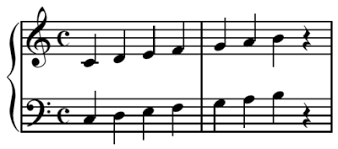
The written notes in order from left to right are C,D,E,F,G,A,B.
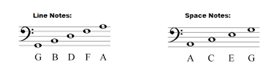
Learning to read the notes is a foundational skill. Learn the lines and spaces. For the bass cleff, the lines going from bottom to top are G,B,D,F,A and the spaces are A,C,E,G.
3. In order to read efficiently you need to understand key centers and key signatures. On the example above, there are no accidentals in the key signature. So the key is either C major or A minor. All of the notes are natural, so the written notes are the same as the pitch you play. Given the written notes, it's fairly safe to assume C major.
However if we add an accidental to the key signature things change. If we add an F# to the key signature, we assume the key is G major or E minor.
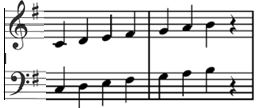
Now the written notes are C,D,E,F#,G,A,B
You could also write the accidental next to the note. Here I change F to F#.
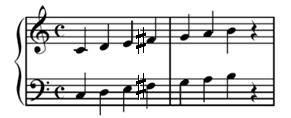
When you see an accidental before a note, you know the specific pitch.
There is also the matter of enharmonics. An enharmonic is two different notes with the same pitch. For example F# is the same pitch as Gb. Which note should actually be written depends on the situation. I am not going into the reasons here.
Learning the key signatures starts with learning the order of the flats and sharps and the circle of 5ths.
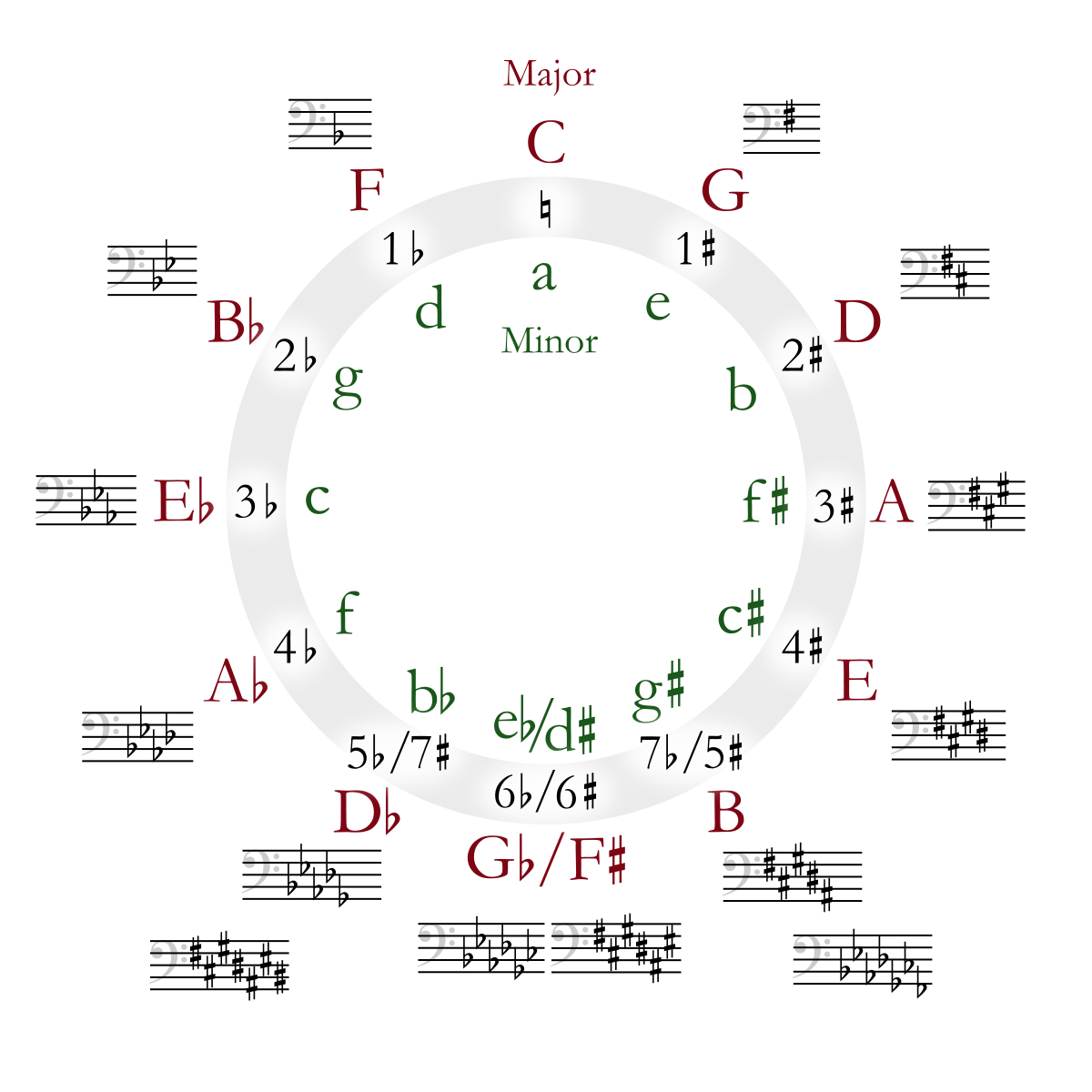
The order of flats comes from starting at the top and moving counterclockwise around the circle. Order of flats: Bb,Eb,Ab,Db,Gb,Cb,Fb.
Cb Major has all 7 flats. As you see the order from left to right is Bb,Eb,Ab,Db,Gb,Cb,Fb.
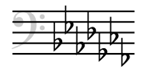
Cb Major is enharmonic to B Major, which only has 5 sharps. Cb sounds like B natural, Db sounds like C#, Eb sounds like D#, etc.
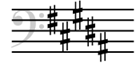
So while it's possible to write a piece in Cb Major, it's more common to use B Major.
The order of sharps come from starting at the top and moving clockwise around the circle. Order of sharps: F#,C#,G#,D#,A#,E#,B#.
C# Major has all 7 sharps. As you see, the order from left to right is F#,C#,G#,D#,A#,E#,B#.
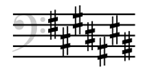
C# Major is enharmonic to Db Major, which only has 5 flats. C# sounds like Db, D# sounds like Eb, E# sounds like F, etc.
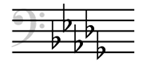
So while it's possible to write a piece is C# Major, it's more common to use Db Major
Reading standard notation involves integrating at least three skills.
1. Rhythmic notation
2. Recognizing notes
3. Using key centers and accidentals to recognize specific tones.
I would suggest that you need to learn each of the three skills in order to be a good reader.
1. To understand rhythmic notation you need to learn about subdivisions and the symbols that are used to represent when to play and when to avoid playing. The symbols are notes and rests. It's useful just to practice reading the rhythmic notation without worrying about the notes. Most musicians agree that playing the correct rhythm is usually more important than playing the correct pitch.
2. Notes are written on specific lines and spaces. However, the note and pitch you are expected to play are not necessarily the same thing.
The written notes in order from left to right are C,D,E,F,G,A,B.
Learning to read the notes is a foundational skill. Learn the lines and spaces. For the bass cleff, the lines going from bottom to top are G,B,D,F,A and the spaces are A,C,E,G.
3. In order to read efficiently you need to understand key centers and key signatures. On the example above, there are no accidentals in the key signature. So the key is either C major or A minor. All of the notes are natural, so the written notes are the same as the pitch you play. Given the written notes, it's fairly safe to assume C major.
However if we add an accidental to the key signature things change. If we add an F# to the key signature, we assume the key is G major or E minor.
Now the written notes are C,D,E,F#,G,A,B
You could also write the accidental next to the note. Here I change F to F#.
When you see an accidental before a note, you know the specific pitch.
There is also the matter of enharmonics. An enharmonic is two different notes with the same pitch. For example F# is the same pitch as Gb. Which note should actually be written depends on the situation. I am not going into the reasons here.
Learning the key signatures starts with learning the order of the flats and sharps and the circle of 5ths.
The order of flats comes from starting at the top and moving counterclockwise around the circle. Order of flats: Bb,Eb,Ab,Db,Gb,Cb,Fb.
Cb Major has all 7 flats. As you see the order from left to right is Bb,Eb,Ab,Db,Gb,Cb,Fb.
Cb Major is enharmonic to B Major, which only has 5 sharps. Cb sounds like B natural, Db sounds like C#, Eb sounds like D#, etc.
So while it's possible to write a piece in Cb Major, it's more common to use B Major.
The order of sharps come from starting at the top and moving clockwise around the circle. Order of sharps: F#,C#,G#,D#,A#,E#,B#.
C# Major has all 7 sharps. As you see, the order from left to right is F#,C#,G#,D#,A#,E#,B#.
C# Major is enharmonic to Db Major, which only has 5 flats. C# sounds like Db, D# sounds like Eb, E# sounds like F, etc.
So while it's possible to write a piece is C# Major, it's more common to use Db Major
Last edited:

I like using Tux Guitar to compose songs and practice bits with. I can write out scales (or chords) as tabs and see the standard notation as well as fretboard. Plus, it'll even play it back audiably and highlight the note it's on!
It's available for free, cross-platform but, the android version is more basic. I recommend a laptop or tablet running Ubuntu Studio.
It's available for free, cross-platform but, the android version is more basic. I recommend a laptop or tablet running Ubuntu Studio.
It is! MuseScore is an awesome tool in this regard - free and very very usable.Absolutely! It’s not enough on its own but it’s very, very helpful.
The only software I’ve ever bothered to learn:It is! MuseScore is an awesome tool in this regard - free and very very usable.
I should probably get with the times, eh?

Well, I started out playing brass instruments back when I was about 8, but before that singing from hymnals maybe a year or two before that so I had the basics of Standard Notation at an early age.What the most effective music notation learning method out there - an easy to understand method that works?
THNX!!
View attachment 7305927
I started playing guitar around 10 years old playing by ear and using chord charts or chord notations on sheet music. When I got into high school I switched to Baritone Horn which exposed be to bass clef so making the switch to bass very easy.
Even though I’m still not a great sight reader (which becomes more of a problem when wearing Bi-vocals) standard notation still my preferred choice. Mainly because I’ve tended to play in larger ensembles with horns which almost always have SN charts.
That said, tabs are great for smaller ensemble work where there isn’t much risk of musical conflict. The other plus is not having to fumble around with a 5 pages chart on a windy day..lol.


