• TalkBass has been independent since 1998. Add your voice.
    Create a free account to reply to discussions, view embedded media, and browse with fewer display ads.
    Join freeLog in
    Want zero display ads or expanded classifieds tools? Compare plans.

Double Bass Mounting a mic under the bridge (Neumann KM86i)

Even when I'm playing live with a mic, I've typically used a mic on a stand, but I recently acquired a Neumann KM86i side address SDC. I picked it up with the primary purpose as a utility mic for recording, but it seems like it might be the perfect mic for placing under the bridge in live settings due to its small size, light weight, side-address dual-capsule, and sound quality. I haven't thought of the best way to mount it under the bridge, yet. I'd like the mic to be securely in place, but I don't want to limit the bass's resonance by wedging a bunch of foam against the table and the bridge. Does anyone have any crafty secrets?
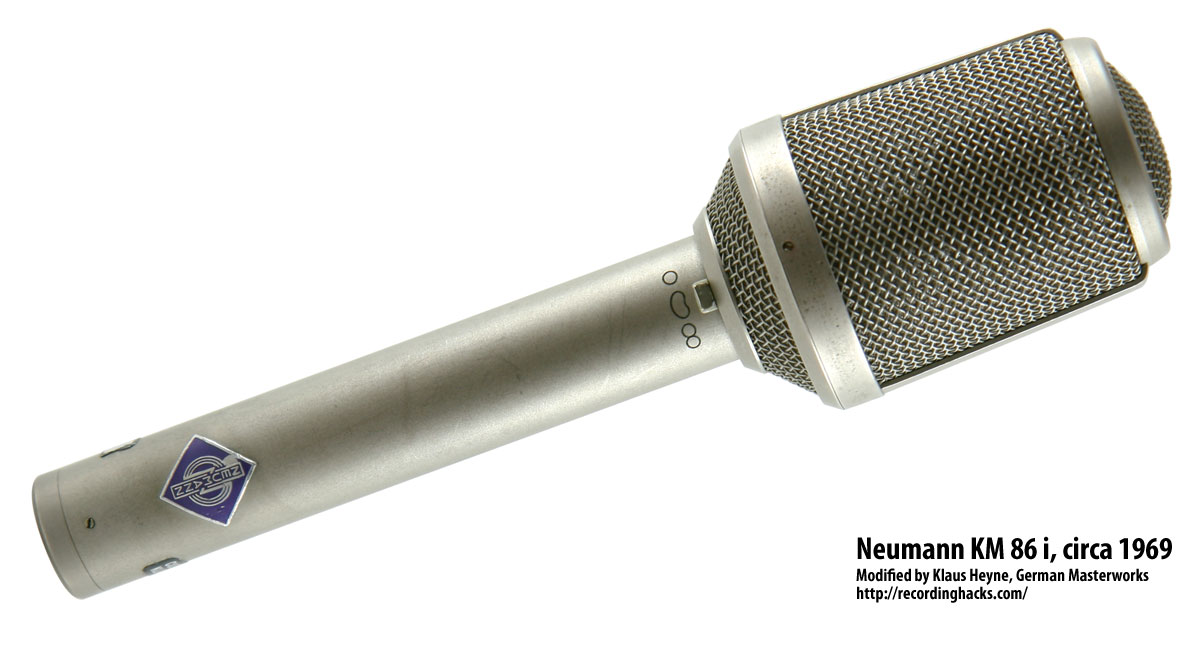
KM86i.jpg


It has great lowend for a SDC, especially in omni or figure-8 mode. Too bad figure-8 and omni are a bit risky in a live situation.
 
But a 57 isn't side address so that setup will not be optimal. You may want to look into an "H clamp". I use one to hold a Neumann Km185 which appears to be of similar size.

look here:

[Invalid or Expired Link Removed]

Regarding bass response--you can actually get more bass response in cardioid than figure 8 or omni by close micing and taking advantage of that polar pattern's exaggerated low end. It's not always even though. Using a mic live can be frustrating since the best sound is usually several inches from the bass and it's usually necessary to place the mic very close to get any kind of level before feedback at least if you'll be monitoring through your amp. If the mic is for the PA, you may have many options.


bob
 
Mounting a mic in the bridge with elastics is actually a lot easier with a side address mic. I've had engineers do it a number of times in studios. Hard to say if it would be better than just stuffing it in some foam under the bridge or tailpiece, sometimes that works pretty good too.

If you want to try it, here's a picture. I don't have a mic like that so you'll have to use your imagination a bit....


mic mount.jpg
 
Mounting a mic in the bridge with elastics is actually a lot easier with a side address mic. I've had engineers do it a number of times in studios. Hard to say if it would be better than just stuffing it in some foam under the bridge or tailpiece, sometimes that works pretty good too.

If you want to try it, here's a picture. I don't have a mic like that so you'll have to use your imagination a bit....


View attachment 218086

I don't know why I didn't think of hair ties. I'm a bit reluctant to use rubber bands because they can snap, but hair ties seems like a great compromise.

Thanks to all for your input.
 
Regarding bass response--you can actually get more bass response in cardioid than figure 8 or omni by close micing and taking advantage of that polar pattern's exaggerated low end.

That would be true for most mics, but the km86 has a proximity effect with every polar pattern due to its dual-cardioid capsule design. Omni = both capsules in phase, figure 8= both in antiphase.
 
That would be true for most mics, but the km86 has a proximity effect with every polar pattern due to its dual-cardiod capsule design. Omni = both capsules in phase, figure 8= both in antiphase.

Generally speaking the proximity effect is reduced when using omni pattern compared to cardioid in dual capsule multi pattern mics.

It's unlikely the bass boost in cardioid would be necessary or desirable, at that distance and for this application.

But for whatever reason, the KM86 actually has reduced low end in cardioid compared to omni (with figure 8 having a little more, as you would expect). This link has curves for each pattern if you scroll down

Neumann KM 86 | RecordingHacks.com

I've used many mics for recording upright, not including a KM86, but including other Neumann and other makes of SDCs. My guess is that the KM86 would have hotter output and more detail than necessary, when mounted on the bass. Sanken makes a less sensitive side address SDC that would probably work very well for this, but for a KMK86 (a real classic mic, used at one point for everything on Motown recordings from Detroit, including vocals on the classic Marvin Gaye album "What's Going On"), I would suggest just using a stand.
 
But for whatever reason, the KM86 actually has reduced low end in cardioid compared to omni (with figure 8 having a little more, as you would expect). This link has curves for each pattern if you scroll down...

I'm pretty sure this is due to the phase relationships resulting from the dual-capsule design consisting of two cardioid capsules. Most multi-pattern mics (correct me if I'm wrong) use one figure-8 element and one omni element. The KM86 uses two figure-8 elements and 2 omni elements (being that a cardioid capsule is a superposition of both).
 
I'm pretty sure this is due to the phase relationships resulting from the dual-capsule design consisting of two cardioid capsules. Most multi-pattern mics (correct me if I'm wrong) use one figure-8 element and one omni element. The KM86 uses two figure-8 elements and 2 omni elements (being that a cardioid capsule is a superposition of both).

I don't think that's quite right. There are dual capsule (like a C414), and dual diaphragm mics (like a U87) where one backplate is shared by one diaphragm on each side.

My understanding is that the condenser diaphragms themselves are all really omni, until they are mounted or attached to something or their output is mixed with another signal in degrees to change that behavior. As a rule, the patterns come from progressively exposing a phase reversed signal from the second, opposite facing diaphragm, unlike in fixed pattern mics where they can be created using venting in the headshell and body.

The exception to this being mics that use purely mechanical means to change the patterns by basically having you physically open and close shutters that control what the mic sees, like the Schoeps multi pattern mics and clones thereof (Shure makes one).

Figure 8 in a condenser is generally coming from one of the above configurations, but Schoeps and Neumann and maybe a few others do make a single membrane figure 8 condenser capsule (with the headshell being partly responsible for the shape of the pattern).

I've heard of stereo mics designed for mid/side that combine figure 8 and cardioid in one body with separate outputs, and stereo mics with lots of patters which are really two independent dual capsule multi pattern mics living together so you can do various true stereo positions, m/s, or blumlein pairs from the same mic. But those are special cases.
 
Even when I'm playing live with a mic, I've typically used a mic on a stand, but I recently acquired a Neumann KM86i side address SDC....... Does anyone have any crafty secrets?


It has great lowend for a SDC, especially in omni or figure-8 mode. Too bad figure-8 and omni are a bit risky in a live situation.

Aaron,
I have used Neumann's in the recording studio with the Explore Audio H Clamp. It's simple and would probably get the job done as long as the top and back of your bass are flush.

Ric
 
My understanding is that the condenser diaphragms themselves are all really omni, until they are mounted or attached to something or their output is mixed with another signal in degrees to change that behavior. As a rule, the patterns come from progressively exposing a phase reversed signal from the second, opposite facing diaphragm, unlike in fixed pattern mics where they can be created using venting in the headshell and body.

That jogs my memory a little bit. I know I should have a couples texts somewhere with a lot of info on this subject. I'll try to find them.
 
Regarding bass response--you can actually get more bass response in cardioid than figure 8 or omni by close micing and taking advantage of that polar pattern's exaggerated low end.

bob

Except it's not low end. Most mics have their proximity bell centered at about 200Hz, which is two+ octaves above where the fun is. So you get a lot of stuff you don't want along with the stuff you need.
 
The lowest four notes in standard tuning (E, F, F# ,G) are all below 50 Hz. And if you have a five-string or an extension, there are more. So while you might not want a boost below 50 Hz, you certainly don't want a lot of rolloff.

There's not a lot of fundamental for those bottom 4 half steps, in an upright bass.

I do a lot of recording and mixing. I always roll off upright basses in that range. It can be seen as counterintuitive, but definition, pitch "trackability", and the perception of how much low end exists in a bass track is almost always dramatically improved when excessive rumbly stuff is taken out of the first octave, and usually if some additive EQ around 1200 and/or some harmonics from an amp or plugin are added to the signal.

The first track in page linked in my sig has a high pass, 24 db/octave below about 80. IMO it's still too fat and I will cut some more bottom before that track is mastered. (Tracks 3-5 have already been professionally mastered, for comparison.)
 
Would an Audio Technica AT4041 Cardioid Condenser Mic. be suitable for the Double Bass?--it is good for acoustic guitar.

Possibly.

I use an AT2020 with good results, which is a cheaper mic, but a large diaphram one. I own a AT2021, which is again cheaper but similar to the 4041. I think the 2020 sounds better.

Bearing in mind your other thread about amps, making sure you know that condensor mics are more prone to feedback, less robust, and require phantom power.

Edit : clarifying, I mount on a stand, not under bridge.
 
I don't think that's quite right. There are dual capsule (like a C414), and dual diaphragm mics (like a U87) where one backplate is shared by one diaphragm on each side.

My understanding is that the condenser diaphragms themselves are all really omni, until they are mounted or attached to something or their output is mixed with another signal in degrees to change that behavior. As a rule, the patterns come from progressively exposing a phase reversed signal from the second, opposite facing diaphragm, unlike in fixed pattern mics where they can be created using venting in the headshell and body.

It looks like you're right on this one. From what I understood from one of the texts: Originally, cardioid patterns were achieved by combining figure-8 and omni mics, but modern microphones typically use the same idea, but using a mathematical or mechanical means to achieve this. I'm not entirely sure what is specificaly meant by "mathemical means", but it seems to be congruent with your explanation.

I'm still not exactly sure how the KM86 functions in order to get the different polar patterns, and why, even at close proximity, the lows are stronger in omni and figure-8 than cardioid. I guess I don't really need to know these things unless I'm designing a microphone, though.
 
Would an Audio Technica AT4041 Cardioid Condenser Mic. be suitable for the Double Bass?--it is good for acoustic guitar.

Sure, that is a decent small diaphragm condenser mic. For recording, it's definitely a solid choice, especially for the price.

If your intent is live use, you'll need to bear in mind the same considerations that apply with any condenser mic, you'll need some sort of preamp that provides phantom power and which will produce a line level output signal (unless it's built into an amp). Feedback can be a problem and the quality of the preamp does have an effect on your results. You may not want to depend on whatever the house PA might be.

If you already have it, it's worth a try. If you're thinking about a purchase, you might want to play the field a bit because there are lots of good SDCs around that price. Beyer MC930 is a good one too. If it's more for live use, you might want to also look at mini condensers that are designed to mount on the bass.