• TalkBass has been independent since 1998. Add your voice.
    Create a free account to reply to discussions, view embedded media, and browse with fewer display ads.
    Join freeLog in
    Want zero display ads or expanded classifieds tools? Compare plans.

Multi-Scale

i'm personally not a big fan of multi-scale or 35" scale. To me 35 is too spanky and the multi-scale makes the low string(s) too spanky and tight and also, very difficult to solo on in the low positions and also becomes uncomfortable to reach the first fret on the low strings. And if you compensate with the body geometry, body cut and bridge placement (i.e. moving the body cut more toward the top horn and moving the bridge toward the end of the body, then it becomes very uncomfortable to play above the 12th fret.

I had a lesson the other day with Tony Grey who is now playing a 30" fodera and the low B string on it sounds amazing.

For me personally, unless you are playing the instrument in the vertical position, i'd rather not deal with scale lengths beyond 34...
 
I guess where I'm at is that if Peavey were bring out a full line of basses (at 2-3 different price points) and one of them featured a 5-string MS model, that would be a strong entry back into the market, and I think they'll be successful.

But if Peavey is going to restart their bass line and the first model is a 5-string MS, to be followed at some point by some other models, I'd be surprised if it worked out for them. It either has to steal significant market share away from the existing MS entries, or be compelling enough to expand the MS market enough to survive until the other models make it onto the market.
 
I guess where I'm at is that if Peavey were bring out a full line of basses (at 2-3 different price points) and one of them featured a 5-string MS model, that would be a strong entry back into the market, and I think they'll be successful.
I agree. Peavey have a strong fan base, much of it fairly traditional, which is where they should target first, and add exotics like MS as a sideline to attract the more adventurous, less traditional players.
 
Looking for some input -

Getting ready to re-introduce some bass guitars and wondered what y'all prefer. I was thinking for a 5 String a multi-scale bass might be cool, but at the same time I don't think there is a need for it on a 4 string. What would y'all think about a series where the 4 is standard 35" and the 5 is Multi?

Or what do you think about multi-scale in general

-Fred
I love my 5 string Dingwall multiscale. I know it doesn’t seem very beneficial for 4 strings but a lot of people playing modern rock and metal are tuning 4 strings very low and don’t want the chunkier neck of a 5. If you’re going to do a standard scale make it stand out in a different way. Like as a fretless or as a short scale 5 specifically designed for eadgc (high c) tuning
 
  • Like
Reactions: Nuage420
I own some multi-scale acoustic guitars. I own a bunch o basses. Within the confines of standard tuning AND less than 7 strings, I don't feel like I'm missing multi-scale on bass. 35"-34" on a 5-6 string bass might help take the sting out of the higher register. I sometimes compensated with lighter strings. I'll admit that some of my bias is from being a mostly fretless player and unlined. The thought of an unlined multi-scale fretless bass is the stuff of nightmares.

IMO, I'd be a huge fan of bringing back the good stuff like the Cirrus, Millennium, B-Quad, G Bass, TL, etc. I regret not buying an unlined fretless 6 from the custom shop before it closed. Still have my custom shop Cirri.
 
I think it's cool you're asking Talkbass for feedback! I have no experience with multiscale so I can't say if I prefer it or not. I can say the right bass hasn't come by yet to get me to check one out. I don't see it as a needed feature, and I agree with those who say weight and balance are more important. As well as overall playability, sound, and how it appears as a package.

Dingwall does intrigue me, and so does the Spector NS Dimension because these are all basses that have brought interesting designs to the table. Dingwall especially as all their basses are designed to specifically be multiscale. They're just too expensive for me right now.

All of that said here's how I'd design a multiscale series:
  • Redesign the Jazz Bass for 4/5 string MS at >=33-35"/33-36"
  • Place a single T-40-updated humbucker in the P position or 2 in the Ric positions
  • Passive, light, and headless
  • Again start with a Jazz for the neck profile but make it slightly asymmetric and thinner on the 5
  • Make the body thin with plenty of curves
  • Rear-routed electronics and no pickguard
  • Transparent and/or sparkle finishes
Whatever Peavey does it'll be cool to see.
 
I own some multi-scale acoustic guitars. I own a bunch o basses. Within the confines of standard tuning AND less than 7 strings, I don't feel like I'm missing multi-scale on bass. 35"-34" on a 5-6 string bass might help take the sting out of the higher register. I sometimes compensated with lighter strings. I'll admit that some of my bias is from being a mostly fretless player and unlined. The thought of an unlined multi-scale fretless bass is the stuff of nightmares.

IMO, I'd be a huge fan of bringing back the good stuff like the Cirrus, Millennium, B-Quad, G Bass, TL, etc. I regret not buying an unlined fretless 6 from the custom shop before it closed. Still have my custom shop Cirri.

oh?


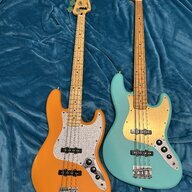
IMG_0789.jpg
 
Here's my two cents. This is coming from a guy who gigs nothing but Peavey basses, and owns over 40 of them.

If you're going to revisit old models, be faithful to them. The hard part is going to be matching the quality of the old US built ones for anywhere near what they sell for on the used market.

New stuff, fanned frets work. If I could have anything in the bass world, it would be a five string pickup that captures the magic of the Super Ferrite pickups, while allowing for wider spacing. I do have four five stribgs with SF pickups, and the spacing is pretty narrow, while the pickups just barely grab the outer strings.