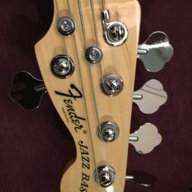
Then how is it that when i have the pups in my Jazz bass angled with the E higher than the G, my G string is still louder than having my old Ray34 or Sub the opposite way around?
Why is it that with all pole pieces set equal in my Sub the G still sounded weak and would get lost in the mix? Same goes for my Ray34 with Nordy in it?
it must be magic, then

And if it really was that simple this issue wouldn't crop up so often. After all, it doesn't effect a lot of owners, if it was a bad pup design we would all suffer from it.
Set-ups are simple, yet basic questions keep coming up again and again.
I think that only a certain % of owners *notice* the problem. This could be due to their being not too sensitive to these things (someone I know can hear minute volume differences ina guitar and spends a lot of time adjusting polepieces, well after I think it sounds fine), or maybe their basses are set-up differently.
Think about how a sound is produced. There aren't many factors.
I've been around guitars and basses for longer than I'd admit, and achieving a quasi-perfect balance between strings has always been (in my experience) a matter of getting the polepieces/pickup heights right. Some pickups are harder to work with than others, due to how hot they are, or their polepieces being non adjustable, some are staggered, some are flat... It also depends on the curvature of the fingerboard, the mass of the strings (related to gauge)... etc. At the end of the day it's a compromise, but not a terribly mysterious thing.
My money is still on EQ and freq response of the preamp.
I can see how EQ may affect the perceived differences.
A lot of people run the bass control all the way up, especially on 2EQ Stingrays. That is going to make the lower notes fatter but will have comparatively much less effect on higher notes (on the G string). So, if you have an imbalance to start with, you may make it more obvious through your EQ settings.
But at any given EQ (i.e: take the preamp out of the equation) output will be higher or lower depending on how close the pickup is to the string, and thinner strings with less mass will generate a lower current at any given distance from the pickup.
It really isn't magic.
Other things like alignment of the string/polepiece may play a part, although in my experience may only significant if the string is way out of alignment.
It's not magic, I promise.







 btw, I think you did a fine job in the old dudepit -- I miss the dudepit!



 Ridiculous. Im suddenly glad I bought a used stingray. No weak g string but the neck could sure use more stability. Wait... was this thread about string output or neck stability?