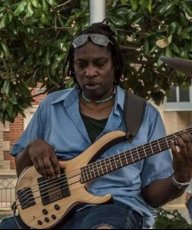
I love Victor, but in my opinion, he's wrong on this one.
 Keys
Keys and
key signatures are two separate (but related) concepts.
Keys are a sonic/musical reality, while
key signatures are an abstract notational device.
Our ears tell us there are 24
keys in western music: one major key for each note of the 12-tone chromatic scale, and one minor key for each note of the 12-tone chromatic scale.
Key signatures are a shorthand that we've invented to make notated sheet music easier to read. Theoretically it is not "necessary" to use key signatures at all! Any song can be notated in any key signature. For example, John Coltrane's "Giant Steps" is often notated with a key signature of 0 sharps and 0 flats. But that doesn't mean "Giant Steps" is in C major (or A minor)! It's just notated that way because it's easier to read.
Our standard system of music notation is flawed and imperfect. It has accumulated a lot of quirky features along the way throughout its history. For example, a common beginner question, "Why does the major scale start on C? Wouldn't it make more sense to start on A?"
Because of these flaws in standard music notation, there are certain key signatures that exist in theory, but aren't commonly used because the notation is awkward. For example, imagine we are playing in C# (7 sharps) and we want to modulate to the key of G#. Modulating up a perfect 5th is called the "dominant key" and is probably the most common modulation in all of music history. If you are following the Victor Wooten video, you might say, "G# major is not allowed, because there are only 15 major keys, and you can only have 7 sharps." But Ab major (4 flats) is "allowed" so you might choose to notate your song in C# with a modulation to Ab. Awkward!!
But in fact there
is a key of G# major. It has 8 sharps, or more accurately, 6 sharps and a double-sharp (F##). Look at a composition such as "Prelude and Fugue no. 3" from J.S. Bach's "Well Tempered Clavier." It is notated in the key signature of C# major and modulates to the dominant key of G# major. Bach accomplishes this modulation through the use of F## just as we would expect.
Victor Wooten teaches that there are 15 major keys and 15 minor keys for a total of 30. But that is simply a limitation or quirk in our notation system. The 30 keys he's talking about are the ones that can be written without using double-sharps or double-flats. But given that double-flats and double-sharps are a "thing" that exists, we have to conclude that keys like G# major or Fb minor do theoretically "exist". Even good old C major can be written enharmonically as B# major! We don't avoid these keys because they "don't exist" but rather because they are cumbersome to read, with all the double-flats and double-sharps. In theory, every key signature has at least one enharmonic equivalent; in practice, the only enharmonic keys that are commonly encountered are the ones that are easy to read and write: Db/C#, Gb/F#, and Cb/B.
In conclusion, there are 24
keys (12 major and 12 minor), at least 48
theoretical key signatures (24 major and 24 minor), and 30
practical key signatures (15 major and 15 minor) that are typically encountered in the real world.
It's important not to get hung up on the significance of the number 15. The truly significant number is 12 (because the octave is divided into 12 parts), whereas 15 is just an artifact or quirk of our notation system. My grandpa used to do a magic trick where he tried to convince me he had 11 fingers. The 3 "extra" key signatures (bringing the total from 12 to 15) are "enharmonic equivalents" or "two different names for the same thing." F# and Gb are undoubtedly two different
key signatures, but saying they are two different
keys is like my grandpa counting the same finger twice!