Music Theory helps with soooooooo much. It really helped me, and still helps me, a ton. Music Theory can help with transposing songs into different keys, changing keys while playing, and knowing the fretboard better. DEFINITELY LEARN MUSIC THEORY. Its worth it.

Enjoy the benefits of a premium membership!
Upgrade Account
-
TalkBass has been independent since 1998. Add your voice.
Create a free account to reply to discussions, view embedded media, and browse with fewer display ads.
Join free Log in
Want zero display ads or expanded classifieds tools? Compare plans.
You are using an out of date browser. It may not display this or other websites correctly.
You should upgrade or use an alternative browser.
You should upgrade or use an alternative browser.
Musical Theory VS Musical Ear
- Thread starter SurferJoe46
- Start date
More options
Who Replied?
+1/ Good thinking jhan! Sing the notes to train your ear. Use the theory to stay inside "common practice" or play outside (love that discord!)Theory + Ear Training makes you a better bass player AND a better musician.
Theory will:
1) Help you learn songs faster
2) Make you a more effective songwriter
3) Help you communicate better with other musicians
To learn theory - and especially how it applies to being a bass player - the best thing I could have done is find the right teacher. A REAL working bass player, not a guitarist doubling as a bass teacher.

Yes. Yes. Yes. And yes. Hope that helps.
yeah.
if you want to become a scientist, do you just screw around with a home chemisty set or do you formally study science..?
music is not an acception- to learn it, you need to formally study it. can you be a rock musician and not know what mixolydian means? sure. absolutely, 100%. but will you write better rock (or any other) music if you understand the function of I IV and V chords? yes.
it will improve you. its as simple as that.

want me to fry you, bro? i seem to be pretty good at itThanks to you all - and I really thought I was opening myself up to getting fried for my post, but I see a lot of wisdom and kindness in the responses.

nah, i wouldn't do that. but i will say that it doesn't have to be a choice. you can do both.
If I have to carry or lift anything over 5 lbs, I have to shuck clothing to compensate. That makes playing a 9 lb bass kinda interesting. And drafty.
Sorry to hear you are in such bad shape!!!
Check out the "Performer Stand" made by Gracie Stands. It holds the instrument for you, and can be used either standing or sitting down.
This is a great video lesson by Billy Sheehan, who simplifies things even more. Check it out it's good.
http://www.youtube.com/watch?v=ngRicIFHzAI&feature=related
I watched all 3 parts...holy crap, that boy can TAP!


Ear trumps all. Good ears can hear ALL those chords/forms/voicings etc and you can know what to play but have no idea what it's called in theory.
Not to say that theory can't be very useful, but it is really only way of trying to explain what one hears.
I grew up taking formal lessons and was in band for years and years and thought I could play because I knew all this theory. I would get on gigs and generally sound like crap. I would get trapped in the thought of what was going on and try to play based on all this theory. The whole time I should have been developing - using - and trusting my ears.
This subject is dear to my heart because I wish I spent my first 10 years of learning to play getting my ears together rather than memorizing modes. The most progress I have made as a player has been in the years since I've really worked on my ears.
The Justin Meldel-Johnsen forum in here has several good threads that discuss the importance of ear training. He also has a great talk he did at NAMM (or some guitar show thingy) where he mentions it as well. I think its on the BassPlayerTV website.
Long post - my apologies
Not to say that theory can't be very useful, but it is really only way of trying to explain what one hears.
I grew up taking formal lessons and was in band for years and years and thought I could play because I knew all this theory. I would get on gigs and generally sound like crap. I would get trapped in the thought of what was going on and try to play based on all this theory. The whole time I should have been developing - using - and trusting my ears.
This subject is dear to my heart because I wish I spent my first 10 years of learning to play getting my ears together rather than memorizing modes. The most progress I have made as a player has been in the years since I've really worked on my ears.
The Justin Meldel-Johnsen forum in here has several good threads that discuss the importance of ear training. He also has a great talk he did at NAMM (or some guitar show thingy) where he mentions it as well. I think its on the BassPlayerTV website.
Long post - my apologies
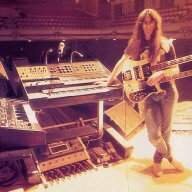
They go hand in hand (so to speak). The Ear tells what notes Geddy is playing. Theory tells you why those notes sound good to you as a listener and why Geddy might have chosen to use those notes.Musical Theory VS Musical Ear
Yes, any knowledge that helps you in expressing yourself is going to contribute to your abilities, be they in performance or writing. & yes, some know all of those scales/chords. Even, I suppose, a Major Phrygian (Dom b6 b9)Will learning Major Phrygians and Melodic Minor Lydian Dominants make me a better player?
Does anybody really know all those gazillians of forms?

want me to fry you, bro? i seem to be pretty good at it
nah, i wouldn't do that. but i will say that it doesn't have to be a choice. you can do both.
Yeah - you ride me like a two dollar horse sometimes. Somehow I like it though!
Just for kicks I tried to follow that Geddy/RUSH stuff and was getting into his boxes pretty good. He's a great talent, but I think he's a lot to do with the general performance and not so much complicated bass lines. He's mostly technique and multitasking I think - maybe I'm wrong. I dunnow.
I'm in the process of trying to find a bass teacher who actually PLAYS a bass as his primary instrument. Maybe I can break this 'code' of nodes and forms and such and make some sense of it - all I need is a living Rosetta Stone.
What I find is that I play against a lot of MP3s and they help a lot. I've got another hour or so before sack time and I'll break out the AEB and follow Miles Davis on Grooveshark for a while.
Invalid Link Removed
The AEB DEMANDS good form to sound even remotely close to good, so it helps a lot for finger strength and style.
Sorry to hear you are in such bad shape!!!
Check out the "Performer Stand" made by Gracie Stands. It holds the instrument for you, and can be used either standing or sitting down.
I've seen them and wondered about them.
Hmmmm. Not that bad off yet - I can still actually hold a 9lb bass yet! But I use a high stool that lets me take the weight off my feet when I need to.
Once I am sitting, that Jazz cutaway really comes into play.
I can't WALK with it very far - but it depends too on the enthusiasm I feel when I'm playing (and the Vicadin I took) - I can sometimes play right through two meals and that's NOT my normal style!
Once I get into a groove - and it's usually the second set that makes it all start to come together - then I am good until the Vicadin wears off.
But as modest as I am - I try to not have to strip down or play in my skivvies either.

Perhaps a pool party?


Hi SurferJoe,
One thing that can also be very helpful when working out theory and harmony is to have a keyboard handy. It can be any crummy little keyboard but it can really help to both see and hear the intervals that way.
Peace,
S
One thing that can also be very helpful when working out theory and harmony is to have a keyboard handy. It can be any crummy little keyboard but it can really help to both see and hear the intervals that way.
Peace,
S
Wow man. Thanks for serving our Country. Seriously, hope your health improves
The age old question. Theory is another tool in your box you can use, but within reason. I really can't stand music that sounds like Chinese Geometry. I don't wanna think Major/Minor/Dominant "oh wow. Look how he used the flatted 6th on that solo"...who cares...the question is does it 'sound good'?
Like stated earlier, start with G-Major Scale G-A-B-C-D-E-F#-G. Then play the same scale starting on the next note up...A-B-C-D-F#-G-A-B******B-C-D-F#-G-A-B-C
You get the point. Don't know what fancy name that is and can't read a lick of music (hard enough time with words) but I can play the sh!t..
Now soloing over changes such as "Giant Steps"...uh hang on
The age old question. Theory is another tool in your box you can use, but within reason. I really can't stand music that sounds like Chinese Geometry. I don't wanna think Major/Minor/Dominant "oh wow. Look how he used the flatted 6th on that solo"...who cares...the question is does it 'sound good'?
Like stated earlier, start with G-Major Scale G-A-B-C-D-E-F#-G. Then play the same scale starting on the next note up...A-B-C-D-F#-G-A-B******B-C-D-F#-G-A-B-C
You get the point. Don't know what fancy name that is and can't read a lick of music (hard enough time with words) but I can play the sh!t..
Now soloing over changes such as "Giant Steps"...uh hang on
One other thing that I think rates mention is *rhythm*. All the work on tonality is of no use without it. "Don't mean I thing if it ain't got that swing."
Peace,
S
Peace,
S
Hi SurferJoe,
One thing that can also be very helpful when working out theory and harmony is to have a keyboard handy. It can be any crummy little keyboard but it can really help to both see and hear the intervals that way.
Peace,
S
Ya know - I keep a drawing of the piano keys (middle C to B) on a 8x10 piece of cardboard and wrote the notes on it and can even transpose keys from it. I had a girl friend in high school who taught me that trick - 'way back in 1962!
My wife who plays keyboard doesn't seem to want to help, but that's OK anyway. She actually dislikes the bass - a LOT!
I play it really loud with the 810s at the full 600 Watts just for her sometimes! Lots of open Es too.  I shouldn't - but it makes me feel better once in a while - ya know what I mean?
I shouldn't - but it makes me feel better once in a while - ya know what I mean?She has an operatically trained professional voice and attended some pretty prestigious voice schools in California, New York and Hawaii, but she keeps it all to herself.
Wow man. Thanks for serving our Country. Seriously, hope your health improves
The age old question. Theory is another tool in your box you can use, but within reason. I really can't stand music that sounds like Chinese Geometry. I don't wanna think Major/Minor/Dominant "oh wow. Look how he used the flatted 6th on that solo"...who cares...the question is does it 'sound good'?
Like stated earlier, start with G-Major Scale G-A-B-C-D-E-F#-G. Then play the same scale starting on the next note up...A-B-C-D-F#-G-A-B******B-C-D-F#-G-A-B-C
You get the point. Don't know what fancy name that is and can't read a lick of music (hard enough time with words) but I can play the sh!t..
Now soloing over changes such as "Giant Steps"...uh hang on
Yeah - I saw that Giant Steps too. Righteously done. Made me start the man-tears flowing it was so good.
Funny thing I do is try the music I hear with my harmonicas once in a while. It kinda opens the music up to actually play along with it and then just go to the bass for what I really need after I appreciate all the modes, although I couldn't tell one from a snakebite --- yet.
Harmonicas are actually tuned to a key, and if it won't fit the music I hear, I swap harps around until I find the appropriate key and that's a way I cheat. I'm getting a lot better at recognizing the notes now too.
I can lay down a good back or bottom line OK - I am just wanting to work on the theory now to really get into the music. Like I say, the boxes are pretty easy for me ..... ear-wise.
There's a post going on about walking bass lines and I find them exciting and somehow I can hear where they are going and get along in them pretty good. It's easy for me to anticipate what's next and how to resolve to the next chord a half-tone at a time with ghosts and slides.
I like the musical license you automatically get with walking a bass line - ya know what I mean?
My health, is not coming back and I realize that. I am just trying to put off the premature inevitable. I am just in a holding pattern right now, with daily minor altitude losses.
J
jhan
Guest
+ 1,000,000.
If you can't groove, nuthin means nuthin.
My teacher said that he knows a lot of players who can shred for 30 seconds, but can't actually play MUSIC.
If you can't groove, nuthin means nuthin.
My teacher said that he knows a lot of players who can shred for 30 seconds, but can't actually play MUSIC.
One other thing that I think rates mention is *rhythm*. All the work on tonality is of no use without it. "Don't mean I thing if it ain't got that swing."
Peace,
S
You have to ask yourself what type of bass player you ultimately want to be.
A few years ago I bought a road bicycle (with drop bars) to improve my cardio fitness and to get outdoors. It's just a hobby for me, but I invested time in learning how to improve my riding skills to the same level as someone who races seriously. I don't race, but the skills I learned (and confidence) has improved my abilities way beyond where I would have been had I thought I was fine just puttering around the nieghbourhood. Now 4 hour rides are the norm and I can tackle all types of terrain, and my body has improved along with it.
Many people can get by learning by ear (and using tab) to play cover songs. I've learned a number of Rush songs by tab/music, having just completed Xanadu recently with my guitar player, and we did a pretty good job of it for our first time out. But don't ask me what key it's in, what chords Alex uses, etc. All I know is what notes to play and how fast and when to stop playing and when my parts kick in.
From a by ear only perspective you can pick up and play a lot of music, even complicated parts. But when you look into that well of bass knowledge in various situations you will come up empty, and that is frustrating because it limits you.
Why be limited when there are so many available tools to us now? In my case bass playing/learning is low on the list of hobbies for me, yet I still want to do my best when I learn and play bass. And now I jam with a very experienced guitar player and I can already see where my gaps in knowledge (and technique) are, and where I need to improve if I want to progress.
If you're curious, you may want to pick up this book I just bought:
http://www.amazon.com/Theory-Contemp.../dp/0739062891
It's aimed at bass players who want to understand his/her role effectively, with enough theory to give you a solid toolset.
Not only does it cover a lot of basic, common ground, but includes a CD for ear training. It also includes quizzes and tests after each section where you can test your knowledge, which I believe is important to give you a guidepost of how well you understand the material.
A few years ago I bought a road bicycle (with drop bars) to improve my cardio fitness and to get outdoors. It's just a hobby for me, but I invested time in learning how to improve my riding skills to the same level as someone who races seriously. I don't race, but the skills I learned (and confidence) has improved my abilities way beyond where I would have been had I thought I was fine just puttering around the nieghbourhood. Now 4 hour rides are the norm and I can tackle all types of terrain, and my body has improved along with it.
Many people can get by learning by ear (and using tab) to play cover songs. I've learned a number of Rush songs by tab/music, having just completed Xanadu recently with my guitar player, and we did a pretty good job of it for our first time out. But don't ask me what key it's in, what chords Alex uses, etc. All I know is what notes to play and how fast and when to stop playing and when my parts kick in.
From a by ear only perspective you can pick up and play a lot of music, even complicated parts. But when you look into that well of bass knowledge in various situations you will come up empty, and that is frustrating because it limits you.
Why be limited when there are so many available tools to us now? In my case bass playing/learning is low on the list of hobbies for me, yet I still want to do my best when I learn and play bass. And now I jam with a very experienced guitar player and I can already see where my gaps in knowledge (and technique) are, and where I need to improve if I want to progress.
If you're curious, you may want to pick up this book I just bought:
http://www.amazon.com/Theory-Contemp.../dp/0739062891
It's aimed at bass players who want to understand his/her role effectively, with enough theory to give you a solid toolset.
Not only does it cover a lot of basic, common ground, but includes a CD for ear training. It also includes quizzes and tests after each section where you can test your knowledge, which I believe is important to give you a guidepost of how well you understand the material.
As an Amazon Associate, TalkBass may receive commissions from qualifying purchases made via links on this site.
You have to ask yourself what type of bass player you ultimately want to be.
If you're curious, you may want to pick up this book I just bought:
http://www.amazon.com/Theory-Contemp.../dp/0739062891
It's aimed at bass players who want to understand his/her role effectively, with enough theory to give you a solid toolset.
Not only does it cover a lot of basic, common ground, but includes a CD for ear training. It also includes quizzes and tests after each section where you can test your knowledge, which I believe is important to give you a guidepost of how well you understand the material.
What 'type' of bass player? Hmmmm. That's easy: I wanna be the Hendrix/Smits/Jamerson of bass players. I'm that good in my dreams! I don't want to play for money, but I'd like to be good enough to be asked what I charge to play.

You mentioned tab. I dislike it.
I always thought tab was cheating and it wasn't a real musical representation since it has no meter or timing. I know that's not a true representation of what it is and many people use it exclusively, but I see no actual value in using it to me.
The bass cleft scoring isn't much better, as it never did and still doesn't FEEL natural and really lends itself more to keyboards, but I have already made a (rather forced) association to it and feel it might just generally confuse me to make any changes in that vein now.
I can sight read pretty good and have made the scored notes association to my fingers work, albeit somewhat slowly. I can't just pick a music sheet up and play it outright but I can noodle it until I can hear the song and make the notes mean something. (IE: This B natural note is two positions higher than the last note and comes before the next, lower note so I have to go down a half tone here....etc)
NEXT PART: I hope everyone knows what I mean when I say I play 'boxes'.
I form mental images about the fretted notes I need for a particular bassline and it makes a shape like a connect-the-dots box in my mind and I just stay in that area to play. I can make a lot of chord/box inversions and I guess I am getting into arpeggios indirectly that way.
Some of these boxes have 'tails' on them, some are open in the center of the box, others have 'eyes' to the right, left or top or bottom of the box.
I guess in my own way I have found a lot of the modes and just mentally renamed them for my own clarity.
Maybe a "Mixolduvian IIX-Diminished" is my "C-left tail-top, one eyed" box! But it clicks with me; now if I can learn the real names of the boxes all will be good-er.
I've got a lot of nice gear and I have a strong desire to just jam and have a good time - and perhaps I will be happy with that - but there's always the 'other side of the fence' mentality running a full video show in my brain.
If I am smiling when I play, I can bet you it isn't a pending bilabial capacitive.
I want to never become delusional and go in the deep side of the wading pool, but the bass-playing Zero-G waters are very enticing and provide me with a great amount of mental vacation time when I can crawl out of this body and just fly without gravity dragging me down for a short while, fingers unchecked and with full control of my own creativity.
I think I just got something in my eye.
As an Amazon Associate, TalkBass may receive commissions from qualifying purchases made via links on this site.
Music theory helps you know what your ear is hearing.
Mark
Harumph...
For most pop and rock simply knowing your major and minor patterns is about all the theory you'd "need" to help decipher most tunes. You'll find that most of those songs and their sections tend to live in major, dominant or minor spaces with 'little deviations' here and there. Those little deviations tend to be either accidentals (note's not in the key, but added at that point in the song) or those deviations actually represent a 'mode' outside of Maj, Dom, min.
As everyone has said - yes, yes, and yes. Learning your theory will help you demystify songs. Relying on theory to teach you songs, not so much. You can also learn any music without one stitch of formal music theory in your head.
When it comes to most popular music - non-jazz - non-classical - contemporary pop, rock, r 'n b, funk, etc... Get your head around your major (Ionian), dominant (mixolydian) and minor (aeolian) scales/modes/patterns - and you'll be well prepped.
As everyone has said - yes, yes, and yes. Learning your theory will help you demystify songs. Relying on theory to teach you songs, not so much. You can also learn any music without one stitch of formal music theory in your head.
When it comes to most popular music - non-jazz - non-classical - contemporary pop, rock, r 'n b, funk, etc... Get your head around your major (Ionian), dominant (mixolydian) and minor (aeolian) scales/modes/patterns - and you'll be well prepped.
I see the modes as shapes as well. Like you say, little boxes. I had a chart I made years ago with the modes, and their shapes as how they look on a bass fretboard. It's a really good visual tool that I wish I could post here. I'll look tonight, I thought I had a digital version at sometime. But that Sheehan video I posted, had some of those same shapes, (the boxes with tails)  if you watch it again, pause the video when it's showing the shapes at the bottom of the screen. That will show you some scales to get you started.
if you watch it again, pause the video when it's showing the shapes at the bottom of the screen. That will show you some scales to get you started.


