

Enjoy the benefits of a premium membership!
Upgrade Account
-
TalkBass has been independent since 1998. Add your voice.
Create a free account to reply to discussions, view embedded media, and browse with fewer display ads.
Join free Log in
Want zero display ads or expanded classifieds tools? Compare plans.
You are using an out of date browser. It may not display this or other websites correctly.
You should upgrade or use an alternative browser.
You should upgrade or use an alternative browser.
My .5 Aligned Sealed 610 Build
- Thread starter 5StringPocket
- Start date
More options
Who Replied?
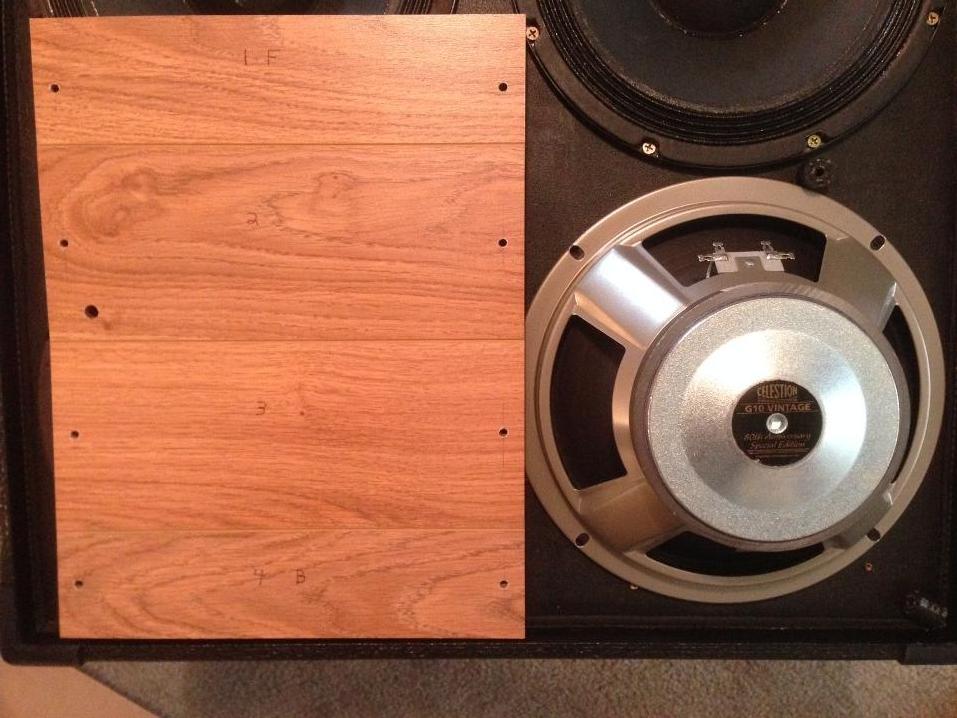
Yes, I did try briefly but there didn't seem to be much interest at the time so I thought I might as well finish this out. I picked up a 16 ohm Celestion G10 Vintage to use in the upper left position and picked up some flooring remnants to build a strong but light sectional divider.
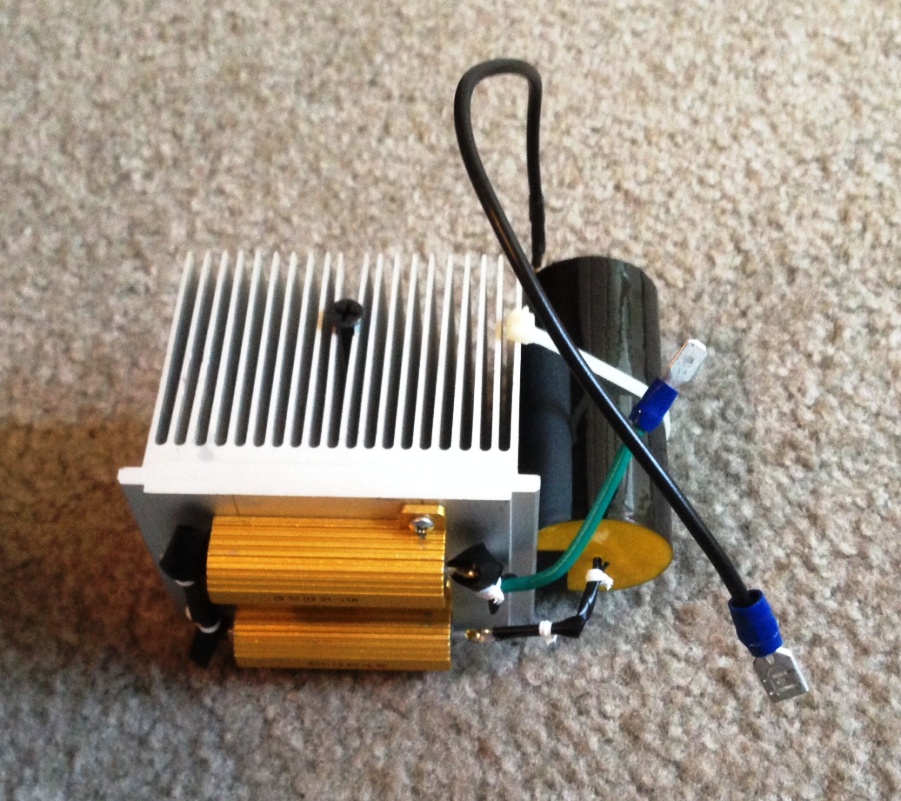
I used a capacitor, a pair of 50 watt 8 ohm resistors in series, and an aluminum heat sink to make a first order high pass which attenuates frequencies below 200 Hz. The G10 is a pretty beefy guitar speaker at 60 watts but it's not recommended to put a lot of sub 100 Hz power into it. This high pass voltage divider with heat sink only allows half as much power to the Celestion compared to the other speakers but maintains the 32 ohm per speaker layout.
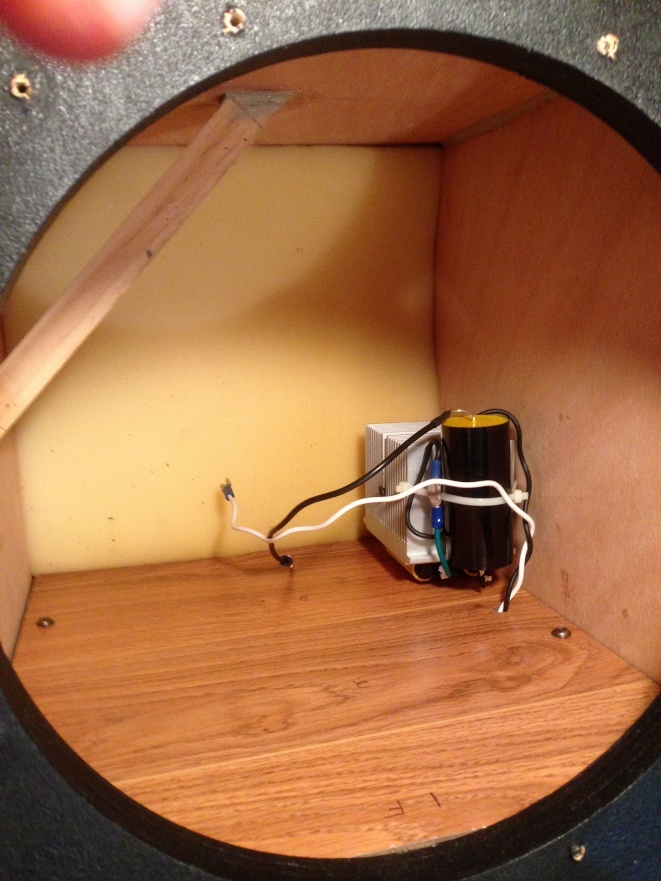
I removed the acoustic wool and most of the foam in order to install the partition and high pass as shown.
After replacing the foam and glass wool, the speaker was wired and mounted to the baffle. When I hooked it up and played through it, the presence of that guitar speaker was noticeable in a good way. The mids and highs seemed richer with a bit of controlled breakup when pushed. Replacing a bass speaker with a guitar speaker reduces the maximum low end output slightly as one would expect but there is still ample low end push and the mid/high voicing is better. It's a good trade off and that Celestion G10 is a sweet sounding speaker. I like it. Both configurations are quite useful and easy enough to switch between. Even though the G10 only gets half the wattage of the other speakers, it's +3dB more efficient and holds its own quite well.
I used a capacitor, a pair of 50 watt 8 ohm resistors in series, and an aluminum heat sink to make a first order high pass which attenuates frequencies below 200 Hz. The G10 is a pretty beefy guitar speaker at 60 watts but it's not recommended to put a lot of sub 100 Hz power into it. This high pass voltage divider with heat sink only allows half as much power to the Celestion compared to the other speakers but maintains the 32 ohm per speaker layout.
I removed the acoustic wool and most of the foam in order to install the partition and high pass as shown.
After replacing the foam and glass wool, the speaker was wired and mounted to the baffle. When I hooked it up and played through it, the presence of that guitar speaker was noticeable in a good way. The mids and highs seemed richer with a bit of controlled breakup when pushed. Replacing a bass speaker with a guitar speaker reduces the maximum low end output slightly as one would expect but there is still ample low end push and the mid/high voicing is better. It's a good trade off and that Celestion G10 is a sweet sounding speaker. I like it. Both configurations are quite useful and easy enough to switch between. Even though the G10 only gets half the wattage of the other speakers, it's +3dB more efficient and holds its own quite well.

- Jun 29, 2006
- 5,148
- 3,217
- Disclosures
- President, CEO, CFO, CIO, Chief Engineer, Technician, Janitor - Reiner Amplification
I'm a big fan of incorporating guitar speakers into the mix. I'd highly recommend using a second order and crossing over a bit higher unless you are careful with the volume/not running much power. It is pretty easy to damage it with a first order that low.

That looks like an old Dell CPU heatsink.I used a capacitor, a pair of 50 watt 8 ohm resistors in series, and an aluminum heat sink to make a first order high pass which attenuates frequencies below 200 Hz.
Nice to see it go to better use than occupying landfill space.
The Fs on the G10 Vintage is 115 Hz and it's a 60 watt speaker so I figured 2*Fs at 230 Hz was a good target frequency. I use an MB Fusion 800 and Puma 900 through this cab at moderately loud volume and haven't heard any signs of distress but your caution is valid. I'd rather not cross higher in order to retain as much low mid push as I can, but adding a coil to make it 2nd order would be a prudent thing to do. This would drop it to -12dB (1/4 power) by Fs. Here is the current configuration:I'm a big fan of incorporating guitar speakers into the mix. I'd highly recommend using a second order and crossing over a bit higher unless you are careful with the volume/not running much power. It is pretty easy to damage it with a first order that low.
It probably is. We have an electronics store that has all kinds of random, sometimes useful junk. It worked out well for my purpose and only set me back $4. Wondering if they have a coil to make my high pass 2nd order?That looks like an old Dell CPU heatsink.
Nice to see it go to better use than occupying landfill space.
- Jun 29, 2006
- 5,148
- 3,217
- Disclosures
- President, CEO, CFO, CIO, Chief Engineer, Technician, Janitor - Reiner Amplification
I think you can probably run at twice Fs with a second order, but with a first order, it's likely not going to roll off as fast as predicted and hence send more power than you want to the lower frequencies. You can also try the first order up higher and see if you prefer that to the second order. it's probably fine as is when running flat, but if you ever dial in a big low end boost, you might run in to trouble.
I currently have a 50uF cap in for the 1st order high pass which puts the roll off frequency around 250 Hz. This is the product info link for the G10 Vintage Invalid Link Removed
They provide a frequency response but no impedance response (especially for the 16 ohm version). I don't have SPICE or another loudspeaker circuit emulator to generate the impedance curve, but from other driver curves I've seen the impedance is pretty close to the DC resistance at lower frequencies. For the 16 ohm version Re=12.33 ohms so 13 ohms might be a decent approximation. However, even if you come up with C and L values with 3 decimal precision you can't get components with your exact values and they commonly have up to 5% tolerance. A couple of online calculators came up with these 2nd order component values:
For 12.3 ohms at 230 Hz: C = 39.8 uF, L = 12.0 mH
For 13.0 ohms at 230 Hz: C = 37.6 uF, L = 12.7 mH
I found caps at 40, 39, and 36 uF and coils at 12 and 13 mH. My best single source (Erse Audio) has C = 39 uF and L = 12 mH. I think this is what I'll go with unless someone has better values and an explanation why. Another thing I found is that inductors at these values tend to be large and high power. The only ones I saw that made sense were 19 ga rated at 250 watts which is more than enough (0.68 lb). This will probably cost $30 with shipping but should provide the right attenuation to minimize low mid loss while protecting the driver.
They provide a frequency response but no impedance response (especially for the 16 ohm version). I don't have SPICE or another loudspeaker circuit emulator to generate the impedance curve, but from other driver curves I've seen the impedance is pretty close to the DC resistance at lower frequencies. For the 16 ohm version Re=12.33 ohms so 13 ohms might be a decent approximation. However, even if you come up with C and L values with 3 decimal precision you can't get components with your exact values and they commonly have up to 5% tolerance. A couple of online calculators came up with these 2nd order component values:
For 12.3 ohms at 230 Hz: C = 39.8 uF, L = 12.0 mH
For 13.0 ohms at 230 Hz: C = 37.6 uF, L = 12.7 mH
I found caps at 40, 39, and 36 uF and coils at 12 and 13 mH. My best single source (Erse Audio) has C = 39 uF and L = 12 mH. I think this is what I'll go with unless someone has better values and an explanation why. Another thing I found is that inductors at these values tend to be large and high power. The only ones I saw that made sense were 19 ga rated at 250 watts which is more than enough (0.68 lb). This will probably cost $30 with shipping but should provide the right attenuation to minimize low mid loss while protecting the driver.

Passinwind
I know nothing.
- Dec 3, 2003
- 23,093
- 46,079
- Disclosures
- Designer/Toaster Tech @ Passinwind Electronics
I found caps at 40, 39, and 36 uF and coils at 12 and 13 mH. My best single source (Erse Audio) has C = 39 uF and L = 12 mH. I think this is what I'll go with unless someone has better values and an explanation why. Another thing I found is that inductors at these values tend to be large and high power. The only ones I saw that made sense were 19 ga rated at 250 watts which is more than enough (0.68 lb). This will probably cost $30 with shipping but should provide the right attenuation to minimize low mid loss while protecting the driver.
You can get capacitance values very precise by measuring and then paralleling different values. For coils you can buy a higher value and de-wind (or wind your own, even). Room EQ Wizard can measure impedances for you, just have to build a simple jig to interface to your soundcard.
I understand what you're saying about measuring and paralleling caps and winding/de-wind coils but I want to keep it simple (2 components) and minimum cost at this point. That Room EQ Wizard might be useful though http://www.roomeqwizard.com/
Maybe roomeqwizard could give the correct impedance to target, then buy the closest cap and a slightly higher value coil which can be de-wound slightly to match the cap and only be a few Hz off target.
Maybe roomeqwizard could give the correct impedance to target, then buy the closest cap and a slightly higher value coil which can be de-wound slightly to match the cap and only be a few Hz off target.
Passinwind
I know nothing.
- Dec 3, 2003
- 23,093
- 46,079
- Disclosures
- Designer/Toaster Tech @ Passinwind Electronics
I understand what you're saying about measuring and paralleling caps and winding/de-wind coils but I want to keep it simple (2 components) and minimum cost at this point. That Room EQ Wizard might be useful though http://www.roomeqwizard.com/
Maybe roomeqwizard could give the correct impedance to target, then buy the closest cap and a slightly higher value coil which can be de-wound slightly to match the cap and only be a few Hz off target.
Yep, that's how most people do it and it's close enough for rock 'n roll. You could look at paralleling two medium value caps to make one big one though, something I find myself doing pretty often. Partsconnexion has a nice range of crossover cap values if you want to expand beyond just Erse stuff, BTW.
Nice detail, man. And your construction scheme looks nice and solid without adding any unnecessary weight.
I had also wondered about that lone neo on the bottom there but it looks like it'd be easy enough to add a panel under that bottom angle brace there should you decide you want it in it's own chamber. Judging from Kringles thread, they do seem to play nice together, although I believe his are all in their own chambers.
I didn't catch what impedance individual driverw you're using but I guess this could be considered a nominal impedance of 5.33 below the filter and 2.67 above it or something like that?
All in all, looks like nice quality work. I've been shying away from the Weber stuff due to the lack of specs and not being able to predict what I'll get until after I bought it, but thanks to our resident TB guinea pig (Kringle), I'm getting a little bug for a tube amp friendly 4ohm 410 in the voicing of the old flatbacks. Don't know that I'll follow through on that anytime soon, but at least a viable option is out there.
Again, nice detailed, quality looking work.
I too am on the fence sometimes about just how handy small and modular is when it means extra trips. A smart build with well thought out ergonomics/handle placement, etc. makes it more convenient sometimes to just make one trip with a bit larger, but easy to handle box. My little 112's pack in small cars easy but there's only been exactly 2 gigs in 2 years where I've only used one of them.
and I thought my guit-fiddle speaker cab designs were off the wall, wow

- Nov 24, 2008
- 4,343
- 7,163
- Disclosures
- Owner & designer, AudioKinesis; Auth. mfg, Big E (Home Audio only)
I'm a big fan of incorporating guitar speakers into the mix. I'd highly recommend using a second order and crossing over a bit higher unless you are careful with the volume/not running much power. It is pretty easy to damage it with a first order that low.
Sorry I'm so late to the party on this thread.
First order high-pass filters often fail miserably to provide the expected degree of attenuation into a driver's resonant peak(s), and given the high Qms typical of guitar speakers, that resonant impedance peak is likely to be a big one. So I agree with your suggestion of a second order filter, as they do a much better job into a load that includes resonant peaks. Or a resonant peak filter can be used as an alternative, assuming a true 6 dB/octave rolloff would be adequate protection.
Last edited:
I know this is sound advice but this cab has been pushed pretty hard with no noticeable effect to this point. I sold it to a friend who uses it with an Orange BT500 and really likes it with both guitar and bass. We were both blown away at how good it sounded with his Strat and a 30 watt Vox amp. He is able to get quite workable settings for both guitar and bass from the BT500. If this ever becomes and issue I'll put in the 2nd order filter for him and reverse leads to the Celestion to phase align it with the low passed side. That G10 vintage is a nice sounding driver.


