Unique implementation of EQ.
I read this elsewhere.
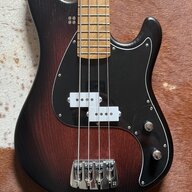
Really excited about my inbound DCX Bass.
I'm pretty sure we stoked the flames up high enough now that your expectations are to sound like a demigod by now.

TalkBass has been independent since 1998. Add your voice.
Create a free account to reply to discussions, view embedded media, and browse with fewer display ads.
Join free Log in
Want zero display ads or expanded classifieds tools? Compare plans.
Unique implementation of EQ.
I read this elsewhere.
Really excited about my inbound DCX Bass.

Isn't this implementation of the HF an d LF similar (not quite 100%) to the 4OTF and CrashBox by Genzler?Enabler to the rescue.The source was Origin Effects themselves, albeit I was the intermediary:
"
Thank you for your email. The DCX's L.F. and H.F. knobs work the same regardless of whether it's in EQ or OD mode, but the way they work is quite clever and unusual.
The L.F. control effectively cuts before the drive circuit but boosts after it. This means that you don't get the usual "flubbiness" of high levels of bass going into a drive circuit. When cutting, it tightens up the sound. When boosting, it adds bass to the already overdriven signal.
The H.F. control does the opposite - it boosts before the drive circuit and cuts after it. This means you can push higher frequencies into the drive circuit to get a more aggressive, cutting drive tone. But, when you use the H.F. control to cut treble, it's also removing the "fizz" from the drive tone. Both controls are completely flat when set to 12:00.
The VOICE switch is located after the drive and does change with EQ/OD modes. This removes treble higher up than the H.F. control, with three levels of severity - flat, medium and dark. In OD mode, this high cut is always active, with the switch just selecting how much it's cutting. In EQ mode, the high cut increases as the pedal overdrives. So, if you're on the edge of breakup, clean tones will be bright, then get warmer the harder you dig in.
All this makes it a very versatile and responsive pedal."



The difference there is that the Genzlers are using simple cut-only pass-filters (one adjustable filter cutting lows before distortion and one adjustable filter curting highs after distortion) whereas the Origin Bass and Treble are both cut and boost with apparently some fancy implementation that changes the place they are in the signal path depending on whether you are cutting or boosting.Isn't this implementation of the HF an d LF similar (not quite 100%) to the 4OTF and CrashBox by Genzler?
My preferences for overdrive and distortion tend to lean towards the classic end of the spectrum rather than the clanky, modern sounds - I always use the first Audioslave record as a reference. I have been through a lot of pedals, and finding ones that don't get fatiguing, can do lower gain always-on tones, and sound integrated with the tone rather than tacked on top of it is an ongoing challenge. I have to say the two new Genzler pedals that @agedhorse designed are game changers for me. They integrate so well like a great compressor where you forget that they are on until you...
- JGR
- Replies: 18
- Forum: Effects [BG]
View attachment 7286514

Ha!I'm pretty sure we stoked the flames up high enough now that your expectations are to sound like a demigod by now.
Noted.@dedpool1052 just don't make the same mistake that I did and put the DCX behind your compressor if you're running one up front. I was very disappointed with mine until I started shifting my compressor down the chain.
I actually like mine after a comp, but I’m also usually using a slow attack on the comp so the peaks of my playing are actually accentuated rather than smashed.@dedpool1052 just don't make the same mistake that I did and put the DCX behind your compressor if you're running one up front. I was very disappointed with mine until I started shifting my compressor down the chain.


Still a worthy experiment, but I’m not sure the result is generalisable. The next circuit may play well with that tube, and of course, someone else might have liked the result you got here. I mean, who wouldn’t want a two-dimensional overdrive?View attachment 7287541
So this was a shot in the dark - and it missed.
I loaded the Tube Drive with a pair of JJ 12AT7 tubes, because these run with less gain than the 12AX7 it came with - and which are meant to be in there.
Swapping the tubes yielded a slightly darker tone, and a lot more headroom. The former was not expected, the latter was what I hoped for.
With the same knob positions, I suddenly had a clean sound, and needed to ride the volume higher to reach unity. Audible distortion now happens around 11 o'clock, but the complete nature of the drive is different, and I don't like what I'm getting.
For want of a better word, the drive feels flat and two dimensional all of a sudden, and the voice it has feels a bit off, more like driving a circuit that does not really want to be driven.
Well. I loaded a set of 12AT7 tubes into sockets that are labeled 12AX7. What did I expect?
Given that I judged the Darkglass Vintage Microtubes to be two dimensional and flat, and that this particular pedal has a huge following, you might be right.Still a worthy experiment, but I’m not sure the result is generalisable. The next circuit may play well with that tube, and of course, someone else might have liked the result you got here. I mean, who wouldn’t want a two-dimensional overdrive?
View attachment 7287541
So this was a shot in the dark - and it missed.
I loaded the Tube Drive with a pair of JJ 12AT7 tubes, because these run with less gain than the 12AX7 it came with - and which are meant to be in there.
Swapping the tubes yielded a slightly darker tone, and a lot more headroom. The former was not expected, the latter was what I hoped for.
With the same knob positions, I suddenly had a clean sound, and needed to ride the volume higher to reach unity. Audible distortion now happens around 11 o'clock, but the complete nature of the drive is different, and I don't like what I'm getting.
For want of a better word, the drive feels flat and two dimensional all of a sudden, and the voice it has feels a bit off, more like driving a circuit that does not really want to be driven.
Well. I loaded a set of 12AT7 tubes into sockets that are labeled 12AX7. What did I expect?
Ha! Fun fact:From Effectrode: Whats more, you can fine-tune the character of the Tube Drive by swapping out tubes. The tone and gain characteristics of an overdriven guitar can be drastically altered by interchanging tubes—in fact, the pedal is designed for easy access to the tubes for this purpose. The Tube Drive is quickly and easily transformed into a high-gain distortion beast or a mellow blues driver by simply swapping out a tube for a different type. For example, swapping out the 12AX7 tube in the top right hand position for a lower mμ 12AY7 or 12AV7. This will alter the pedal’s overdrive characteristics so that is becomes more full-bodied and bluesy sounding.
Maybe try swapping in just 1 12AT7 in? And try it in both positions?
I don't know if you necessarily did it wrong, but maybe you just overshot what you were going after. And without having a good idea of what the each tube position is doing maybe just experiment with different values in 1 slot at time and see what happens. Just my chemistry dropout brain thinking about keeping all things consistent and only changing 1 variable at time.I swapped out both tubes, then I swapped one back, but according to that text, I used the wrong one.
Best tone: 2x 12AX7I don't know if you necessarily did it wrong, but maybe you just overshot what you were going after. And without having a good idea of what the each tube position is doing maybe just experiment with different values in 1 slot at time and see what happens. Just my chemistry dropout brain thinking about keeping all things consistent and only changing 1 variable at time.

Did you try through both headphones and a cab? This description is how I feel when the phase of a signal gets inverted ("oh no, here he goes again...") Do you still have the Jive? If so, try it in front just as a boost.the drive feels flat and two dimensional all of a sudden
I was going to suggest keeping the 12AX7 in the first gain stage and swapping a 12AT7 for the second but it looks like you've already covered it.Best tone: 2x 12AX7
Second best tone: upper tube 12AT7, lower tube 12AX7
Third best tone: 2x 12AT7
Fourth best tone: lower tube 12AT7, upper tube 12AX7