

Enjoy the benefits of a premium membership!
Upgrade Account
-
TalkBass has been independent since 1998. Add your voice.
Create a free account to reply to discussions, view embedded media, and browse with fewer display ads.
Join free Log in
Want zero display ads or expanded classifieds tools? Compare plans.
You are using an out of date browser. It may not display this or other websites correctly.
You should upgrade or use an alternative browser.
You should upgrade or use an alternative browser.
My Dirt Bender - Another Jounal
- Thread starter el murdoque
- Start date
More options
Who Replied?
No sorry. This describes the removal of white goo. Mine, unfortunately, is black.


- Feb 16, 2008
- 21,240
- 23,638
- Disclosures
- John K Custom Basses
some "wierdo" didn't do that. that's what klon did on the originals. i wouldn't try to remove it since it will devalue the pedal a ton!Some weirdo has smeared black gunk all over the board.
It has hardened completely, now I can't make out which part is which - and I can't reach most bits to solder in the new ones. TB, please help! This pedal has cost me $4500!
- Feb 16, 2008
- 21,240
- 23,638
- Disclosures
- John K Custom Basses
you can always sell it and buy the warm audio version (Centavo) which has a low end" switch.
When I figured out that I can't solder the new parts into that darn pedal, I put them back into the Playstation and gave the pedal to my nephew. He's just turned 13 and wants to try guitar. I guess he has use for a dirt box.
What Klon-Type pedal would be the best for bass?

When I figured out that I can't solder the new parts into that darn pedal, I put them back into the Playstation and gave the pedal to my nephew. He's just turned 13 and wants to try guitar. I guess he has use for a dirt box.
What Klon-Type pedal would be the best for bass?
I like the TL Pedals SP+.
- Feb 16, 2008
- 21,240
- 23,638
- Disclosures
- John K Custom Basses
i just made my own bass klon:When I figured out that I can't solder the new parts into that darn pedal, I put them back into the Playstation and gave the pedal to my nephew. He's just turned 13 and wants to try guitar. I guess he has use for a dirt box.
What Klon-Type pedal would be the best for bass?
Pretty!

This joke has gotten out of hand, sir!
That said, hope your little cousin enjoys their new dirt box lmaooooo.
Facetiousness aside, @el murdoque, if you really do wanna go down the Klone road, you could do a lot worse than looking at that Tumnus Deluxe. Pretty sure the active bass EQ would allow for dialling in any low end that may be naturally lacking in that type of circuit.
Or, y’know, @johnk_10 builds some pretty incredible stuff, too. You’ve got options, Herr Murdoque!
That said, hope your little cousin enjoys their new dirt box lmaooooo.
Facetiousness aside, @el murdoque, if you really do wanna go down the Klone road, you could do a lot worse than looking at that Tumnus Deluxe. Pretty sure the active bass EQ would allow for dialling in any low end that may be naturally lacking in that type of circuit.
Or, y’know, @johnk_10 builds some pretty incredible stuff, too. You’ve got options, Herr Murdoque!
Well, first of all I must play more with the Pantheon. Damn, that pedal is good! Many options, but really easy to set.
Then I'll move on to the mystery pedal or to the Beta V, whichever arrives first.
The Beta will most likely a short one.
I feel that it can give you that vintage flats through a farting out vintage amp kind of tone when you feed it with roundwounds. High cutting is the easy thing. Using even, odd or whatever harmonics to create a lively tone from a dead flat is something else entirely. Maybe it excels at that, maybe not. I would like to love it, but I fear I'll play it thrice and move on.
That mystery pedal that was mentioned more than once now, which should be here on Saturday,
that's gonna be wild, though.
Then I'll move on to the mystery pedal or to the Beta V, whichever arrives first.
The Beta will most likely a short one.
I feel that it can give you that vintage flats through a farting out vintage amp kind of tone when you feed it with roundwounds. High cutting is the easy thing. Using even, odd or whatever harmonics to create a lively tone from a dead flat is something else entirely. Maybe it excels at that, maybe not. I would like to love it, but I fear I'll play it thrice and move on.
That mystery pedal that was mentioned more than once now, which should be here on Saturday,
that's gonna be wild, though.
Speaking of Klon circuits I really recommend (and regret selling) Rawkworks Light OD. It was recommended here on talkbass by Justin Meldahl-Johnson actually Rawkworks Light OD
Currently unobtainium though
Currently unobtainium though

Very affiliated. I was using Rimrocks Mini Mo with great results. I've moved on from using Klon based pedals as my setup has changed though so I'm selling it. 
Oh, interesting. Been curious about the Fake plastic trees and its output transformer. This is the one from BC CLs ? (Edit: it's not)
Last edited:
Oh, interesting. Been curious about the Fake plastic trees and its output transformer. This is the one from BC CLs ? (Edit: it's not)
It was listed on Reverb, from Germany. According to Audio Kitchen, the units with green leaves are identical to the red leaved ones, apart from the color of the leaf.
And props to you for recognizing it from the pic

It was listed on Reverb, from Germany. According to Audio Kitchen, the units with green leaves are identical to the red leaved ones, apart from the color of the leaf.
And props to you for recognizing it from the pic
Nice score. Had the Big Trees and dug how the dirt channel was sounding with bass - nice high mids emphasis, tasty breakup and no low-end loss iirc.
A first impression from a small session with the Audio Kitchen Fake Plastic Trees:
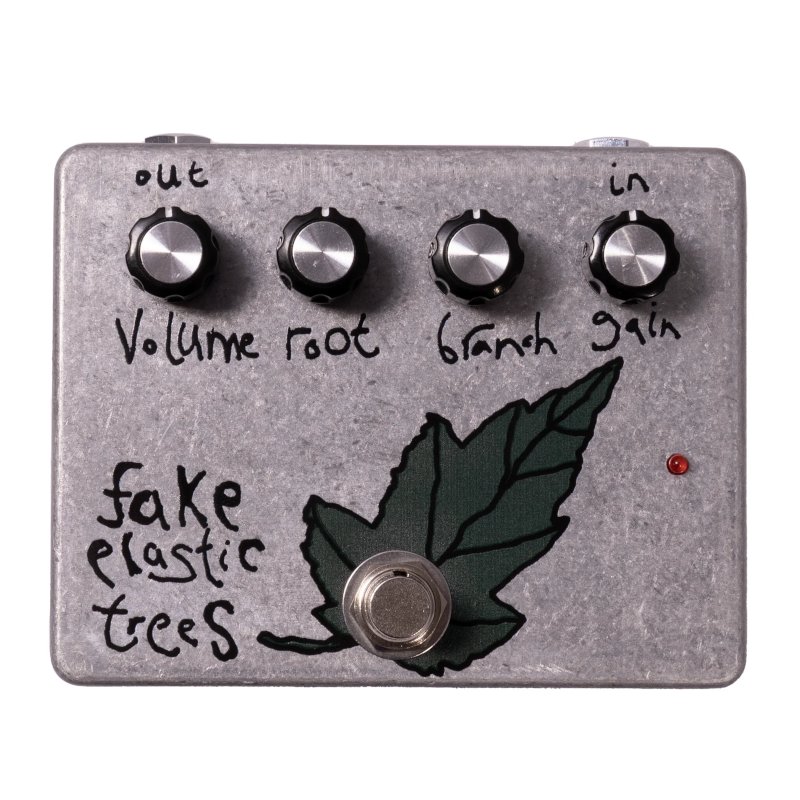
From the outside, it is a fairly simple affair. You get your master volume, two band EQ, and gain.
What the picture does not show is that the pedal is quite tall.
A look on the inside tells us why that is:
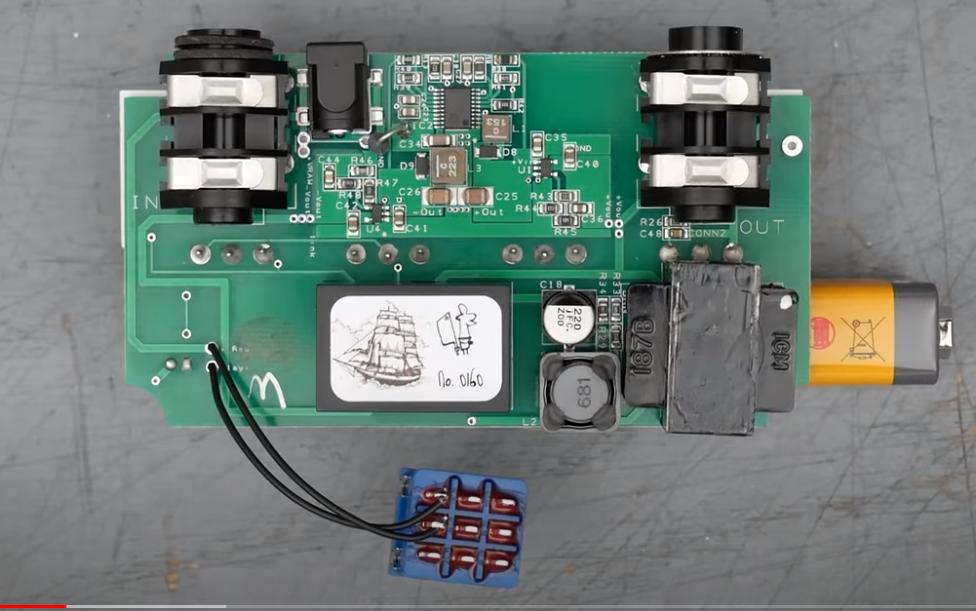
There are some tall components on the pcb.
To quote the Audio Kitchen website on the contents of the pedal:
So I think of it as a micro amp that does drive a dummy load (instead of a cabinet) and you get the sound from the output transformer. Correct me if that's entirely off.
The knob layout does not reflect the internal sequence of things - the EQ section comes before the gain/clipping stage.
So how does it sound and how does it feel?
Given that Audio Kitchen bases all their work around tubes and this is the only solid state pedal, the name Fake Plastic Trees is aptly chosen.
I want to say the Fake Plastic Trees sounds and feels like something organic that mimics being something plastic that mimics being something organic, even though from the tube enthusiasts viewpoint,
it merely is something plastic that mimics something organic.
The Volume knob is self explanatory. The gain, branch and root will interact with each other.
In my setup, setting all three to noon is not particularly spectacular. The sound remains clean and while it feels and sounds a little different, it's not really worth mentioning. When you leave the gain as is, but dime the EQ, you get dirt.
When you leave the EQ at noon and raise the gain, you also get dirt,
but a slightly different flavor because you don't have scooped mids now. This invites tinkering around.
When you try and use this pedal as a low gain overdrive, you will find that it can be touch sensitive.
You know those pedals where the lows stay mostly clear and the highs already start singing?
And their counterparts where the lows get a bit of grind while the top stays rather clean?
Well, the FPT can do either, just boost the treble when you want upper registers breaking up and boost the bass for a dirty low end - boost neither for flat response and cut a bit of both for bringing out the mids in the dirt making process.
The vibe that comes across is that of a small amp pushed to 110% of what it's capable of.
What sticks out is a formidable note separation when playing double stops or power chords, and what feels a bit different to traditional overdrive circuits is how it clears up on the note decay.
If I'm honest, the way this pedal overdrives the signal is what I would have expected the Colour Box to do.
There are components in the tone that sound like you're forcing something past what it is capable of, but also components showing that this is intended.
Raising gain, branch and root will get you more into synth territory. You can dial in a very driven, very smooth sound that clearly identifies as fuzz. When you dime everything, you get a strong compression and tons of drive; A sound that makes you think "I could use this in a synth chain without an octaver".
Once more, the decay is interesting. Where a fuzz pedal set to "face melting" often needs a gate because the note decay becomes a sputtering mess (not without a certain brutality), the FPT will fade into clean notes in a very linear fashion, which feels different from anything I've used before.
It could be that I'm imagining things here, I'll have to analyze that ASAP.
From the outside, it is a fairly simple affair. You get your master volume, two band EQ, and gain.
What the picture does not show is that the pedal is quite tall.
A look on the inside tells us why that is:
There are some tall components on the pcb.
To quote the Audio Kitchen website on the contents of the pedal:
Class A, hand-graded JFETs, a discrete stage modelling the EL84 grid-clipping profile, a custom Mumetal output transformer, TBT speaker load, and a Class A line driver.
So I think of it as a micro amp that does drive a dummy load (instead of a cabinet) and you get the sound from the output transformer. Correct me if that's entirely off.
The knob layout does not reflect the internal sequence of things - the EQ section comes before the gain/clipping stage.
So how does it sound and how does it feel?
Given that Audio Kitchen bases all their work around tubes and this is the only solid state pedal, the name Fake Plastic Trees is aptly chosen.
I want to say the Fake Plastic Trees sounds and feels like something organic that mimics being something plastic that mimics being something organic, even though from the tube enthusiasts viewpoint,
it merely is something plastic that mimics something organic.
The Volume knob is self explanatory. The gain, branch and root will interact with each other.
In my setup, setting all three to noon is not particularly spectacular. The sound remains clean and while it feels and sounds a little different, it's not really worth mentioning. When you leave the gain as is, but dime the EQ, you get dirt.
When you leave the EQ at noon and raise the gain, you also get dirt,
but a slightly different flavor because you don't have scooped mids now. This invites tinkering around.
When you try and use this pedal as a low gain overdrive, you will find that it can be touch sensitive.
You know those pedals where the lows stay mostly clear and the highs already start singing?
And their counterparts where the lows get a bit of grind while the top stays rather clean?
Well, the FPT can do either, just boost the treble when you want upper registers breaking up and boost the bass for a dirty low end - boost neither for flat response and cut a bit of both for bringing out the mids in the dirt making process.
The vibe that comes across is that of a small amp pushed to 110% of what it's capable of.
What sticks out is a formidable note separation when playing double stops or power chords, and what feels a bit different to traditional overdrive circuits is how it clears up on the note decay.
If I'm honest, the way this pedal overdrives the signal is what I would have expected the Colour Box to do.
There are components in the tone that sound like you're forcing something past what it is capable of, but also components showing that this is intended.
Raising gain, branch and root will get you more into synth territory. You can dial in a very driven, very smooth sound that clearly identifies as fuzz. When you dime everything, you get a strong compression and tons of drive; A sound that makes you think "I could use this in a synth chain without an octaver".
Once more, the decay is interesting. Where a fuzz pedal set to "face melting" often needs a gate because the note decay becomes a sputtering mess (not without a certain brutality), the FPT will fade into clean notes in a very linear fashion, which feels different from anything I've used before.
It could be that I'm imagining things here, I'll have to analyze that ASAP.
One more thing:
With the pedal (mostly) clean, but the branch knob turned up for a treble boost, there is that little something in your tone that you can't really place, but when you switch the pedal off, the tone becomes bland and loses a bit of life it had before.
Two more thing:
I have the JPTR FX Jive on my board. It lives behind the comp and I set it to give me the maximum amount of saturation without actual distortion.
For want of better words, I'd describe it as this: The attack of a note, the "Thud" remains unchanged, but there is something living behind the note that becomes apparent when you let it ring, even for the shortest amount of time - just when the initial thud is done, it comes out.
With the FPT set to the mildest of drives, playing into the comp and then the Jive, that thing behind the note suddenly becomes huge. I only discovered that in the last minute yesterday, just before I had to leave, but this interaction needs to be investigated further, too.
I can see the need of sound clips.
With the pedal (mostly) clean, but the branch knob turned up for a treble boost, there is that little something in your tone that you can't really place, but when you switch the pedal off, the tone becomes bland and loses a bit of life it had before.
Two more thing:
I have the JPTR FX Jive on my board. It lives behind the comp and I set it to give me the maximum amount of saturation without actual distortion.
For want of better words, I'd describe it as this: The attack of a note, the "Thud" remains unchanged, but there is something living behind the note that becomes apparent when you let it ring, even for the shortest amount of time - just when the initial thud is done, it comes out.
With the FPT set to the mildest of drives, playing into the comp and then the Jive, that thing behind the note suddenly becomes huge. I only discovered that in the last minute yesterday, just before I had to leave, but this interaction needs to be investigated further, too.
I can see the need of sound clips.
Let's talk about the recording thing.
Here's what I can offer right now:
A looper pedal with the sole purpose of recording a single loop and keeping that for the future, to keep things consistent. I'm thinking about a loop that will include lowest notes, a little riff on the money part of the fret board, higher notes, and chords/double stops - and maybe letting a few notes ring out completely, plus some staccato playing?
Would it be better to compose a piece/riff that encompasses all of that and has the vibe of a song or would it be better to keep it analytical and play each of those things without a (musical) connection?
After the pedals, I have a Behringer Flow8, which has a USB out that connects to my laptop, running either Windows 10 or Linux. The last things I recorded, I used Audacity.
Will this suffice for the elaborate (cork sniffing) listening habits of this thread's readership?
Any ideas to make the experience more better?
I want to get this right from the start, so I can go through all the dirt pedals I (still) own, without needing to change the approach after a fair bit of them has been archived.
Here's what I can offer right now:
A looper pedal with the sole purpose of recording a single loop and keeping that for the future, to keep things consistent. I'm thinking about a loop that will include lowest notes, a little riff on the money part of the fret board, higher notes, and chords/double stops - and maybe letting a few notes ring out completely, plus some staccato playing?
Would it be better to compose a piece/riff that encompasses all of that and has the vibe of a song or would it be better to keep it analytical and play each of those things without a (musical) connection?
After the pedals, I have a Behringer Flow8, which has a USB out that connects to my laptop, running either Windows 10 or Linux. The last things I recorded, I used Audacity.
Will this suffice for the elaborate (cork sniffing) listening habits of this thread's readership?
Any ideas to make the experience more better?
I want to get this right from the start, so I can go through all the dirt pedals I (still) own, without needing to change the approach after a fair bit of them has been archived.
I would love if this was some up'n'down the neck fingerstyle type of riff (think: rhcp give it away sort of combining root notes and slides up the neck), some chordal stuff/double stops, some plectrum even if just buncha 8 notes
Btw I was about to ask you about Jive ... with all the goodness coming your way in parcels does Jive still hold the spot on your board?
Btw I was about to ask you about Jive ... with all the goodness coming your way in parcels
does Jive still hold the spot on your board?


