• TalkBass has been independent since 1998. Add your voice.
    Create a free account to reply to discussions, view embedded media, and browse with fewer display ads.
    Join freeLog in
    Want zero display ads or expanded classifieds tools? Compare plans.

My new Epiphone EB0

The first bass I ever owned (back in the late 60s) was a Kalamazoo. It had the same pickup as the EB-O with a bolt on neck. Although you could minimize the low end woof with amp tone settings, there wasn't much tonal variety. But - for certain musical and playing styles, it was perfectly workable (I played in a folk group with two acoustic guitarists).For the price, that is a nice bass.
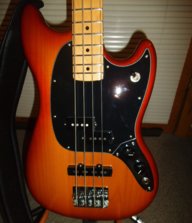
 
Strange thing I noticed - my Tone knob is apparently wired backwards.

When I turn it to 0, the sound brightens up - and vice versa. It works the opposite direction from the Volume knob.

Anyone else have this? Or did I just get a weird one. I've never messed with wiring before, so I think I'm gonna'
leave it as-is for now.
 
Strange thing I noticed - my Tone knob is apparently wired backwards.

When I turn it to 0, the sound brightens up - and vice versa. It works the opposite direction from the Volume knob.

Anyone else have this? Or did I just get a weird one. I've never messed with wiring before, so I think I'm gonna'
leave it as-is for now.
I've owned two of these and never had that issue, but I've heard of it before. For a $200 bass that's generally excellent for what it is, it's a minor issue.
 
I've been looking at starting playing, and I want a short scale for various reasons. The EB-0 seems like a valid choice, but no one has any in stock around me.

There's been some talk back and forth on ply vs. solid body. Is there any way to tell from an external inspection (ie, getting the GC drone in another state to eyeball a used model)? Are the black versions different wood than the red versions?

If I can pick one up for less than a c-note used, I'd be pretty happy.
 
Quick tip - if you try any bridge height adjustments, loosen the strings a bit first.
I'm thinking that might be the cause of some of the insert problems I've read about.
There's a lot of tension when trying to turn those screws when the strings are tightened up.
But they turn very easily with loosened up strings.
 
I've been looking at starting playing, and I want a short scale for various reasons. The EB-0 seems like a valid choice, but no one has any in stock around me.

There's been some talk back and forth on ply vs. solid body. Is there any way to tell from an external inspection (ie, getting the GC drone in another state to eyeball a used model)? Are the black versions different wood than the red versions?

If I can pick one up for less than a c-note used, I'd be pretty happy.


I don't know how to tell the difference, or if there is a difference between black/red other than color.
The only thing I've read is that there's a bass/amp package available, and the ones that come with those are plywood.
Hopefully, someone else who knows will chime in.
 
Wasn't sure if maybe the somewhat less common used black models might have a non-transparent finish so they were all ply, or not. -shrug-

The only other thing I've noticed is some have a Gibson truss rod cover; others have an Epiphone truss rod cover.

While I'm not assuming Gibson=Quality in this case, I am going to assume that Gibson=Older Model and probably solid, not ply.
 
The first bass I ever owned (back in the late 60s) was a Kalamazoo. It had the same pickup as the EB-O with a bolt on neck.

Me too. It was white and cute as hell. One day during a basement jam, it broke in half -- it was made of MDF or something like it and the neck pad just snapped off the rest of the body. Funny, most Gibson necks break at the other end...
 
There's been some talk back and forth on ply vs. solid body. Is there any way to tell from an external inspection (ie, getting the GC drone in another state to eyeball a used model)? Are the black versions different wood than the red versions?

If I look very closely at the edges of mine, I can see where there's a line between two planks of wood used to form the body. I assume if it was ply, you could possibly see the different levels here.

Otherwise, because of the veneer top and bottom I cannot see the line between the two planks. I guess that doesn't really help with plywood though, eh?