• TalkBass has been independent since 1998. Add your voice.
    Create a free account to reply to discussions, view embedded media, and browse with fewer display ads.
    Join freeLog in
    Want zero display ads or expanded classifieds tools? Compare plans.

My preamp bender: A Journal.

Face it @el murdoque you enjoy doing this and will never be satisfied.
Perhaps you consider therapy.


Anyone recognize the bass player?


Is that the poor guy who was forced to join Metallica?
(Luckily, the force they used was money. I'm kinda sad that a beast on bass like that is wasting all the chops playing Metallica songs, but I'm quite happy for him to get the attached fame and paychecks.)


As to the wild accusation of me enjoying this and never being satisfied:

You should know that this is absolutely true while also it is not. What?

I personally have laid under the stars on warm summer nights and pondered the universe without and within, and in a moment of clairvoyance I have had the epiphany that tone chasing is a hobby in its own right.

The deeper I go into that particular rabbit hole, the more I realize that I could absolutely break out the old Pedaltrain Nano, slap on ol' reliable (Sansamp PBDDI), a tuner and the Strymon BlueSky and I could play my current bands' last set list for a large audience and nobody would bat an eye.
It'd be something like 70% there, with just three pedals. The only thing I'd miss would be a reliable peak limiter in form of a compressor, but I might also take the tuner off and put a comp in its place .

I have built a second board with spares because of the fun it brings,
and I will keep toying around with bits and bobs that are absolutely fine and do not need to be toyed around with - when I feel like I have exhausted a topic, I will shift to another. I don't do this to finally catch the magic bullet at the deepest end of the rabbit hole - I do know that this goes on and on until I stop it.

That is an important difference. I do not do this to reach an end. I am totally happy with the tones I get from my gear and have been for a long time. I do it because I enjoy doing it. I'm not here to reach the destination, I'm here for the ride.
 
Last edited:
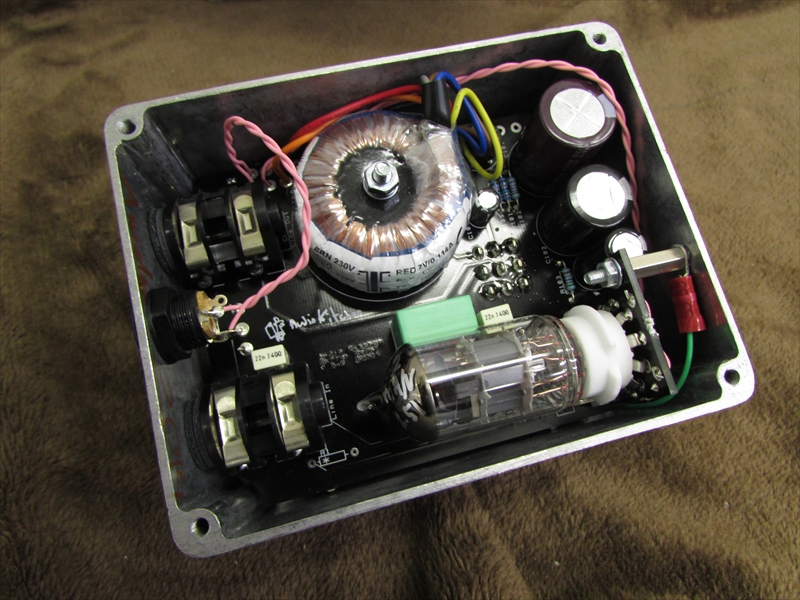
The inside is full to the brim. With fancy stuff.
img_2104_r-jpg.5246860

(this is a pic I pulled from the Internet of the TST, not the DI version - but you get the idea)
I wonder how they fit a DI transformer inside too?!
 
Is that the poor guy who was forced to join Metallica?
(Luckily, the force they used was money. I'm kinda sad that a beast on bass like that is wasting all the chops playing Metallica songs, but I'm quite happy for him to get the attached fame and paychecks.)


As to the wild accusation of me enjoying this and never being satisfied:

You should know that this is absolutely true while also it is not. What?

I personally have laid under the stars on warm summer nights and pondered the universe without and within, and in a moment of clairvoyance I have had the epiphany that tone chasing is a hobby in its own right.

The deeper I go into that particular rabbit hole, the more I realize that I could absolutely break out the old Pedaltrain Nano, slap on ol' reliable (Sansamp PBDDI), a tuner and the Strymon BlueSky and I could play my current bands' last set list for a large audience and nobody would bat an eye.
It'd be something like 70% there, with just three pedals. The only thing I'd miss would be a reliable peak limiter in form of a compressor, but I might also take the tuner off and put a comp in its place .

I have built a second board with spares because of the fun it brings,
and I will keep toying around with bits and bobs that are absolutely fine and do not need to be toyed around with - when I feel like I have exhausted a topic, I will shift to another. I don't do this to finally catch the magic bullet at the deepest end of the rabbit hole - I do know that this goes on and on until I stop it.

That is an important difference. I do not do this to reach an end. I am totally happy with the tones I get from my gear and have been for a long time. I do it because I enjoy doing it. I'm not here to reach the destination, I'm here for the ride.

Well put!

Plus, you know, you’re an adult and can make your own decisions.
 
  • Like
Reactions: el murdoque
I wonder how they fit a DI transformer inside too?!

Looking at the pic and external designs, the original TST had the power jack on top. Now the power jack is on the side for TST and TSTDI and the DI is on the top of the TSTDI. The newer TST’s enclosure has a cover over where the DI would go. Steve, head honcho at Audio Kitchen, advised me the newer TSTs can be modded to add the DI.

BTW, these pedals have tall enclosures which helps fit everything in. Here’s a Fake Plastic Trees which I believe has the same height as TSTDI. Next to it is a Broughton FlipTop. The FPT is a standout pedal.
12AD3FD9-020B-45DB-8F64-D127C09D6F56.jpeg
 
Last edited:
I will have to do a bit more playing and listening back to it, but the one weird thing about the Small Trees DI is how incredibly good the DI sounds with the pedal switched off.
In off position, the tube circuit is bypassed and there is no boost available, but those Sowter transformers seem to work their magic just fine. Using that DI signal feels like your signal chain is $2000 more expensive.
 
  • Like
Reactions: davelowell2
How about throwing in another preamp pedal from the sideline:
fliptop.jpg


Meet the Broughton Fliptop.
I've only had a single playing session with that pedal, and Broughton fans beware, this will be nasty.

All in all, I did not like that pedal one bit. I do think it looks boring and the LED is way too bright - it's one of those laser pointers that will even sting your eye when you're playing a festival stage in bright sunlight.

There is a two band EQ, a Gain and Master and a knob labeled cab.
The whole experience feels a bit muffled and a bit like it's lacking horsepower.
I could not get a clean sound out of the pedal with my six strings, neither with the active Bongo, nor with the passive Le Fay. Even with the gain set super low, the lows sounded like they farted out when I approached the low E - the B string was totally out of the question.
It sounded a bit thin to my ears, too - so the bass knob needed to be up at 3/4 at least, which certainly did not help with the distortion. The CAB knob just enhanced the muffled experience, reducing both bottom end and top end at the same time. When it failed delivering a preamp sound that I liked, I switched gears and tried to make it sound good as a drive pedal, but I must admit that this felt like driving a circuit that does not like to be driven.
Maybe a far fetched car-analogy, but using the Fliptop as a drive pedal, because it's modeled after a vintage tube amp, felt like trying to drift with a Model T - whereas cranking an SVT would be drifting in a '69 Mustang.
You don't have the feeling of unleashing raw power. You have the feeling of pushing over a frail old man that walks with a stick.

I will have to try if increased voltage yields increased headroom and run the pedal at 18V, but I fear that we were not made for each other.

If you love your Fliptop please let me know why.
 
How about throwing in another preamp pedal from the sideline:
View attachment 5250007

Meet the Broughton Fliptop.
I've only had a single playing session with that pedal, and Broughton fans beware, this will be nasty.

All in all, I did not like that pedal one bit. I do think it looks boring and the LED is way too bright - it's one of those laser pointers that will even sting your eye when you're playing a festival stage in bright sunlight.

There is a two band EQ, a Gain and Master and a knob labeled cab.
The whole experience feels a bit muffled and a bit like it's lacking horsepower.
I could not get a clean sound out of the pedal with my six strings, neither with the active Bongo, nor with the passive Le Fay. Even with the gain set super low, the lows sounded like they farted out when I approached the low E - the B string was totally out of the question.
It sounded a bit thin to my ears, too - so the bass knob needed to be up at 3/4 at least, which certainly did not help with the distortion. The CAB knob just enhanced the muffled experience, reducing both bottom end and top end at the same time. When it failed delivering a preamp sound that I liked, I switched gears and tried to make it sound good as a drive pedal, but I must admit that this felt like driving a circuit that does not like to be driven.
Maybe a far fetched car-analogy, but using the Fliptop as a drive pedal, because it's modeled after a vintage tube amp, felt like trying to drift with a Model T - whereas cranking an SVT would be drifting in a '69 Mustang.
You don't have the feeling of unleashing raw power. You have the feeling of pushing over a frail old man that walks with a stick.

I will have to try if increased voltage yields increased headroom and run the pedal at 18V, but I fear that we were not made for each other.

If you love your Fliptop please let me know why.
If you couldn't get it clean, you were probably using too hot a bass for the voltage. I usually use mine at 18V or 24V, even though I use a passive bass. I get a totally clean sound either way. At 24V I can hardly get any distortion with my passive bass.

The best thing this pedal does, I think, is basically a Pultec trick. Boost the bass and treble-- I just crank both knobs-- and then turn the cab sim up to carve out the extreme highs and lows. I only turn either one down if my ear tells me to, such as turning bass down for a boomy room. This basically just gives you a more nuanced frequency response than just a scooped EQ. I find this to be a pleasant sound for many genres, although if what you want is to play aggressive modern music, then you might be a little disappointed.

The cab sim knob has a lot of sweet spots; I believe there's some interaction between the clean signal and the cab sim signal that brings out different harmonics at different knob positions. Cranking the cab sim will definitely give you a muffled sound that would fit best in Motown cover bands, that's the point of having it be infinitely variable on a knob. I usually tend to go between 9:00 to 1:00 on the knob, depending on what bass I'm using, whether it has roundwounds and flatwounds, and just tuning it by ear. I will occasionally turn it up higher when I'm actually playing Motown or some other similar type of music, but I only do that to fit a genre. I usually won't turn it down below 9:00.
 
If you couldn't get it clean, you were probably using too hot a bass for the voltage. I usually use mine at 18V or 24V, even though I use a passive bass. I get a totally clean sound either way. At 24V I can hardly get any distortion with my passive bass.

The best thing this pedal does, I think, is basically a Pultec trick. Boost the bass and treble-- I just crank both knobs-- and then turn the cab sim up to carve out the extreme highs and lows. I only turn either one down if my ear tells me to, such as turning bass down for a boomy room. This basically just gives you a more nuanced frequency response than just a scooped EQ. I find this to be a pleasant sound for many genres, although if what you want is to play aggressive modern music, then you might be a little disappointed.

The cab sim knob has a lot of sweet spots; I believe there's some interaction between the clean signal and the cab sim signal that brings out different harmonics at different knob positions. Cranking the cab sim will definitely give you a muffled sound that would fit best in Motown cover bands, that's the point of having it be infinitely variable on a knob. I usually tend to go between 9:00 to 1:00 on the knob, depending on what bass I'm using, whether it has roundwounds and flatwounds, and just tuning it by ear. I will occasionally turn it up higher when I'm actually playing Motown or some other similar type of music, but I only do that to fit a genre. I usually won't turn it down below 9:00.

Thank you for the insight - I shall try cranking bass and treble (something I usually know how to do) and run it into the cutoff of the cab sim. This is not the Pultec trick, though.

This is running a shelving boost and a filter - I do that with the Noble and the Broughton RFE. By filtering out the unwanted frequencies in the Broughton, I can set the Noble to massive boost levels.
The secret ingredient for the thing called the Pultec trick is that you have your frequency knob that sets both boost and cut, but the boost and cut circuits have slightly different parameters and do not both attack exactly where the frequency knob says, but are slightly off.
Here's a pic of the EQ curve
Pic-8-Improve-the-low-end-of-your-tracks-with-the-Pultec-trick-EQ-analogue-warm-sound-emulation.jpg

(taken from here )

I think running a boost in a filter is a legit method on getting a fat sound, though.
You can get somewhere close to the Pultec thing with the Empress Para EQ when you run the shelving lows very high, use the HPF to cut what you don't want in there and then use the bass EQ with a fairly narrow Q to get a dip in the desired spot, but I've failed getting the same result. Dialing down some of the bass on the Empress and then raising the boost (and cut) on the Equinox gets a result that feels less muddy, but has an abundance of those frequencies that massage your body in that particular way.


I tried feeding the Broughton 18V, but I must admit that I am not sure if I was able to spot a difference.
I used a six string Bongo most of the time, but switched to my passive 6 string at some point and that bass does not send a strong signal - still, the lows lacked clarity. But cranking the knobs sounds like a good idea. I will try tonight.
 
Yeah. I don't normally do the scooped mids thing, but for me, this sound just works really well. I should say I also tend to use it with a Precision with flatwounds as well as other similarly configured basses, which can certainly put out some mids to balance out the scoop.
 
  • Like
Reactions: Charlie Tuna
So much talk about the Pultec Trick lately. Today was the day that ZeroFive Audio restocked their Low Rider pedal. I was on the mailing list and hopped to their website the minute the mail came in, and luckily, three pedals were left. I have a Low Rider incoming now and shall test what it can do in comparison to the Equinox.
The smaller footprint is of course something desirable, but it does not do the treble things, plus it has a fixed ratio between boost and cut - and the Equinox is not only a fully featured Pulltec-style device, it is also a beautiful pedal to have on the board.
However, swapping Equinox for Low Rider would mean that I can have two more pedals, provided they are small and have top jacks.
 
The good news:
IMG-20231216-WA0004.jpg


That Low Rider is finally here.

The bad news is that I also picked up the current issue of the Corona virus and can't do much at the moment - this time around it's quite a handful.

I managed a short test drive and what I want to say up until here:
Obviously, the Low Rider only does the bass part of the Equinox / Pultec.
I tried to make the small pedal do the same the big one is set at, and quickly found myself very close.
To my ear, the Low Rider offers a bit more of a rounded, warmer sound (where the Equinox is more sterile and clean), but it totally pulls off the pultec trick. It is a great pedal. More later, gotta sleep now.
 
More testing revealed basically two things:
1. I WANT to like the Equinox better, because I really really like how it looks on the board. The Jewel in that shade of blueish green (or greenish blue) along with the sidewalls, plus the knobs makes it look like a great piece of audio gear. While I'm counting off vanity reasons, the Equinox is also sold out on the website and Spaceman moved it from "current equipment" to "legacy", which sounds like they won't be making more anytime soon.

2. I cannot help liking the Low Rider more.


Running dirt into either of the two reveals different outcomes, which is of course due to what the Spaceman can do in the 1k-5k range that the Low Rider cannot, but I can easily move those duties to the ParaEQ Deluxe, which is capable of delivering what my ears demand in that spectrum.
Swapping out Equinox for Low Rider would mean that I can move around a lot of pedals on the board, effectively storing the Low Rider and the Cali76 in the place the Equinox went and still having room for one more (top loaded) pedal in that place.
 
  • Like
Reactions: Derek Williams
Which brings me to a theoretical, and possibly very stupid question about EQ:

Given that every device operates well within their given limits (tone stays clean at all times), will it make a difference on the outcome if I run A into B or B into A?
Let's say pedal A has a baked in scoop at 500Hz and does a gentle low shelving boost,
and pedal B is set to counteract the scoop with a boost at 500Hz, plus it boosts around 1k for more definition.

Will there be an audible difference in playing A->B vs. B->A ?