edwinhurwitz
Supporting Member
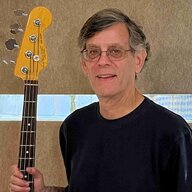
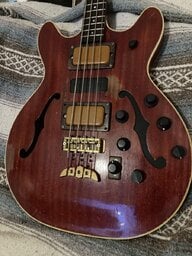
I've been learning these lessons over and over. When I started playing bass (mid 70s in jr. high- I'm 52 now), I played an EB2-D with a pick. In 1982, I decided to try my hand at Berklee and thought they'd laugh me out of there if I went there playing like that, so I got a Fender Jazz and got my fingers operating in a reasonable fashion (and I was getting into slap playing and my pick/slap hybrid seemed a little awkward-shoulda stuck with that as I found out later that Bobby Vega was all over it). So, I worked really hard and got together what I could. Then, in my final semester, I found out that one of the most influential players in the bass department had played an EB2 with a pick-Steve Swallow. For years, though, I blew off that part of my playing until 2007. Then I was back to it. Sometimes I wonder how life would have been had I kept with my original vision.
I also went through a similar deal with my rigs. I started with a Showman and a double JBL 15 cab. Over the years, I've been through all kinds of high tech, high powered crazy rigs but here I am again, playing through a Showman and a JBL double 15.
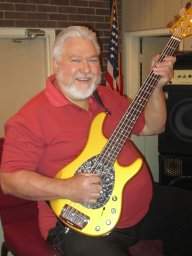
I spent year traveling the country playing original music with varying degrees of success. I never played in a cover band until 2009, when I found myself enjoying a weekend thing after I started law school at the age of 48. I guess I chose wisely in some ways because being in a Grateful Dead cover band means I'm pretty much encouraged to be as far out as I want, but my background in funk and jazz means that even the most far out stuff is more grounded than a lot who play that music. But now that school is over, it might be time to find another original gig. At the end of the day, my playing is pretty idiosyncratic. But I realized early on that there were a ton of bass players a lot better than me at everything except being me. I've never had much success in emulating other players (although I'm told my Phil Lesh is pretty close, but I think that's more of a result of seeing shows in the 70s and knowing the background material, from my time playing bluegrass, classical, jazz, etc., than aping the tapes.). It's been pretty gratifying to meet players younger than myself who tell me that I influenced them early on, especially when they've had a decent measure of success. And teaching is lot of fun. Really, music is great!
The only advice I'd give to younger players is to make sure they really want to do it if that's what they're going for. You have to give up a lot to follow that path, especially with original music. When you start hitting your thirties and you're still living like you did when you were 22 and your high school friends are having families, buying houses and driving new cars, it can be psychologically challenging. There's no shame in having it be a hobby; even original music can become a job and drain your energy like playing in a cover band.
All in all, my only real regret is not wearing ear plugs more often.
I also went through a similar deal with my rigs. I started with a Showman and a double JBL 15 cab. Over the years, I've been through all kinds of high tech, high powered crazy rigs but here I am again, playing through a Showman and a JBL double 15.
I spent year traveling the country playing original music with varying degrees of success. I never played in a cover band until 2009, when I found myself enjoying a weekend thing after I started law school at the age of 48. I guess I chose wisely in some ways because being in a Grateful Dead cover band means I'm pretty much encouraged to be as far out as I want, but my background in funk and jazz means that even the most far out stuff is more grounded than a lot who play that music. But now that school is over, it might be time to find another original gig. At the end of the day, my playing is pretty idiosyncratic. But I realized early on that there were a ton of bass players a lot better than me at everything except being me. I've never had much success in emulating other players (although I'm told my Phil Lesh is pretty close, but I think that's more of a result of seeing shows in the 70s and knowing the background material, from my time playing bluegrass, classical, jazz, etc., than aping the tapes.). It's been pretty gratifying to meet players younger than myself who tell me that I influenced them early on, especially when they've had a decent measure of success. And teaching is lot of fun. Really, music is great!
The only advice I'd give to younger players is to make sure they really want to do it if that's what they're going for. You have to give up a lot to follow that path, especially with original music. When you start hitting your thirties and you're still living like you did when you were 22 and your high school friends are having families, buying houses and driving new cars, it can be psychologically challenging. There's no shame in having it be a hobby; even original music can become a job and drain your energy like playing in a cover band.
All in all, my only real regret is not wearing ear plugs more often.


 Unfortunately, last year I had a computer crash and lost every song I had ever written. Thought I had a backup or two but couldn't find them.