• TalkBass has been independent since 1998. Add your voice.
    Create a free account to reply to discussions, view embedded media, and browse with fewer display ads.
    Join freeLog in
    Want zero display ads or expanded classifieds tools? Compare plans.

NAD/Project SVT Blueline

These projects can take time.

When I got my personal ‘71, I enjoyed spending months on the restoration.

Yeah, I am really looking forward to working on it and getting it working again. On my V4b, I went overboard and replaced everything on the boards. It came to me in pieces like this one. This time around, I am only going to replace caps and test every resistor to make sure it is in spec. Have some Deoxit G5 (im almost out) and fader/pot cleaner on the way.

Do you have 6146's in yours or did you go 6550's?
 
  • Like
Reactions: beans-on-toast
Yeah, I am really looking forward to working on it and getting it working again. On my V4b, I went overboard and replaced everything on the boards. It came to me in pieces like this one. This time around, I am only going to replace caps and test every resistor to make sure it is in spec. Have some Deoxit G5 (im almost out) and fader/pot cleaner on the way.

Do you have 6146's in yours or did you go 6550's?

Mine came standard with 6550’s. Black painted chassis.

The biggest job is often painstakeningly cleaning everything.

At one point Ampeg was reworking the 6146B models and converting them to 6550’s. I match the power tube plate and one ohm cathode resistors. Not required but simply my preference to make a level playing field for when setting the bias. If you replace them, offset them from the board by a mm, and turn the bottom (withthe glue) sideways. Do not use a larger wattage than what is specified. The plate resistors are intended to blow like fuses.
 
No updates yet. Ordered some new caps for the power supply so I can get them replaced to test the transformer and overall voltages. Well, after I go through the main board for repairs, wiring, testing, etc.. In the meantime I have been testing and calibrating a BK 700 tube tester I picked up. Ran through a quick calibration before replacing anything and it calibrated perfectly. But since it is new to me I am still going to replace the caps and found one resistor out of spec.

This is on topic, but sort of off topic... What are your guys thoughts on pricey caps like the paper in oil Jensens or similar? Worth it at all in the pre-amp or are they really a waste of $$? I have most caps to redo the amp in either a Mallory or Orange drop, but have always wondered about those. I went with a Sozo in my V4b, but only because it was a value that not many others stocked.
 
Last edited:
I’ve never used Jensen paper in oil caps in the signal path. Hi-fi folks like them. It wouldn’t hurt to use them but the cost is way up there. I stick with regular components in musical instrument amps. I suppose you have to consider how much of the amp’s character you want to change.

There are high end audio caps that Nichicon makes that I see in expensive studio equipment where noise floor is important. I don’t see that these sort of products are necessary in this application.

Mallory vs Sozo caps, I’ve used them both. Some claim that sonically Sozo has better low mids. I don’t know if I buy into that. A little EQ corrects for any differences.

It is important to check out the 40uF 450V electrolytic cap in the preamp. It’s often overlooked. I like the performance of F&T caps and use this one, the size is right:

Invalid Link Removed

I find that the brown PEC muti-leg tone modules are often out of spec. The circuit is made up of carbon composition resistors and ceramic capacitors. You can test the module. Replacing them can be like tonally lifting a veil, increasing clarity.
 
Last edited:
I’ve never used Jensen paper in oil caps in the signal path. Hi-fi folks like them. It wouldn’t hurt to use them but the cost is way up there. I stick with regular components in musical instrument amps. i suppose you have to consider how much of the amp’s character you want to change.

There are high end audio caps that Nichicon makes that I see in expensive studio equipment where noise floor is important. I don’t see that they are necessary in this application.

Mallory vs Sozo caps, I’ve used them both. Some claim that sonically Sozo has better low mids. I don’t know if I buy into that. A little EQ corrects for any differences.

It is important to check out the 40uF 450V electrolytic cap in the preamp. It’s often overlooked. I like the performance of F&T caps and use this one, the size is right:

Invalid Link Removed

I find that the brown PEC muti-leg tone modules are often out of spec. The circuit is made up of carbon composition resistors and ceramic capacitors. You can remove it and test the parts. Replacing them can be like tonally lifting a veil, increasing clarity.

I doubt I could ever tell a difference in tone, just was curious what others felt and I appreciate the input!

The 40uf/450v will definitely receive a replacement. For the electrolytic caps I usually use F&T or Sprague and this one was included in the caps I ordered. Think I ordered a Sprague for that one in a 40uf/500v. I usually lean toward F&T as the ones I have ordered in the past seem to be a smaller physical size and a lot cheaper. Havent ordered parts in a while so I am out of my routine of checking both brands as well as different places for pricing. Too bad Mouser, Newark or Digikey dont sell the F&T brand. Although, if I am not ordering in higher numbers I will usually go with AES, TubeDepot, etc...

The PEC module was in my sights as well. I replaced the one on my V4b with individual components and will most likely do the same on this head.

Have been on the search for a 8.2k 15w resistor (r49) in case I need to replace the current one or change the value. But they are not easy to find in 15w, so may go a different route when I cross that bridge.
 
No updates yet. Ordered some new caps for the power supply so I can get them replaced to test the transformer and overall voltages. Well, after I go through the main board for repairs, wiring, testing, etc.. In the meantime I have been testing and calibrating a BK 700 tube tester I picked up. Ran through a quick calibration before replacing anything and it calibrated perfectly. But since it is new to me I am still going to replace the caps and found one resistor out of spec.

This is on topic, but sort of off topic... What are your guys thoughts on pricey caps like the paper in oil Jensens or similar? Worth it at all in the pre-amp or are they really a waste of $$? I have most caps to redo the amp in either a Mallory or Orange drop, but have always wondered about those. I went with a Sozo in my V4b, but only because it was a value that not many others stocked.

Just my opinion. This is a rare old amp and I would tend to try and preserve it as close to original as possible. I would replace faulty components with components of similar construction and leave the rest alone. Completely rebuilding the amp with modern components will devalue the amp and likely change the way it sounds...not necessarily change for the better or worse, since that is a subjective matter.

I do know the following components have been replaced on my 69: power transformer, screen and plate resistors, all filter capacitors and associated bleeder/balance resistors, hum balance pot. Most of the other components are original and the amp sounds awesome!

It is your amp and I respect your right to do with it as you wish...here to help regardless :D.
 
There’s a PEC replacement board if you are interested. You can populate it with whatever components you desire.

Technical - Amplifier | TalkBass.com

Ah, I saw those for the V4's as well, but did a hand wire job. The only bad thing was using caps that were on hand and possibly too high of a V rating which raise a chanllenge for fitting them in a small space. May consider the board though.

Sourcing all the components from a sing supplier is next to impossible these days.

A 20W resistor can be used in this case if it fits.

Yeah I have been searching, but with what I have been reading I will test the original first. Also, I will take readings with the voltages to see where I am at in case I need a diff resistance. Just thinking ahead.

Just my opinion. This is a rare old amp and I would tend to try and preserve it as close to original as possible. I would replace faulty components with components of similar construction and leave the rest alone. Completely rebuilding the amp with modern components will devalue the amp and likely change the way it sounds...not necessarily change for the better or worse, since that is a subjective matter.

I do know the following components have been replaced on my 69: power transformer, screen and plate resistors, all filter capacitors and associated bleeder/balance resistors, hum balance pot. Most of the other components are original and the amp sounds awesome!

It is your amp and I respect your right to do with it as you wish...here to help regardless :D.

The PEC board is something that is easily removed and can be replaced without permanent mods to the board. I think with the V4, they were possibly hard to source (probably the same here, may even be the same PEC) and someone posted a layout of what the internal contained for values. Any Electrolytic will be changed as it is safe to do so and I dont have a capacitor checker. The resistors and some of the other caps will remain (unless they test bad or the circuit isnt working as it should). Trying to keep this as original as I can in regards to the state it is in, but give it a very through review.
 
FYI, the same PEC module was used in all the vintage Ampeg amps.

I’ve seen NOS ones available from fliptops but depending on their age, they might be out of spec.

I thought I remember reading that somewhere, but did not want to post mis-information, good to know. And agreed, pulling the PEC for the new style board or other component method would help bring everything back into spec. As would any resistor or cap on the boards that tests out of spec. Keeping everything original is great, but any tech would recommend replacing any item on a board out of spec.

My Mouser order came today which included a few small preamp items. CDE, Sprague/Vishay caps for some replacements on the SVT and the rest to finish my BK 700 tube tester calibration/re-work. Should have just ordered all the caps through Mouser, but went AES first. Mousers shipping is much faster and some prices are cheaper, but they dont have tube specific items like sockets. I think the AES package should be here Friday.
 
  • Like
Reactions: beans-on-toast
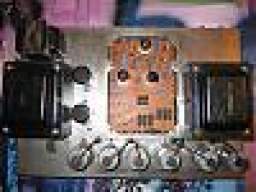
So I started digging into the preamp today. Have it out of the preamp enclosure and goign through the testing phases. In the V4 community it is recommended to swap out the yellow square caps as they can be problematic. Any other suggestions while it is out? Not like it is going back together soon. lol

Think I'll order the pec boards as the hand wire config on my V4b was kind-of a pain.
 
  • Like
Reactions: Wasnex
So I started digging into the preamp today. Have it out of the preamp enclosure and goign through the testing phases. In the V4 community it is recommended to swap out the yellow square caps as they can be problematic. Any other suggestions while it is out? Not like it is going back together soon. lol

Think I'll order the pec boards as the hand wire config on my V4b was kind-of a pain.
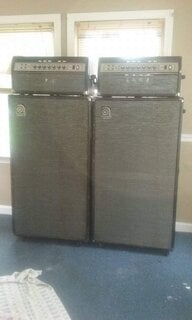
I would start with a good cleaning. Get the dirt and gunk off. Use a small amount of deoxit on the sliding switches and pots. Careful with the wires, the are prone to breaking if you move them. Check their solder joints. Check that there is no oxidation between the jacks and the chassis. This is the main ground point so it has to be clean and tight.

I don’t know about your caps. Usually they are fine.
 
Yours looks about the same year as mine. 1970.
Doesn’t have the time relay socket so definitely not early 69.
I do not think they had a cover over the power amp circuit board.


My 69 has an aluminum plate over the Power PC board and also the black plate on the rear of the chassis. Perhaps they were added after the fact.

Mine has the relay socket, but it is jumpered.