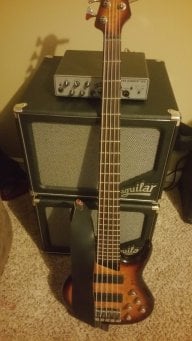
Looking a bit like something from Home Depot, the Quilter Bass Block 800 is quite the impressive new power tool for bassists in a market flooded with micro amp choices.
A while ago on TalkBass, a thread appeared regarding Quilter entertaining the idea of a small form factor power amp for bass players. From the good number of those who participated in the discussion, I found that I was not alone in wanting a micro-sized power amplifier. The popular requirements among posters included high output, low weight, reasonable cost, and no-nonsense functionality. I myself simply wanted a small amplifier with one knob for a volume control.
As time went on and news of an actual Quilter product was surfacing, I was disappointed to learn that the above concept had instead morphed into what appeared to be another micro amp. After finally test driving one however, I stand corrected and am now a believer and owner of one.
Leading the BB800's charge is a power section that refuses to bottom out, with a track record of quality and reliability that designer Pat Quilter is known for. The preamp section is built around dual-stage limiting circuitry coupled with a non-traditional, refreshing and musical EQ section. The results are spectacular and highly-enjoyable no matter one's bass guitar or connected speaker cabinet. The BB800 will happily accommodate. It is made in the USA, includes a padded carry bag, and sells for under $600 USD.
Despite all the above and this being TalkBass, I cannot help but want to nitpick

This product is such an unexpected home run that my hope in doing so is to somehow influence future Bass Blocks.
If you are satisfied with my brief review and recommendation, and wish to leave it at that, you would not offend me if you now stop reading. As incentive for those who continue, I will pepper my commentary with useful things to know about the BB800 if you are considering purchase.
Cheers!
... Continued
As jacks on the rear panel are connected via an inverted circuit board, directional jacks are upside-down. This is an annoyance for jacks that have a thumb release, like the SpeakON Out and XLR In, as those releases will not be anywhere near one's thumb. On a positive note, both SpeakON, XLRs, and 1/4" are quality Neutrik.
The two legacy 1/4" speaker Outs should be removed and at least one of them accommodated via a Neutrik combination SpeakON jack. There does not appear to be room enough for a second Neutrik SpeakON jack on the rear panel.
The rear XLR out does not feature a ground-lift switch nor a level pad switch. The XLR Out level is directly affected by the Master knob, regrettably a moving target, and output varies between MIC and LINE level.
The XLR In enters the signal path before the Master knob. Its signal is merged with the preamp's output so that it is possible to hear both a front panel signal and a rear panel signal at once.
IMHO, both XLR In and Out should have instead been 1/4" TRS jacks as a traditional effect loop. With the "Send" jack one could then easily employ their own external DI box, immune to Master knob levels, and likely featuring ground lift and pad switches there. With both XLR's removed, the rear panel now has room for a dedicated Tuner Out jack.
Appreciated, the cooling fan is quiet and runs at a gentle purr from power on, increasing modestly as per internal temperature. The amp gets a bit warm on top even with the cooling fan.
Like nearly every 1/8" TRS jack on electronic devices, the BB800's front panel headphone out feels of poor quality and not up to the standards in place on the rest of the BB800. In the interest of quality and longevity, a 1/4" TRS should have been used instead and located on the rear panel.
Appreciated, all front panel knobs have 20-step detents and a quality, professional feel.
Appreciated, 4 nicely-tall rubber feet allow for amp placement over speaker cabinet top handles.
Interestingly, the Mute switch is a momentary electronic switch and not the toggle switch I expected. A brief audio "pop" is heard is the signal chain when switching Mute On/Off. It is easy to accidentally Mute while adjusting Gain.
I would have greatly preferred one instrument input on the front panel with a toggle switch pad. With a single instrument Input and effect Send/Return suggestion from above, Quilter could place these 3 jacks dead-center front panel as is the case with the other Tone Block products.