

Enjoy the benefits of a premium membership!
Upgrade Account
-
TalkBass has been independent since 1998. Add your voice.
Create a free account to reply to discussions, view embedded media, and browse with fewer display ads.
Join free Log in
Want zero display ads or expanded classifieds tools? Compare plans.
You are using an out of date browser. It may not display this or other websites correctly.
You should upgrade or use an alternative browser.
You should upgrade or use an alternative browser.
NBD: Ibanez SR300
- Thread starter Jim85IROC
- Start date
More options
Who Replied?

These are great. I used a Mk VI head and a Scorpion 15 for years on stage before I started to DI in. Still have it now and it works fine, but weighs about the same as a small apartment building. For a fixed practice or rehearsal space rig, for the price you can pick one up, you won't do better.
I don't as basically the class of amp is irrelevant to tone in a bass rig; note this is coming from a EE who's designed and built hundreds of amps, and repaired, restored and modified literally thousands more over the last 30+ years.
Get whatever has the feature set you want/need, that you're happy to carry around, a brand with a reputation for reliability that's at a price you can afford.
I'm glad you agree about the tried and true Talkbass advice and general experience with old peaveys. My TNT 130 had that same scorpion 15 and lasted me through the last 25 years. I just sold it and it is surely going strong for the next owner.
As for our difference of experience and opinion about class AB solid state vs. other new lightweight amps, I know it's an old one here. But please think of it this way: I could listen to the opinion of a botanist about a violin -- and it would have relevance, but the opinion of the musician is likely to outweigh it.
When you say "[g]et whatever has the feature set you want/need, that you're happy to carry around, a brand with a reputation for reliability that's at a price you can afford" -- you say nothing about the tone or response characteristics of the amplifier. That's a bit of an unfair "gotcha" but that is what you wrote.
I would guess that you have made the same "I'm an EE and you're wrong about amps" argument elsewhere; and while that argument carries weight when discussing technical aspects of amp construction and function, it doesn't match my experience with tone and musicality.
My larger point about AB vs. D is that they do -- the good ones -- have a more organic response that creates a sort of biofeedback for the player. I think that this informs the development of technique. Especially for guitar players who are used to using the amp as an extension of the instrument with feedback and varying levels of distortion. As an experienced player, I can find something like my tone in amps with an SMPS or Class D amps, but I believe that's because I discovered nuance that I can put in to my music through my fingers over years of playing through, say, my old Peavey, my Eden, Mesa, or current GK happy place. Lightweight amps just don't respond quite the same way; and I am pretty certain that I could tell the difference between AB and D in a blind comparison, especially with my own bass in my hands and even more especially if I could demo them on a gig. The difference in power supplies might be less obvious, but I still think that there is a difference.
There is a similar difference for me when I go DI on a gig or in the studio. My band is in the Jam Band genre, and nuance and communication between bandmates is important. When I have my amp on stage at a club or brewery gig, my color palate is wider and I can say and communicate more with the band, and I think the audience too. Our PA is mainly for vocals and keys. At a bigger show, opening for national acts and going direct, I'm perfectly happy going DI and letting the pros do their job. But things react differently, similar to a class D amp. I can't play in that perfect zone, moving between clean and slightly harmonically distorted drive as the song and moment call for.
That all may or may not be relevant to the OP, but I'll leave it up to them. My advice is to get an amp that sounds and feels good.
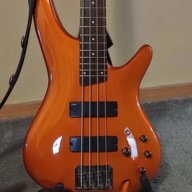
Thanks for the offer! If the one that I ordered on Ebay doesn't end up being correct, I'll let you know!I can send you a knob for free. Just let me know. I have extras for this model. I'll cover shipping as well.
Ha! I'm an EE also! I haven't played internally with too many amps, but I'm familiar enough with how they work. I'm more familiar with hifi amplification than with musical instrument amps, but it seems that unlike guitar amps, a lot of bass amps seem to be closer in function to a hifi amp in that a lot of them seem to strive for a neutral, less colored tone instead of purposely altering it like guitar amps.I don't as basically the class of amp is irrelevant to tone in a bass rig; note this is coming from a EE who's designed and built hundreds of amps, and repaired, restored and modified literally thousands more over the last 30+ years.
Get whatever has the feature set you want/need, that you're happy to carry around, a brand with a reputation for reliability that's at a price you can afford.
I actually became an EE because as a kid I was an audiophile and was heavily interested in the gear. I was a huge car audio nut all through high school and college, and after college I got into designing and building loudspeakers until I started a family. Even now with guitars (and now bass), I seem to be more into the gear than actually using it.


See what sort of community this is? We're crazy! A good type of craziness, indeed!I can send you a knob for free. Just let me know. I have extras for this model. I'll cover shipping as well.


Wow. Were you deliberately trying to be insulting? No need to answer as it's rhetorical, and all it did was show your ignorance. As well as having the technical experience and knowledge of amplifiers, it's not as if I haven't been playing for 40 years. After repairing every amp, I played through it to test it, especially with amps I had less experience with, so as well as knowing how they actually work (very different from a musician onlys belief about them; which is almost always wrong) I have far more actual experience of a wider variety amps than you most likely do. I also designed and built the PA our band used for 2 decades and have done FOH and supplied PA for many others over the years. So yeah, no experience of amps as a musician.As for our difference of experience and opinion about class AB solid state vs. other new lightweight amps, I know it's an old one here. But please think of it this way: I could listen to the opinion of a botanist about a violin -- and it would have relevance, but the opinion of the musician is likely to outweigh it.
Cool, there seem to be only a few of us here. As for tonal characteristics you're correct, bass power amplifiers tend to be far more straight wire with gain than guitar amps with most of the tonal changes determined by the pre. As well as the Peavey rig, I used a Yamaha P series pro amp and a PB1 pre. The new PX5 I have is featherweight compared to it.Ha! I'm an EE also! I haven't played internally with too many amps, but I'm familiar enough with how they work. I'm more familiar with hifi amplification than with musical instrument amps, but it seems that unlike guitar amps, a lot of bass amps seem to be closer in function to a hifi amp in that a lot of them seem to strive for a neutral, less colored tone instead of purposely altering it like guitar amps.
I did the same, as well as designing amps for hifi up until a few years ago when I sold my latest design and decided I was close enough to the asymptote that it was enough. I designed my first speakers in 85 or so and continue to do so. All of what I use, except for some LSR205s in my study, I designed and built, all active, including the DSP controller used in the mains.and after college I got into designing and building loudspeakers
Wow. Were you deliberately trying to be insulting? No need to answer as it's rhetorical, and all it did was show your ignorance. As well as having the technical experience and knowledge of amplifiers, it's not as if I haven't been playing for 40 years. After repairing every amp, I played through it to test it, especially with amps I had less experience with, so as well as knowing how they actually work (very different from a musician onlys belief about them; which is almost always wrong) I have far more actual experience of a wider variety amps than you most likely do. I also designed and built the PA our band used for 2 decades and have done FOH and supplied PA for many others over the years. So yeah, no experience of amps as a musician.
I think I responded pretty evenly and objectively to your "I'm an EE" thing which sounded to me like condescension, and gave your points due respect. You've now called me ignorant and claimed that I was insulting you. If you can point out where I insulted you with my point about science vs. art, and why that leads me to disagree -- let me know and I'll apologize.
I just pointed out why I have a differing experience and opinion. Again, you can be the most experienced botanist in the world and tell me all about spruce, but I'm going to place discussion of musicality and the response of a violin above technical discussion that -- here, at least -- seems designed more to shut down discussion and "win" an argument than it does seem aimed at informing and discussing.
Last edited:
I didn't complete my own engineering degree in undergraduate school and pursued other things, but just as you are a musician, I'm similarly well able to consider the basics at least of amplifier design, and in my experience, Class D amps overdrive quite differently than class AB amps, and in both my experience and my understanding of the physics, desirable lower order distortion (2nd and 3rd) is part of an amplifier's sound. I like how good AB amps respond in that way. My understanding is that Class D amps respond differently when driven, but that is based more in experience than in anything technical. I'll look it up and see if the literature on the design matches what I hear.You've now called me ignorant and claimed that I was insulting you.
The low pass filters on Class D amps may be what I'm hearing, but I haven't read up on it much. I just know what I like. There are preamp circuits in Class D amps to emulate this, but for me, it's not the same. I have to imagine that for many the same is true.
My 5.1 channel system has a cheap $50 Class D mini amplifier driving my old Carvin 18". It's great for movies. I wouldn't run my pedal board through it, because I'm looking to produce a wide spectrum of frequencies, as well as a small amount of musical, euphonic distortion and intermodulation, not just "bass frequencies."
I'm not upset that you see and hear it differently -- variety is spicy and I like things hot.
Invalid Link RemovedAn analysis of THD in Class D Amplifiers said:The sound quality of an audio amplifier is largely determined
by its performance in term of distortion (e.g. THD) and noise
(e.g. PSRR). One of the pr oblems with open-loop Class D
amplifier is the susceptibility of the PWM or output stage to
non-linearity and noise [2-4]. The non-linearity and noise
will as a result lead to poor THD and PSRR performance in
an open-loop Class D amplifier. In a linear amplifier, these
problems can be easily mitigated by feeding the non-
linearities at the Class D output back to the input. However,
the application of negative feedback in Class D amplifier is
not straight forward due to the high switching frequency
carrier and time delay in the feedback loop. To improve the
stability and dynamic range of the input signal, a low pass
filter is generally employed to provide sufficient attenuation
to the amplitude of the high frequency carrier in the feedback
loop. As a result of low pass filtering, the THD of the
closed-loop Class D amplifier usually suffer from poorer
THD performance at higher frequency (e.g. 3kHz).
The article discusses some methods of improving the failings of Class D amplifiers. Quoted is the third paragraph of the introduction summarizes what I'm talking about.
Foong, Huey & Tan, Meng. (2007). An analysis of THD in Class D amplifiers. 724 - 727. 10.1109/APCCAS.2006.342110.
The replacement knob came today. It's not an exact copy of the other knob, but it's damned close. The knurling is slightly different, but is actually a match for the knurling on the smaller knobs. The set screw is slotted instead of allen, and the dome top is a slightly different shape, but it's more than close enough that nobody will ever notice.
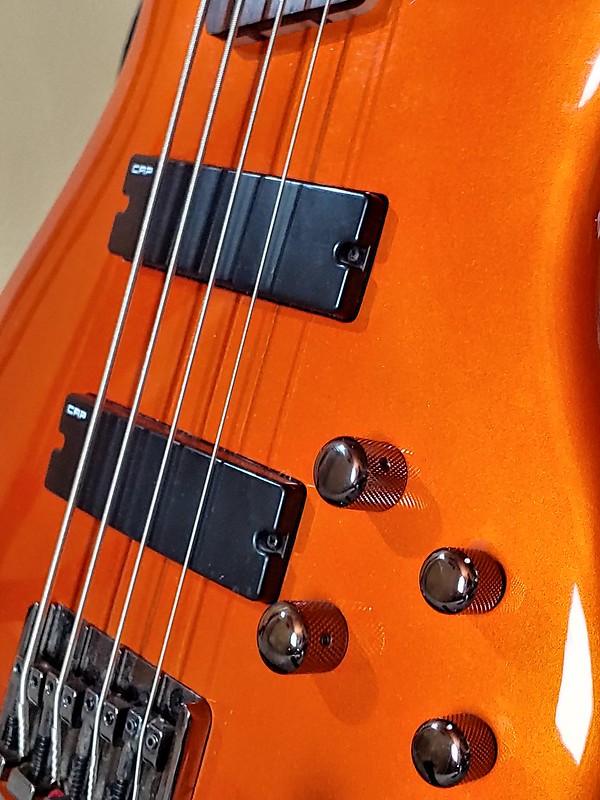
Hate to point out that it's 2020 and class D designs have moved on at an extraordinary rate since then.Foong, Huey & Tan, Meng. (2007).
You should have also read the conclusion paragraph. Then maybe see what Bruno Putzeys (giving just one example) has done with class D. Hell, even a cheap Tripath is much better than the examples given in that paper, which was largely theoretical, and did not specify any actual commercial examples. Just because it was done by a couple of Profs doesn't mean they have the slightest clue of what was actually going on in the commercial world at that time.
I had intended to leave this conversation where it was yesterday, until your last post. However I am now and will put you on my ignore list.


