• TalkBass has been independent since 1998. Add your voice.
    Create a free account to reply to discussions, view embedded media, and browse with fewer display ads.
    Join freeLog in
    Want zero display ads or expanded classifieds tools? Compare plans.

Double Bass Neck removal, American Standard

My luthier's resetting the neck on my 1960 American Standard. He's got the button free of the neck and has alcohol-saturated the neck joint from every angle. There's side-to-side motion, but the neck joint doesn't want to give. There are no signs of added hardware or dowels. Peering up at the neck block from inside the bass, we see a couple of large (1" diameter or so) round marks that could conceivably be dowels or screw covers, but the grain in these marks matches the block exactly, so I'm guessing these are clamp marks from assembly.

Is there something we're missing? Any advice appreciated.

 
My luthier's resetting the neck on my 1960 American Standard. He's got the button free of the neck and has alcohol-saturated the neck joint from every angle. There's side-to-side motion, but the neck joint doesn't want to give. There are no signs of added hardware or dowels. Peering up at the neck block from inside the bass, we see a couple of large (1" diameter or so) round marks that could conceivably be dowels or screw covers, but the grain in these marks matches the block exactly, so I'm guessing these are clamp marks from assembly.

Is there something we're missing? Any advice appreciated.

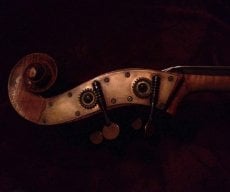
Those basses, like Kays and Martin guitars, have a French dovetail, so the heel will only come out straight up.
Invalid Link Removed
Photo courtesy of Upton Bass

I use a shop-built fixture and a large Bessey deep-throat clamp to press the heel up and out after steaming the joint loose.

Good luck!
 
I removed the necks on two American Standard basses yesterday.One came off in about 10 minutes with a bit of steam and the other was an absolute mess with five (5!!!!!) dowels plus drywall screws, and three different types of glue. Sometimes it takes an hour or two to work everything loose. It is very easy to break the neck block when one side lets loose, but a tiny little bit of the other side is still attached and folks try to force things. On both of the two I removed, one side of the ribs let loose from the neck block before the neck let completely loose from the block. It's funny how folks around here complain about Kay neck joints constantly, but I never hear much about these American Standards, yet they are very similar- both dovetails and less mass that I'd consider to be ideal, and both very commonly broke.

I really should start a separate thread, but what was it in the production process that left about 75% of these American Standard basses with a bubbing, blistering, shredding apart cancer in the ribs? One of the ones that I did yesterday also had that funky almost oliver green look to the finish, but under the tuning machine plates you could see that originally it was a beautiful shade of red. The olive color is not uncommon. It makes me think that one of the finish layers, possibly the sealer coat or such had a reaction- like with the late 50s Les Paul bursts that went to an even lemondrop color. The remaining olive greenish tint also clearly showed that they used a heavy black to tone down the original red color instead of a blue that fades much different.

Interesting stuff. Either way, once you get your hands on a nice old American Standard bass, if you can work with the 43 1/2" scale, you'll never be happy with your other brand old plywood basses again! I uploaded the list of American Standard serial numbers from Superman's expired website to mine and hope to add a bunch more information as the winter progresses. I would have added more, but I took in a 1935 Gibson L7 on trade for some repairs on another old archtop last week and can't keep my hands off it!

j.
www.kaybassrepair.com
www.condino.com
 
Last edited:
My one cent, because it's not worth two:

A few years ago, I did a neck reset on a badly abused '39 King which had the same French dovetail neck heel design as your bass. It had been poorly reset at some point with half a gallon of carpenter's glue and a big fat bolt through the heel into the block, which of course failed, and the neck set was so loose it rocked back and forth.

Of course, that didn't mean that the neck wanted to come out of the block after I removed the ironwork. Oh, no. I had no option but to put a piece of maple on the top over the neck block as a cushion and a pivot and use the handle of a pipe wrench as a prybar to work that sucker out while I prayed that I didn't snap the nice original ebony fingerboard. It took me two or three days to get the neck out a millimeter at a time.

When I got it out, I was surprised to see that in addition to all the dried-out old glop in there, the neck heel tenon was incredibly sloppy and uneven. One side was cut much further in toward the centerline than the other. If you go waaaay back in my post history, you'll find my thread with photos.

I too thought the impressions on the neck block were dowels, but when I got the bass apart it became clear that they were probably clamp marks.
 
My one cent, because it's not worth two:

A few years ago, I did a neck reset on a badly abused '39 King which had the same French dovetail neck heel design as your bass. It had been poorly reset at some point with half a gallon of carpenter's glue and a big fat bolt through the heel into the block, which of course failed, and the neck set was so loose it rocked back and forth.

Of course, that didn't mean that the neck wanted to come out of the block after I removed the ironwork. Oh, no. I had no option but to put a piece of maple on the top over the neck block as a cushion and a pivot and use the handle of a pipe wrench as a prybar to work that sucker out while I prayed that I didn't snap the nice original ebony fingerboard. It took me two or three days to get the neck out a millimeter at a time.

When I got it out, I was surprised to see that in addition to all the dried-out old glop in there, the neck heel tenon was incredibly sloppy and uneven. One side was cut much further in toward the centerline than the other. If you go waaaay back in my post history, you'll find my thread with photos.

I too thought the impressions on the neck block were dowels, but when I got the bass apart it became clear that they were probably clamp marks.


I just pulled the neck and top off another American Standard last night and the inside of the neckblock has the same compression circles. 'Looks like it was part of the production process.

j.
www.kaybassrepair.com
www.condino.com
 
I just picked up a 58 King that is in pretty good condition, except for the neck has some wiggle to it. There are no breaks and from what I can tell, it doesn't look to have been repaired, so my guess is that the old glue has just finally given way. I've had necks out of several Kays, but never on a King. Am I safe to assume that the Kings used the same dovetail design as shown in the picture of the American Standard above?
 
It was the same shop building the Kings and American Standards, so the neck joints are basically the same. The neck wiggle can be from a loose dovetail joint, but it can also be from a broken neck block or, all too often a combination of both.

I just picked up another clean early American Standard top and back this week ( Patent applied for on the label!!!!), missing the whole rib garland from another case of rib rot. I'll likely hold on to it for a few years until somebody comes by with a sad look on their face and a long complicated story about the trauma to their bass.... but on the odd chance that anyone has an American Standard rib garland or even a partial sitting around their place, drop me a line.

j.
www.condino.com
www.kaybassrepair.com