• TalkBass has been independent since 1998. Add your voice.
    Create a free account to reply to discussions, view embedded media, and browse with fewer display ads.
    Join freeLog in
    Want zero display ads or expanded classifieds tools? Compare plans.

Double Bass Neck replacement

Hi All,
This is my first post here, great forum! My thanks to all who contribute.
I repair and make mostly violins in my one person shop in central Virginia.

I bought a bass, or most of one, for myself and I'm repairing the cracks in the top and am starting to think about the new neck it will need.
It is a 1930 Juzek, 7/8th I think.

Here are some specs;
top- 46-5/8" l.
upper bout w. 20-3/4"
c bout 14-3/4"
lower w. 27-1/8"
rib ht. at neck 7"
rib ht. at endblock 8-3/8"

I would like to set the neck as originally intended, if that is optimal, but I have no good reference for a 7/8, I see mostly 3/4 in my shop. I have a

What would be-
the string length I need? (nut-bridge)
neck projection to bridge
overstand
nut to upper end of top plate
round fingerboard or beveled?
fingerboard length, width and thickness

I have some books for reference, Chandler, Traeger, Karl Roy, Strobel but there is so much variablity with basses I have no clear plan.

I am open to the idea of buying a pre-carved neck too.

FWIW the bass needs a new bassbar ( the old one, not original, sits on a crack) and will need to have cleats running under it I'm pretty sure (not the inlaid into the top kind of cleat).
It would be swell too if someone said 'hey that thing is really worth all that effort' but I suppose beauty is in the eye of the restorer.

Any constructive thoughts are greatly appreciated.
 
It would be swell too if someone said 'hey that thing is really worth all that effort' but I suppose beauty is in the eye of the restorer.

Any constructive thoughts are greatly appreciated.

Well, for anyone to say "hey that thing is really worth the effort" it would really be worth the effort to post some pictures, I think!
 
What is the length of the body stop (neck end to f-hole notches)? Many of the 7/8 Juzeks were built horribly long in the upper bout, with string lengths of 43-44". You will want to reduce the string length to 42" if you ever want to resell the bass with relative ease. You might be able to shorten up the neck length and scoot the bridge a bit to end up there. The original neck set is not optimal for modern playing.
 
Matthew, sorry but I'm not able to post pictures at this time. If it helps I can describe it better.
It is gamba shaped, original dark brown varnish with lots of wear, has no neck, and a number of rib cracks and top cracks. Carved back w/ no cracks.
The top is off and has been repaired before, some good and some not so good. Not sunken too bad where the bassbar cracks are since they are pretty fresh.
Are you familiar with 7/8 Juzek or similar origin basses? Perhaps you could shoot me some measurements?

Don
 
I measured between the nicks at the centerline to the cut out at the neck mortice, 24-1/8". For some reason someone cut off the edges of the top that extend past the neck root.
Estimating the distance to the edge of the top to the nicks is 25-3/8".

Thanks for the help Arnoldschnitzer. Since I got it with no neck I can make the neck as I wish. I would certainly want it to be sale-able in the future, but it is going to be for my use, or the 'house bass' so to speak.
I have a 3/4 fingerboard I bought 10 years ago, maybe it is workable?

I would be interested to know more about what an optimal neck set would be.
 
The optimal neck set is what makes that bass comfortable to play. No rules as in violin making!

So, next you're going to need to decide whether you want a "D" neck or an "Eb" neck. This determines the length of actual neck between scroll chin and neck heel for a given string length. I agree 42" string length is what you want to go for. the rest of the measurements are determined by the shape of the bass and playability issues. You want to aim for about a 6.5" bridge height. Depending on the shape of the upper bout, you'll need about 30mm overstand, maybe more, maybe less. careful about bow clearance. your 3/4 fingerboard will probably be fine. rounded fingerboards are now most common but bevelled is fine too. about 43-44mm width at the nut. about 65mm at the end of the neck. no rulez. thems all the measurements you'll need. gee i'm writing like forester ...
 
Thanks for the help guys.
I'm wondering what are the other factors to consider between having a D or Eb neck?
Seems like the Eb would go with the idea of a shorter stringlength, is this correct? (the nut-heel length is shorter, thus bringing the nut closer to the bridge) I think I suffer some kind of math dislexia, I'm not sure if this is right, without drawing it out on paper.
 
I think I have a plan, decide the string length and then just decide how high of a heel seems right, make sense? Then whichever is more appropriate (D or Eb) make the heel to that size, maybe even after it is strung up. Comments?
Don
 
Without seeing the bass, I would probably approach it this way: go for a D neck. Then you can always trim more heel away to get an Eb neck, if you build it right.

Choose your bridge position. Choose your string length. 1/3 from the nut will be your D stop. Now look at how much "meat" you can have between the block and the D stop, hopefully it's quite a bit. That will set your heel height. Build your neck with enough added meat (or tofu if your that way inclined) to give you plenty of adjusting room in the mortise.

sometimes it helps to mock up a dummy neck out of a few 2x1 just to see and measure things.

You might find the body length dictates something inconvenient, like a really shallow neck heel, since you may be shortening the original string length. That becomes a test of your creativity and genius ...
 
I did a quick mock up of a 42" string length and it looks like with a D neck it will be a shallow neck root.
I have some months before I start on a neck so I can give it some thought.
Any ideas on how shallow can a neck root be? I suppose it can go into the mortice further provided the block has enough meat to hold up.
I'll look at some of Chandler's plans and see what the neck/block arrangement looks like.
 
Consider moving the bridge position North until the back of the bridge lines up with the inside notches. Otherwise you will put the notes way down on the body, making thumb position and the transition area difficult. This will also allow you to make the neck heel a bit meatier.
 
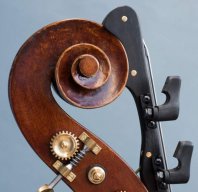
You can always make up your own from a suitable bit of maple or beech, or blackwood, in this case:

3092771768_4e8d0dd280.jpg


3092776976_29269cc6f0.jpg
 
Theirs have even less -- the "ears" are added on (as in glued), not part of the scroll. Pretty grim-looking stuff when you buy a replacement neck. I bought one for a Kay for which a fellow needed a new neck. There was a lot of work necessary to make it usable.

Matthew's scroll is a gem, compared to the Englehardt stuff, for sure.