• TalkBass has been independent since 1998. Add your voice.
    Create a free account to reply to discussions, view embedded media, and browse with fewer display ads.
    Join freeLog in
    Want zero display ads or expanded classifieds tools? Compare plans.

Neck-Thru Bass Design Topic

Sorry if this has been discussed already but…

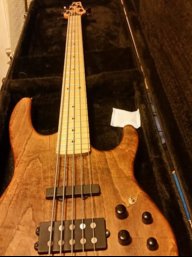
I’m eyeing my first neck-thru, a Carvin LB75, and my concern is,
it’s a sight-unseen no return deal.
It made need some work and I can handle the electronics issue if any.

If a bolt-on is twisted, simply replace the neck, which is why I’m a big Fenderish fan.
Parts are plentiful and often a bargain.

So what problems or concerns would you have about buying a neck-thru sight unseen?

Also, if you want to share your opinions (pros and cons), (positive or negative),
about neck-thru’s please share.

057912
 
So what problems or concerns would you have about buying a neck-thru sight unseen?
Good brand and decent seller, none. Done it maybe 50 times, often from overseas and never had an issue.

Your comment about replacing the neck only applies readily to FSO that adhere to F dimensions, and many brands do not.

As a general rule, even though some of my best basses are BOs I have a strong preference for NT, because the very best basses I've owned have been. NTs also tend to be multilaminate, which if done correctly should make it less prone to warping and moving.
 
Last edited:
This use to be a common, recurring topic on TB around 10-15 years ago. If memory serves correctly, none of us could come up with any evidence to support one construction type being better than the other in terms of resistance to warpage and twisting.

I currently own two BO basses (P-bass and Jazz Bass) and two NT basses (Ric and Thunderbird). None of them have had any neck issues, so I can't really lend any quantifiable comparison info.
 
  • Like
Reactions: ejaggers
Good brand and decent seller, none. Done it maybe 50 times, often from overseas and never had an issue.

Your comment about replacing the neck only applies readily to FSO that adhere to F dimensions, and many brands do not.

As a general rule, even though some of my best basses are BOs I have a strong preference for NT, because the very best basses I've owned have been. NTs also tend to be multilaminate, which if done correctly should make it less prone to warping and moving.

Yeah, I realize ALL necks don’t fit but the ones I have would be easy to replace if need be.
I have a sub-short that I was told the neck was bad,
good thing it isn’t because it would be a bear to find one that fits.

From the pics I’ve seen, there is probably no need for concern about the neck-thur Carvin,
I’m just doing my homework beforehand….Thanks


This use to be a common, recurring topic on TB around 10-15 years ago. If memory serves correctly, none of us could come up with any evidence to support one construction type being better than the other in terms of resistance to warpage and twisting.

I currently own two BO basses (P-bass and Jazz Bass) and two NT basses (Ric and Thunderbird). None of them have had any neck issues, so I can't really lend any quantifiable comparison info.

This post is not about which is better, but about what type of problems,
you may have encountered with neck-thru.

I'm trying to educate myself before I make a purchase I can't return.
Your success stories are important information as well....thanks

057912
 
Most of my basses over the years were neck through axes, primarily 80's BB Yamahas and Alembics.

I far prefer them to a set or screw-on neck, for these reasons:

They're all typically laminated necks. This tends to be stronger than a typical two-piece or occasionaly one piece neck. I've never seen a twist in the ones I owned (and Alembic, like Rickenbacker, uses two truss rods to where supposedly you could 'offset' the tension in the two to remove a twist), and typically once over their new days where the wood may still think it's a tree, they rarely required must adjustment in the ones I owned. All of mine also had ebony fingerboards (a VERY stiff/strong wood) which tended to act as extra reinforcement besides the neck plies themselves. And in my experience, the stiffer and harder a neck is, the better 'isolation' or definition of the notes played, and this can be very helpful of 5's or 6's in terms of making nice, tight low C's, D's, etc.

They typically tend to be 24-fret instruments, so you have deep cutaways (and a smooth neck to body intersection since there's no joint where the two were mated together) making reaching up to the octave and above far easier if you want to play 'up there'. The down side to this is it cuts into the available 'real estate' on the body, so often on these types of basses with two pickups, they can seem closer together than other designs, but you just don't have as much room to space them out further. I really miss not having that smooth heel at the back of the neck, I HATE that neck block on Fender-style instruments.

And something I saw in varying degrees in mine, if you have good ears, that you tend to hear the fundamentals a bit better in a neck through. This can be very dependent on the particular wood in a given bass, and it's a subtle addition to the tone, but it can be there. Separate neck/body instruments tend to interrupt that but can induce that 100-200hz push that is so noticeable in good Fenders or Fender clones. But the low grind of the 1st and 2nd harmonics I heard with one of the Alembics very noticeably was unique playing in the lowest notes.

It's a crapshoot indeed if you had serious problems with a neck through, I just never saw any, and would think that only in case of the most dire problems, none would be beyond the capabilities of a 1st class repairman. I've heard of the occasional 'heat bend' from time to time, but that's pretty rare.

I prefer them, and if anything to me, they take less maintenance than more traditional designs. Like any instrument, their long term performance is dictated by how well they were designed and built, and if buying used, maintained by the previous owner(s).
 
Last edited:
Most of my basses over the years were neck through axes, primarily 80's BB Yamahas and Alembics.

I far prefer them to a set or screw-on neck, for these reasons:

They're all typically laminated necks. This tends to be stronger than a typical two-piece or occasionaly one piece neck. I've never seen a twist in the ones I owned (and Alembic, like Rickenbacker, uses two truss rods to where supposedly you could 'offset' the tension in the two to remove a twist), and typically once over their new days where the wood may still think it's a tree, they rarely required must adjustment in the ones I owned. All of mine also had ebony fingerboards (a VERY stiff/strong wood) which tended to act as extra reinforcement besides the neck plies themselves. And in my experience, the stiffer and harder a neck is, the better 'isolation' or definition of the notes played, and this can be very helpful of 5's or 6's in terms of making nice, tight low C's, D's, etc.

They typically tend to be 24-fret instruments, so you have deep cutaways (and a smooth neck to body intersection since there's no joint where the two were mated together) making reaching up to the octave and above far easier if you want to play 'up there'. The down side to this is it cuts into the available 'real estate' on the body, so often on these types of basses with two pickups, they can seem closer together than other designs, but you just don't have as much room to space them out further. I really miss not having that smooth heel at the back of the neck, I HATE that neck block on Fender-style instruments.

And something I saw in varying degrees in mine, if you have good ears, that you tend to hear the fundamentals a bit better in a neck through. This can be very dependent on the particular wood in a given bass, and it's a subtle addition to the tone, but it can be there. Separate neck/body instruments tend to interrupt that but can induce that 100-200hz push that is so noticeable in good Fenders or Fender clones. But the low grind of the 1st and 2nd harmonics I heard with one of the Alembics very noticeably was unique playing in the lowest notes.

It's a crapshoot indeed if you had serious problems with a neck through, I just never saw any, and would think that only in case of the most dire problems, none would be beyond the capabilities of a 1st class repairman. I've heard of the occasional 'heat bend' from time to time, but that's pretty rare.

I prefer them, and if anything to me, they take less maintenance than more traditional designs. Like any instrument, their long term performance is dictated by how well they were designed and built, and if buying used, maintained by the previous owner(s).


Lots of good info in your post.
Thanks for taking the time to be so thorough.

If I've played a neck-thur it's been a while,
but I don't remember ever doing so.

I'm feeling much better about buying this bass sight unseen.....057912
 
Personally, I never, as I pointed out in your previous post, would ever buy anything with no recourse. Carvins tend to be pretty decently built axes, so Good Luck ! But I got to admit, I'm a hopeless admirer of Koa, if I'm guessing correctly from the pics.
 
Last edited:
  • Like
Reactions: ejaggers
BTW, what the hell is 057912 ? ? ?

My numeric signature or fingerprint, which is also my signoff light saying "over and out".
Or maybe my anal-retentiveness like Sheldon knocking on the door 3 times.
It also works like a charm when I'm searching for my stuff....057912 (over)!!!

Personally, I never, as I pointed out in your previous post, would ever buy anything with no recourse...

I don't have a choice in this case if I want it. Ordinary, I wouldn't either.
 
Last edited:
Making any purchase with the idea that "It might be so badly flawed that I'd need to buy and replace half of the thing I purchased" sounds totally insane. Buying a bolt-on bass and having to replace the neck because it's wrecked doesn't make it a good or safe buy!

If it's a cheap bass then you're probably better off replacing the whole thing than trying to swap necks. That's the risk with something cheap. If it's not cheap, you should be buying from a source with a reputation or warranty to prevent the kind of absolute-nightmare situation you are imagining, which, to be clear, would be purchasing a wholly unusable and damaged instrument.

The cost of buying from a reputable seller is less than the cost of replacing a neck. Don't buy sight-unseen from pawnshops unless you can afford to take the loss if you roll the dice and lose your bet.
 
Making any purchase with the idea that "It might be so badly flawed that I'd need to buy and replace half of the thing I purchased" sounds totally insane. Buying a bolt-on bass and having to replace the neck because it's wrecked doesn't make it a good or safe buy!

If it's a cheap bass then you're probably better off replacing the whole thing than trying to swap necks. That's the risk with something cheap. If it's not cheap, you should be buying from a source with a reputation or warranty to prevent the kind of absolute-nightmare situation you are imagining, which, to be clear, would be purchasing a wholly unusable and damaged instrument.

The cost of buying from a reputable seller is less than the cost of replacing a neck. Don't buy sight-unseen from pawnshops unless you can afford to take the loss if you roll the dice and lose your bet.

I agree with you 1,000,000%, in fact, I've only bought one sight unseen bass in my life, my SS Jag.
I'm a serial modder but had no intention of putting extra dollars or extra time in it.

Since it was new and the price was right I rolled the dice but it needed some fretwork.
It's one of my favorite basses so the dice came up 7 on the first roll.

However, this case is different, I either want it or I pass.
Those are my only options and that's why I'm here on TB doing my homework....057912
 
  • Like
Reactions: JonathanPDX
However, this case is different, I either want it or I pass.

In my experience, totally wrecked necks are quite rare. Even if the neck is damaged I believe there are pretty extreme ways experienced luthiers can try to salvage them, though it's rarely worth the cost. It would take a rare set of circumstances for the instrument to be rendered unplayable, unsalvageable, and for there to be no signs of it in the listing. A reputable seller also likely wouldn't tank their reputation on an obviously-trash instrument.

If I were in your shoes I'd look at it this way:
Can I afford to take a total loss on this purchase?
Do the benefits of it being great outweigh the risks of it needing work beyond what I expect to put into it?

There are a zillion basses out there. This isn't the only one you'll dig, so if you're on the fence, wait until the perfect opportunity comes along. On the other hand, if it's a cost you can afford to eat, then maybe it would be fun to take the risk and gamble on it being exactly what you want.
 
I would have qualms about buying any instrument I could not return, but the big thing giving me pause here is that frankly most old Carvin instruments sound like garbage; dead and dull. Some don’t. But most do.

The change in management to Kiesel has helped a bit, but they’re still pumping out plenty of dogs. Last tour I took through the showroom ran about 50/50 decent/crap ratio.

I personally would never buy a Carvin, or a Kiesel, that I could not return.
 
  • Like
Reactions: ejaggers
In my experience, totally wrecked necks are quite rare. Even if the neck is damaged I believe there are pretty extreme ways experienced luthiers can try to salvage them, though it's rarely worth the cost. It would take a rare set of circumstances for the instrument to be rendered unplayable, unsalvageable, and for there to be no signs of it in the listing. A reputable seller also likely wouldn't tank their reputation on an obviously-trash instrument.

If I were in your shoes I'd look at it this way:
Can I afford to take a total loss on this purchase?
Do the benefits of it being great outweigh the risks of it needing work beyond what I expect to put into it?


There are a zillion basses out there. This isn't the only one you'll dig, so if you're on the fence, wait until the perfect opportunity comes along. On the other hand, if it's a cost you can afford to eat, then maybe it would be fun to take the risk and gamble on it being exactly what you want.

This is good advice, thanks for your time, but the thing is, it's not a dealer it's a one-time shot.
If it turns out not to be worth it, it's a waste, on the other hand, it should be cheap compared to what Carvins are going for on reverb.
I don't know that it's trash but you pay to play in this case, it could be a gem for all I know.

So, can I afford to take a total loss on this purchase?
Yes I can but it would definitely mess up my day, on the other hand, if it works it would really make my day.

I need to decide tomorrow because I'm leaving town, and if I haven't done it by then it's a wash.

I would have qualms about buying any instrument I could not return, but the big thing giving me pause here is that frankly most old Carvin instruments sound like garbage; dead and dull. Some don’t. But most do.

The change in management to Kiesel has helped a bit, but they’re still pumping out plenty of dogs. Last tour I took through the showroom ran about 50/50 decent/crap ratio.

I personally would never buy a Carvin, or a Kiesel, that I could not return.

Hmmm,
I was under the impression Carvin was like USA Peavey's, and that they were excellent instruments.
I've never played one, I'm only going on what I've read here on TB, but this is something for me to consider.
What's your biggest gripe with them?
 
Hey OP,
I own a Kiesel (formerly Carvin) bass and I'm very happy with it. The construction is top notch and my local luthier (whom I trust) also gave it a 95/100 for construction and fit and finish, which is fantastic.
Obviously, there's risk in every purchase. If you're willing to risk the money then I would say go for it. The LBs are known for being top quality basses and I wish I could get my hands on one. My only quarrel is with their in house pickups, which can easily be changed out so no worries there.
If you do end up buying it then send us a couple of NBD pictures!
 
Hey OP,
I own a Kiesel (formerly Carvin) bass and I'm very happy with it. The construction is top notch and my local luthier (whom I trust) also gave it a 95/100 for construction and fit and finish, which is fantastic.
Obviously, there's risk in every purchase. If you're willing to risk the money then I would say go for it. The LBs are known for being top quality basses and I wish I could get my hands on one. My only quarrel is with their in house pickups, which can easily be changed out so no worries there.
If you do end up buying it then send us a couple of NBD pictures!

Thanks @Bassinga,
What are the PUP's lacking?
What about the preamp?
And you know there'll be an NBD post.....057912
 
Thanks @Bassinga,
What are the PUP's lacking?
What about the preamp?
And you know there'll be an NBD post.....057912
Probably good to mention that my Kiesel is a NT since your original question was regarding NTs and I forgot to add that earlier.
I generally play metal with copious amounts of distortion. This requires a hard hitting high end and tight low end.
The KRHB (Kiesel Radiused Humbuckers) pickups which come standard don't have a great high end response and the low end can become a bit muddy with lower tunings (I play in A standard - 1 step down). If you're after a more vintage sound in standard tuning then these pickups may suit your style more than me.
To add, I believe the LBs come with single coils as standard so what I'm describing might not be a problem. If you're lucky you'll even get a single coil in the neck and a MM style HB in the bridge which is also common.
Regarding the preamp, I actually like it a lot. If the configuration is the same then you'll have a ±18dB knob at 30Hz, ±18dB knob at 10kHz and a sweepable mid control which goes from 100Hz to 2.2kHz for ±12dB. Arguably the most useful knob. It's a powerful preamp and can drastically shape your tone with just a small turn of the knobs. All this information is to the best of my knowledge based on my research prior to buying my bass.
Let me know if you have any more questions!
 
  • Like
Reactions: ejaggers