
• TalkBass has been independent since 1998. Add your voice.
    Create a free account to reply to discussions, view embedded media, and browse with fewer display ads.
    Join freeLog in
    Want zero display ads or expanded classifieds tools? Compare plans.

Need help with my mystery rock origin.

More potential holes in my argument ;) In context, the jarring, once depression-inducing term 'potholes' takes on a whole new meaning :woot:
[taken from GC20KPZ DC Rocks (Earthcache) in Maryland, United States created by ZeWrestler] As time flies other tectonic activity occurred in the world and around the Washington DC area. But the evidence of that activity has been lost to weathering of the rocks. This lack of recorded activity is called an unconformity. Instead, we see a bare eroded surface. This erosional plane is topped with river gravel and newer sedimentary deposits that are formed like conglomerate rocks. These rocks are formed much later: during the Cretaceous period, which is about 360 million years after the Taconic orogeny. Conglomerates are sedimentary rocks consisting of rounded fragments that are cemented together over time, but have not received the heat and pressure necessary to transform the sediments into solid rock.
ebb5b0d1-97bb-41e3-ab1d-1bf071de57dd.jpg

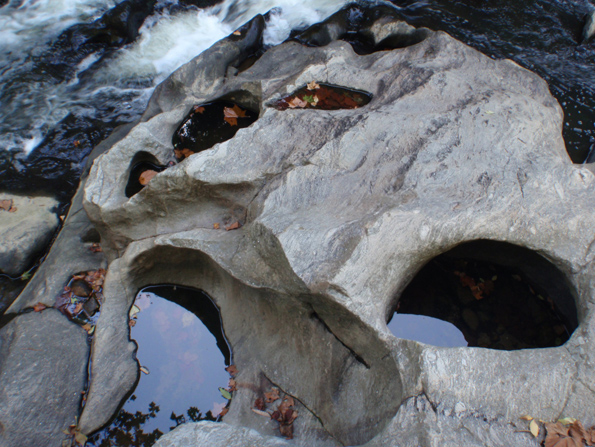
This rock has since changed its shape due to time and the effects of the river. This is particular noticeable in the form of potholes. Potholes are formed when a river causes a vortex of water that erodes a hole into the rock. The abrasion is mainly caused by the circular motion of the small sediments that are carried by the water. These potholes indicate that where this outcrop is was once covered by the river’s surface. In the image above we see various examples of potholes showing that they come in all shapes and sizes. Here we see five different potholes in the same location.
 
Last edited:

I work in a metal fab shop. A drill bit doesn't make a round hole, it makes a slightly triangular shaped hole. Because of the way the flutes want to walk around the hole. Very similar to the OP's first pic. It's good enough to get a bolt through. If you want closer to true round you use a reamer or hole saw.

Though the grain of the rock does lead me to believe it was formed that way. Or in that ballpark, and it was finished off by human intervention.
 
  • Like
Reactions: fhm555 and Hues
A double head scratcher....The formation/flow layer lines saying it came about naturally,underwater around some harder core object.

View attachment 2840338

Then....The interior hole surface and edge, which appears to have been later worn smooth by hanging a along time on a rope or cable,spinning round and round.Likely underwater for balance or an anchor.

View attachment 2840343

???...?.... . . .

Here's a possible explanation. Natural formation around, say, a tree trunk. Many years pass, tree trunk rots away, but stone is under water so erosion takes its toll on the inner part, wearing it smooth.
 
  • Like
Reactions: Hues
Natural erosion from water, wind and sand will cause the same effect we see in the pictures.

Sure, someone might have used it for a boat anchor or pendulum or construction block or whatever else we might imagine, but there is no reason to believe that it was actually ever used by humans for anything. Nature all by itself is sufficient to explain every feature.

I still find it hard to believe natural water,wind and sand would produce such a severe transition from smooth to rough in one unbroken surface.

strw00g.jpg


It reminds me of some unfinished sculptures I've seen.

stw-prisoner-atlas.jpg


Not saying that someone hand smoothed the hole in question.

I'd just like to see some other natural stones with such differing surfaces.
 
  • Like
Reactions: HaphAsSard
I still find it hard to believe natural water,wind and sand would produce such a severe transition from smooth to rough in one unbroken surface.

View attachment 2840883

It reminds me of some unfinished sculptures I've seen.

View attachment 2840884

Not saying that someone hand smoothed the hole in question.

I'd just like to see some other natural stones with such differing surfaces.
Different material wears and polishes differently. The pancake cliff photo for example.
 
  • Like
Reactions: Munjibunga and Hues