

Enjoy the benefits of a premium membership!
Upgrade Account
-
TalkBass has been independent since 1998. Add your voice.
Create a free account to reply to discussions, view embedded media, and browse with fewer display ads.
Join free Log in
Want zero display ads or expanded classifieds tools? Compare plans.
You are using an out of date browser. It may not display this or other websites correctly.
You should upgrade or use an alternative browser.
You should upgrade or use an alternative browser.
Need help with my mystery rock origin.
- Thread starter Stewie26
- Start date
More options
Who Replied?


Still milling about a bit: The folk who once lived here, Anglo Saxons, probably used this shapely stone to keep their roof up - seems they may not even have been aware of its original purpose. Still handy, none the less. Man needs a roof 
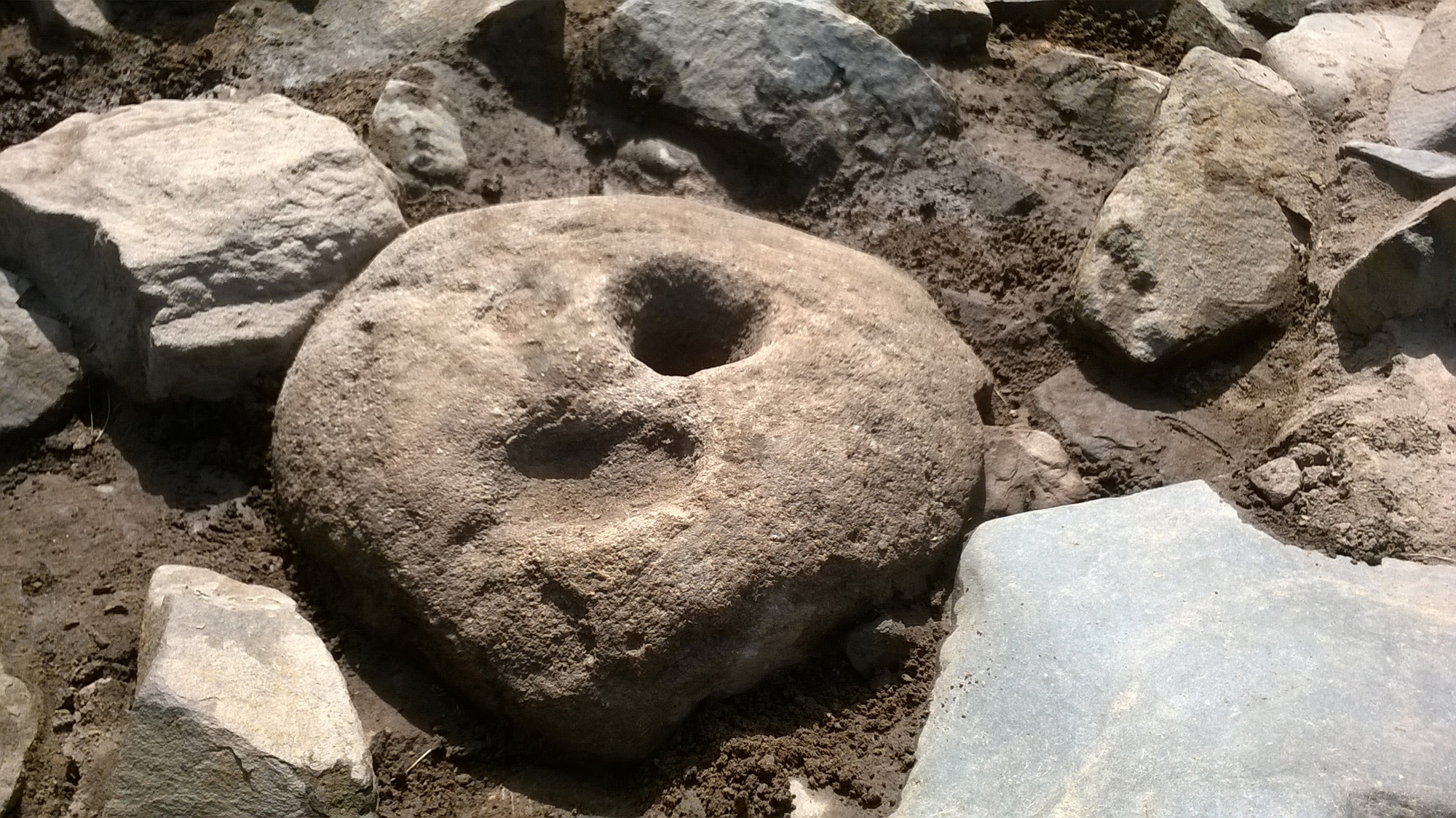
The newly identified quern stone we believe was re-used as a post support
The newly identified quern stone we believe was re-used as a post support
Earlier we identified, what we believe to be a socketed stone that was well sited to be a central roof support. This interpretation of the stone’s final role appears to be still valid, but further investigation has revealed that its a broken, or roughed out, upper stone of a rotary quern.
Anglo-Saxon buildings | Bamburgh Research Project's Blog | Page 2


Could we get some close-up shots of the walls of the hole?....It looks extremely smooth in there.Like modern drilling.
Or like it formed around something smooth and metal.
Could we get some close-up shots of the walls of the hole?....It looks extremely smooth in there.Like modern drilling.
Or like it formed around something smooth and metal.
You know, I've seen something like this from local limestone mines where the charge hole that was drilled would blow out and look like that. Complete despite the the detonation. Maybe?

Could we get some close-up shots of the walls of the hole?....It looks extremely smooth in there.Like modern drilling.
Or like it formed around something smooth and metal.
It is a fairly round hole but not perfect like a machine drilled it. Here are shots from both sides.





yup. The inside appears to be carbonate per the buried tree branch idea. Some strong acid will fizz on it but have much less of a reaction to the sandstone.The interior wall and the exterior surface are just so different from each other.Especially the edge where the two parts meet...Odd.
A double head scratcher....The formation/flow layer lines saying it came about naturally,underwater around some harder core object.
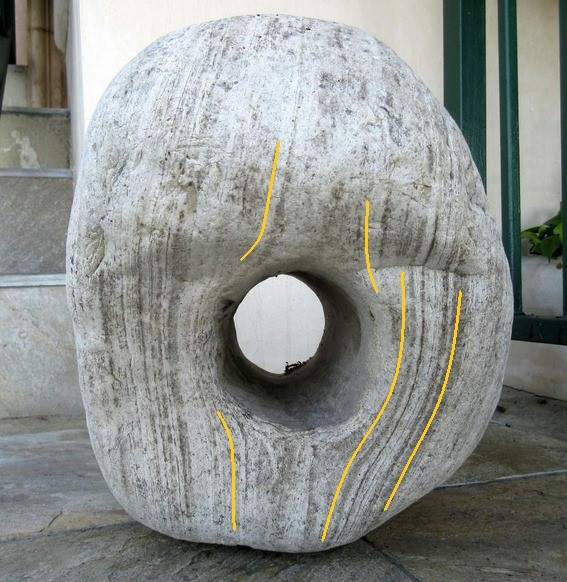
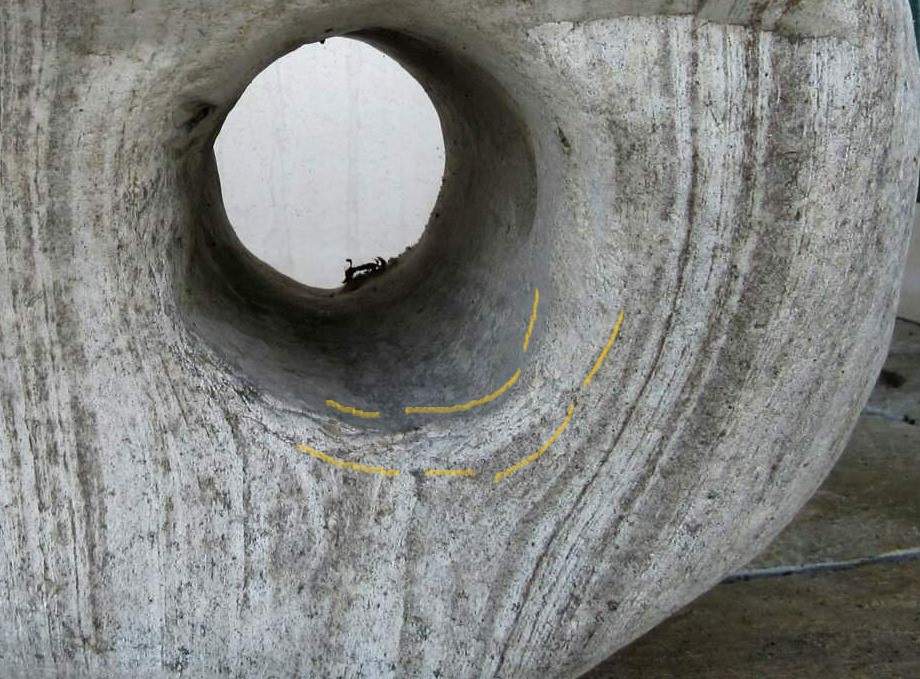
Then....The interior hole surface and edge, which appears to have been later worn smooth by hanging a along time on a rope or cable,spinning round and round.Likely underwater for balance or an anchor.
???...?.... . . .
Then....The interior hole surface and edge, which appears to have been later worn smooth by hanging a along time on a rope or cable,spinning round and round.Likely underwater for balance or an anchor.
???...?.... . . .

Wow...you have a good eye. I need to go out and look at again when I get home.A double head scratcher....The formation/flow layer lines saying it came about naturally,underwater around some harder core object.
View attachment 2840338
Then....The interior hole surface and edge, which appears to have been later worn smooth by hanging a along time on a rope or cable,spinning round and round.Likely underwater for balance or an anchor.
View attachment 2840343
???...?.... . . .
Sediments are laid down by successive floods. Tree falls down squashing into the muddy layers. Eons of successive flood events go by. The whole lot is buried by enough sediment to squidge mud and sand into sandstone. More eons go by. The overlaying rock and sediments are eroded....A double head scratcher....The formation/flow layer lines saying it came about naturally,underwater around some harder core object.
View attachment 2840338
Then....The interior hole surface and edge, which appears to have been later worn smooth by hanging a along time on a rope or cable,spinning round and round.Likely underwater for balance or an anchor.
View attachment 2840343
???...?.... . . .
iirc carbonate rock is the result of marine shells broken down and reconstituting from dissolved mineral.That's what I thought.
It's definitely a sedimentary rock and the layers are distorted around the hole. I assume that sediment was being laid down around and over a log until it was completely buried. The wood would have been preserved for awhile until it was replaced by crystals. Later, the sediment was transformed into hard rock by pressure and time. Eventually, the rock was exposed to the surface and weathering from water and sand eroded the rock into it's rounded, smooth shape. The log shaped crystals would be softer than the surrounding rock and would erode much faster until they were all gone. Result: A smooth stone with a log shaped hole in it.

The interior hole surface and edge, which appears to have been later worn smooth by hanging a along time on a rope or cable,spinning round and round.
Natural erosion from water, wind and sand will cause the same effect we see in the pictures.
Sure, someone might have used it for a boat anchor or pendulum or construction block or whatever else we might imagine, but there is no reason to believe that it was actually ever used by humans for anything. Nature all by itself is sufficient to explain every feature.
Latest posts
-

-
Post a funnier picture than the one above - Parallel Universe Edition
- Latest: BassicJazzy
-

-

-
