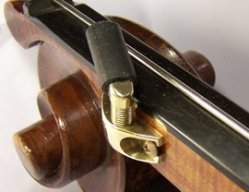
At the ISB convention I got to see/try all different variations of height and angle. Most of the pins had around a 45 degree angle that either went straight back, or were pointing slightly toward the "G side" of the bass. I also noticed that the tip of the pin made contact with the ground just behind the back of the bass.
So, I eye-balled how far behind the bass the tip should be, then measured the length of the straight pin at my preferred height. Then squared both numbers and added them together, then took the square root of the sum which gave me two things:
1. The theoretical length of the bent pin.
2. My first practical application of high school trigonometry, ever.
In my case, the final number was about 7 inches. So I measured a little more than 7 inches and marked it. I had to go a little more because the part of the pin that goes into the socket must be perfectly straight or it will bind up.
As for actually bending the pin, I used the heavy steel endpin that was already on my bass. Tonally, steel endpins aren't great, but it could definitely take being bent, and would still be stable enough to play without any worries.
The penultimate step was going out to my Dad's garage and going for it. I put the section to remain straight in a heavy vice then put a torch on the point that I wanted to bend and used a long, closed end wrench to make the bend.
After it cooled off I put it in the bass to decide if I wanted it to point straight back or offset at an angle. I chose to offset it a little because it makes the bass "lean" into me. I can stand straight up and have access to most of the fingerboard this way. The final step was, after marking the pin, I used a metal file to grind a flat spot for the screw to grip so the pin doesn't spin around in the socket while I'm playing.
I'm very happy with the final result. The straight pin felt a little more stable to me but its a small sacrifice to make. Despite the slight springyness in the bent pin, it's MUCH more comfortable to play.