• TalkBass has been independent since 1998. Add your voice.
    Create a free account to reply to discussions, view embedded media, and browse with fewer display ads.
    Join freeLog in
    Want zero display ads or expanded classifieds tools? Compare plans.

Neil Young speaks out against excessive compression

I honestly don't know what ALAC or AAC mean. I guess I can go look it up.

ALAC = Apple Lossless Audio Codec. It is a form of lossless compression. In order words, it makes audio files smaller without discarding any data, in much the same way a .zip file compresses data files.

AAC = Advanced Audio Codec. This is a form of lossy compression, like MP3. It's what the iTunes store uses.
 
If I'm understanding your test correctly, the listener always knows whether he is listening to A or B. Now if you randomized A and B for each trial so that the listener didn't know which recording he was listening to, and he consistently chose one or the other a statistically significant number of times, I would be more inclined to agree with you that the results conclusively indicated that he was able to tell a difference. If that is what you're suggesting, then we are not too far apart conceptually, although I still prefer an ABX test because it tests only whether the listener can identify a difference, without requiring the listener to make a subjective determination as to which he prefers.

In my test, the listener only knows the selections as a generic label A or B, and not the formats behind the label. But the label is always consistent with the format.

Er, I obviously don't know anything about blind testing:
In an ABX test, do you randomize the label selections.. switch the labels back and forth between different formats?

If that is the methodology for an ABX test, I could understand why a subject would have difficulty perceiving even an uncontroversial subtle difference.
 
You said you're using iTunes. Rip that track in ALAC. Rip the same track in AAC. Burn both files back to a CD, put your car player on random, and without looking, so how many times out of 20 you can correctly identify which one you're listening to.

Ok, so I'll have to mess with the ALAC thing later on. It would actually be great if that had that big of an effect on the sound as you say.
 
Er, I obviously don't know anything about blind testing:
In an ABX test, do you randomize the label selections.. switch the labels back and forth between different formats?

If that is the methodology for an ABX test, I could understand why a subject would have difficulty perceiving even an uncontroversial subtle difference.

A and B stay the same, but X changes with each trial. The listener has to determine whether X=A or X=B.
 
Ok, so I'll have to mess with the ALAC thing later on. It would actually be great if that had that big of an effect on the sound as you say.

Just to be clear, ALAC doesn't have any effect on sound compared to the original CD quality audio, because even though the file is smaller, the data in the ALAC file is still exactly the same as the original CD quality audio.
 
Ok, so I'll have to mess with the ALAC thing later on. It would actually be great if that had that big of an effect on the sound as you say.

An interesting experiment. But to do the experiment for real, how would you know if you were actually identifying the files for what they truly were?

Maybe you could just go by track number. 1 is the lossless, 2 is the lossy. Cover up the display of your car's deck, listen, make your guess, then peek. Or something.

I doubt very, very sincerely that anyone could tell the difference in my car. I have an inexpensive aftermarket deck and four inexpensive aftermarket 6.5" speakers. And my car's a convertible, so lots of road noise.

But hell I doubt if I could tell the diff while playing the files off my iPhone while using my studio monitor headphones. Not if I encoded the AAC at 256k bitrate.
 
Under normal, standard encoding? It has never happened to me!

Dude - listen - WE ARE ON THE SAME SIDE. You didn't encounter it because what was removed was inaudible to begin with. I'm explaining what MP3 does to so effectively compress audio. There are lots of sounds out there that are hitting our eardrums but that our brain does not perceive. This is in large part because sounds in similar frequency bands are louder, and mask them. This is what happens in the notional example of the conversation and the vacuum cleaner, and it's what lossy compression strives to identify and use to its own benefit.

Of course you wouldn't notice it happening, since the encoder is DOING IT'S JOB and removing only those sounds that you woudn't be sensing to begin with.
 
Just to be clear, ALAC doesn't have any effect on sound compared to the original CD quality audio, because even though the file is smaller, the data in the ALAC file is still exactly the same as the original CD quality audio.

So, using ALAC should increase the quality of the file I download from itunes, or no?
 
So, using ALAC should increase the quality of the file I download from itunes, or no?

No. You cannot increase the quality of files you download from itunes. Converting them from a lossy format to a lossless format is like pouring water from a cup into a bucket. The container is bigger, but you still have the same amount of water.

What I was suggesting was to to take the CD that you already own and to rip the same track from that CD in two different formats: one rip in ALAC (which would be the same quality as the CD itself) and separate rip in AAC (which would be a lossy file like what you would download from iTunes) and compare those. That way, you would be doing an apple to apple comparison (no pun intended).
 
take the CD that you already own and to rip the same track from that CD in two different formats: one rip in ALAC (which would be the same quality as the CD itself) and separate rip in AAC (which would be a lossy file like what you would download from iTunes) and compare those.

What bitrate AAC? 256 just like the store-bought ones?
 
No. You cannot increase the quality of files you download from itunes. Converting them from a lossy format to a lossless format is like pouring water from a cup into a bucket. The container is bigger, but you still have the same amount of water.

What I was suggesting was to to take the CD that you already own and to rip the same track from that CD in two different formats: one rip in ALAC (which would be the same quality as the CD itself) and separate rip in AAC (which would be a lossy file like what you would download from iTunes) and compare those. That way, you would be doing an apple to apple comparison (no pun intended).

Yeah, I don't know that that really concerns me. I mean how would I go about obtaining a file of that quality without buying a cd....OH WAIT, is that exactly what Neil Young was talking about?
 
If anyone on this board could pass a foobar ABX between an uncompressed lossless track from a CD and the SAME track encoded to 256kbs AAC (same as used by iTunes) I would be shocked, and would happily introduce them to developers of the LAME encoder who would put them to work testing their software. I'm not kidding - they're dying for people like that.
 
Well, if you take the test Febs is talking about, you might get a sense of if you would need to bother buying the CD.

hmm. Maybe I will because now I'm intrigued. I really think I can hear a difference.

One thing I would be sort of skeptical about on a test like that though is that I agree, and am not contradicting myself here, that there are only some instances where there is a discernible difference. I don't claim to have the golden ear.
 
The "mp3s" sold by Apple, for example, are 256k AAC files. And I haven't seen any evidence that human beings can hear the difference between them and their source masters. I'll consider it interesting if you can show me a group of audiophiles who can do this. I'll be humbled--and admit I am wrong--if you can show me that a majority of average music listeners can do so. Frankly, I bet you yourself can't do it.

I'm confident that most people on Talkbass could hear this difference given the proper source material. I was confronted with this recently myself.

Anyone here can do this test providing they have the right instruments.

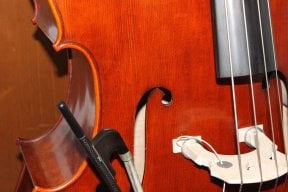
I was making a recording of my carved double bass using a Zoom H2 straight into Apple's Garageband at 16bit / 44.1kHz via USB. The H2, has stereo microphones, mic pre-amp, ADC converters and recorder all in a pretty case for $200. It's not expensive and not "top of the line" anything, but it's very handy.

So recording into Garage Band I get used to the sound of my double bass. Do my tracks as best I could (frustrating, as there is significant latency in the H2 that at the time I thought was me. "Why am I playing so late and out of time?") Anyways, I'm done in Garageband and send it to itunes as AAC at 256kps. Listening it in iTunes I'm shocked at how unclear the bass sound is compared to Garageband. So I re-export from GB to iTunes as AIFF and re-encode as AAC at 256kbps in iTunes 9. Still same sound degradation. I want to send the file to my friend at a higher sounding quality but in a reasonable way. So, I do it via Bandcamp. (I imagine the difference would be more noticeable had I used the better mics, mic-pre and ADC of a regular recording studio.)

Neil should use Bandcamp to reach his customers. :D

The main things is you need a good source. To me, any instrument where the sound comes from a speaker cone (ie. electric guitar, electric bass) is already too altered to be good enough as a source used to detect alterations in sound data storage. Acoustic instruments only please, and make them good ones. People can hear the difference between a $100 plywood acoustic guitar and $700 acoustic guitar with a solid wood top even though they are both guitars and one can play the same music with them. It's similar with lossy compression and uncompressed.

So anyone here can test this by recording a quality acoustic instrument as best they can into their computer. Don't clutter the recording with excessive overdubs or instrumentation that bring in their own frequency masking. Export the project as AIFF/WAV and 256 AAC and listen. I'm sure we'll all hear the difference that comes solely from the conversion of uncompressed audio to compressed audio.

Now if our projects are all about noisy guitars, digital effects, drum machine sounds from the 1980's, crazy EQ's and plugins, then it really gets hard to hear the difference because the sound source of the music itself, is so low. But if the project is all about one person playing an amazing acoustic instrument in a great sounding room, then it is easier to hear the difference.

==

I agree with the rest of what you wrote.

==

for those who remember, iTunes stared off selling m4p files at 128kps when the store opened in 2003. The move to m4a 256kps files happened in 2007 with the brand name of iTunes Plus. Previous purchasers could upgrade their purchased files for a small fee. Who knows, maybe the same will happen in a few years. But with the amount of songs sold off of iTunes growing so fast, a future upgrade of heavier files would be a massive amount of traffic for the iTunes servers.