
• TalkBass has been independent since 1998. Add your voice.
    Create a free account to reply to discussions, view embedded media, and browse with fewer display ads.
    Join freeLog in
    Want zero display ads or expanded classifieds tools? Compare plans.

New EBMM Short Scale Stingrays

I got one. Cherryburst. My first thought was, "I made a mistake." It's my first shortie, and I know shorties are small, but I didn't think this bass would be that small. I think there's a reason why they don't photograph these basses with their larger cousins, but I got over my initial reaction soon enough. The small scale leaves me feeling amazingly nimble. I don't have the largest hands, and I've dealt with finger injuries in the past, so I'm very glad to have added this bass to the quiver.

The craftsmanship is up there, in the same conversation, with my Mike Lull basses, though I'm not overly impressed with the bass/tone push boost on the volume pot.

The neck has a high-quality look and feel. For reference, I have a Fender American Pro II Precision bass and I had a Fender American Ultra Jazz bass. I think both of these Fenders have a more than acceptable, if not a desirable, build quality and finish. The EBMM is a nose ahead of the Ultra. The rosewood fingerboard has a lovely high-grade grain, there are no dead spots, and the frets and fret edges are well-dressed. The gun oil finish on the roasted maple neck is perfect.

Per my request, they shipped my bass with a set of flats. I'm sure they're Ernie Ball flats, but I'm not sure what model. They have green silk, if anyone knows what they are, I'd appreciate knowing it. The neck needed 3/4 tightening of the truss rod, probably because of the flats, but I threw on a set of LaBella Low Tension Flats and didn't have to adjust the truss back. Maybe a little neck relief is intended by the manufacturer. Now that I've removed the neck relief and lowered the action, I'm not sure I prefer the LTFs to the stock flats that they gave me, other than I think the stock flats would need a solid six months to really have the feel you're going for in a flat. The LTFs are 90% of the way there immediately.

I lowered the action two or three turns on each string saddle screw. I might have someone take a look at the nut height because it feels a little high but only slightly. What I'm observing about the nut height might just be how flats sit in the groove as opposed to whatever rounds this bass usually ships with.

It's my first EBMM, and when I plugged it in, it presented a punchy, mid to mid high tone that I've always viewed as characteristic of other EBMM's I've played in shops. Again, my first thought was that maybe this was a mistake. I prefer Ps to EBMMs when pressed, but, again, my initial regret disappeared instantly when I played with other musicians live. I play in jazz combos, and in a "mix," it sounds fantastic. Some of the harshness of the tone melts away when other musicians are playing, leaving a subtle but transparent growl. I love it. The burpy jazz bass quality that is present when a jazz bass is played solo survives and pokes through, while a jazz bass can get lost in a mix. The passive electronics don't have the highs or the punchiness of an active EBMM, which is a feature not a bug for me. The tone knob is more subtle than my P and Jazz basses, and the series mode offers the closest approximate to the aggressive sound of an active bass. The other two modes (single coil and split coil?) are similar to each other and feel passive.

It's light. I have a couple heavy basses (10+ lbs), so I don't get how anyone could fret about a 6.9 oz versus 7.3 oz weight difference. Either way, it's extremely light relative to any non-exotic 34" bass out there.

I grade the Mono case as a mid to high "B." I have a Mono gig bag, which is "bomber," as they say. The Mono hard case doesn't seem to be as overbuilt, but it's fine. I won't be surprised if the stitching comes lose or the rubber bumpers fall off eventually or some other workmanship blemish presents itself at some point. But, again, it's fine. I'd rather have the Mono soft case than the molded hard case that comes with late model American Fenders, and I definitely prefer it to the gig bag one of my snazzy Mike Lull's came in.

I got one. Cherryburst. My first thought was, "I made a mistake." It's my first shortie, and I know shorties are small, but I didn't think this bass would be that small. I think there's a reason why they don't photograph these basses with their larger cousins, but I got over my initial reaction soon enough. The small scale leaves me feeling amazingly nimble. I don't have the largest hands, and I've dealt with finger injuries in the past, so I'm very glad to have added this bass to the quiver.

The craftsmanship is up there, in the same conversation, with my Mike Lull basses, though I'm not overly impressed with the bass/tone push boost on the volume pot.

The neck has a high-quality look and feel. For reference, I have a Fender American Pro II Precision bass and I had a Fender American Ultra Jazz bass. I think both of these Fenders have a more than acceptable, if not a desirable, build quality and finish. The EBMM is a nose ahead of the Ultra. The rosewood fingerboard has a lovely high-grade grain, there are no dead spots, and the frets and fret edges are well-dressed. The gun oil finish on the roasted maple neck is perfect.

Per my request, they shipped my bass with a set of flats. I'm sure they're Ernie Ball flats, but I'm not sure what model. They have green silk, if anyone knows what they are, I'd appreciate knowing it. The neck needed 3/4 tightening of the truss rod, probably because of the flats, but I threw on a set of LaBella Low Tension Flats and didn't have to adjust the truss back. Maybe a little neck relief is intended by the manufacturer. Now that I've removed the neck relief and lowered the action, I'm not sure I prefer the LTFs to the stock flats that they gave me, other than I think the stock flats would need a solid six months to really have the feel you're going for in a flat. The LTFs are 90% of the way there immediately.

I lowered the action two or three turns on each string saddle screw. I might have someone take a look at the nut height because it feels a little high but only slightly. What I'm observing about the nut height might just be how flats sit in the groove as opposed to whatever rounds this bass usually ships with.

It's my first EBMM, and when I plugged it in, it presented a punchy, mid to mid high tone that I've always viewed as characteristic of other EBMM's I've played in shops. Again, my first thought was that maybe this was a mistake. I prefer Ps to EBMMs when pressed, but, again, my initial regret disappeared instantly when I played with other musicians live. I play in jazz combos, and in a "mix," it sounds fantastic. Some of the harshness of the tone melts away when other musicians are playing, leaving a subtle but transparent growl. I love it. The burpy jazz bass quality that is present when a jazz bass is played solo survives and pokes through, while a jazz bass can get lost in a mix. The passive electronics don't have the highs or the punchiness of an active EBMM, which is a feature not a bug for me. The tone knob is more subtle than my P and Jazz basses, and the series mode offers the closest approximate to the aggressive sound of an active bass. The other two modes (single coil and split coil?) are similar to each other and feel passive.

It's light. I have a couple heavy basses (10+ lbs), so I don't get how anyone could fret about a 6.9 oz versus 7.3 oz weight difference. Either way, it's extremely light relative to any non-exotic 34" bass out there.

I grade the Mono case as a mid to high "B." I have a Mono gig bag, which is "bomber," as they say. The Mono hard case doesn't seem to be as overbuilt, but it's fine. I won't be surprised if the stitching comes lose or the rubber bumpers fall off eventually or some other workmanship blemish presents itself at some point. But, again, it's fine. I'd rather have the Mono soft case than the molded hard case that comes with late model American Fenders, and I definitely prefer it to the gig bag one of my snazzy Mike Lull's came in.
The LaBella Low Tension Flats are my go to for flats in general; the feel, the tone, and the ease of play is unbeatable as far as flats go.
It also took me a bit to get used to how small the EBMM shorty was and I didn’t start to really love it until a few months in. I switched over to short scales a few years back, but this felt significantly smaller than my other shorties. I don’t know exactly when it happened, but it started to be my go-to for band practice and gigs. Eventually, it actually evolved into one of my all time favorite instruments. From an ergonomic perspective, it’s is now my gold standard to which I compare all other basses; this is especially true of the neck. Not only is it fast & precise, you can get the action super low without dead/buzzing frets and I’ve fallen in love with its dimensions. I now own three, probably overkill. I initially planned on just having two, i.e., my Starry Night and a pre-owned Silver Shadow that I was lucky to get at about 45% off. I wanted one for flats and the other for rounds. The plan was to have the Silver refinished and modded in the future. In fact, I just sent it out for the refinishing today. But when the new batch dropped, I couldn’t pass up that Goldbar. I’m a massive fan of the color orange, so I was stoked to see that the Goldbar actually looks more orange than gold when looking at it straight on in person. It’s almost like a color-changing chameleon finish, as it turns to gold from the side and then greenish-gold at full tilt. I also love that black hardware! I bought it using credit, but it’s interest free, so that’s a plus.

I’m surprised that you got a Mono gig bag because mine came with the standard Music Man hard shell case. I did jump on the Goldbar within minutes of it dropping, so maybe they had a handful of left over hard cases that they used up before moving over to the Mono.

Anyway, stick with it, you’ll end up loving it! If the lack of an active preamp starts to annoy you, a preamp pedal will scratch the itch. The push/pull vol bump is something I’ve never really found a use for myself. It’d have been really cool if they used a passive fuzz circuit similar to the Serek Grand instead, it would give me a reason to use it.
 
I got one. Cherryburst. My first thought was, "I made a mistake." It's my first shortie, and I know shorties are small, but I didn't think this bass would be that small. There's probably a reason why they don't photograph these basses with their larger cousins, but I got over my initial reaction soon enough. The small scale leaves me feeling amazingly nimble. I don't have the largest hands, and I've dealt with finger injuries in the past, so I'm very glad to have added this bass to the quiver.

The craftsmanship is up there, in the same conversation with my Mike Lull basses. Neck and body finishes are great. Electronics seem top notch, though I'm not overly impressed with the bass/tone push boost on the volume pot.

The neck has a high-quality look and feel. For reference, I have a Fender American Pro II Precision bass and I had a Fender American Ultra Jazz bass. I think both of these Fenders have a more than acceptable, if not a desirable, build quality and finish. The EBMM is a nose ahead of the Ultra. The rosewood fingerboard has a lovely high-grade grain, there are no dead spots, and the frets and fret edges are well-dressed. The gun oil finish on the roasted maple neck is perfect.

Per my request, they shipped my bass with a set of flats. I'm sure they're Ernie Ball flats, but I'm not sure what model. They have green silk, and if anyone knows what they are, I'd appreciate knowing it. The neck needed 3/4 tightening of the truss rod, probably because of the flats, but I threw on a set of LaBella Low Tension Flats and didn't have to adjust the truss back. Maybe a little neck relief is intended by the manufacturer. Now that I've removed the neck relief and lowered the action, I'm not sure I prefer the LTFs to the stock flats that they gave me, other than I think the stock flats would need a solid six months to really have the feel you're going for in a flat. The LTFs are 90% of the way there immediately.

I lowered the action two or three turns on each string saddle screw. I might have someone take a look at the nut height because it feels a little high but only slightly. What I'm observing about the nut height might just be how flats sit in the groove as opposed to whatever rounds this bass usually ships with.

It's my first EBMM, and when I plugged it in, it presented a punchy, mid to mid high tone that I've always viewed as characteristic of other EBMM's I've played in shops. Again, my first thought was that maybe this was a mistake. I prefer Ps to EBMMs when pressed, but, again, my initial regret disappeared instantly when I played with other musicians live. I play in jazz combos, and in a "mix," it sounds fantastic. Some of the harshness of the tone melts away when other musicians are playing, leaving a subtle but transparent growl. I love it. The burpy jazz bass quality that is present when a jazz bass is played solo survives and pokes through, while a jazz bass can get lost in a mix. The passive electronics don't have the highs or the punchiness of an active EBMM, which is a feature not a bug for me. The tone knob is more subtle than my P and Jazz basses, and the series mode offers the closest approximate to the aggressive sound of an active bass. The other two modes (single coil and split coil?) are similar to each other and feel passive.

It's light. I have a couple heavy basses (10+ lbs), so I don't get how anyone could fret about a 6.9 oz versus 7.3 oz weight difference. Either way, it's extremely light relative to any non-exotic 34" bass out there.

I grade the Mono case as a mid to high "B." I have a Mono gig bag, which is "bomber," as they say. The Mono hard case doesn't seem to be as overbuilt, but it's fine. I won't be surprised if the stitching comes lose or the rubber bumpers fall off eventually or some other workmanship blemish presents itself at some point. But, again, it's fine. I'd rather have the Mono soft case than the molded hard case that comes with late model American Fenders, and I definitely prefer it to the gig bag one of my snazzy Mike Lull's came in.
Nice review. Pics would be great, especially of the mono case. Both of mine have hard shell old style case. I might see if I can order one of the mono offerings for mine.
 
The LaBella Low Tension Flats are my go to for flats in general; the feel, the tone, and the ease of play is unbeatable as far as flats go.
It also took me a bit to get used to how small the EBMM shorty was and I didn’t start to really love it until a few months in. I switched over to short scales a few years back, but this felt significantly smaller than my other shorties. I don’t know exactly when it happened, but it started to be my go-to for band practice and gigs. Eventually, it actually evolved into one of my all time favorite instruments. From an ergonomic perspective, it’s is now my gold standard to which I compare all other basses; this is especially true of the neck. Not only is it fast & precise, you can get the action super low without dead/buzzing frets and I’ve fallen in love with its dimensions. I now own three, probably overkill. I initially planned on just having two, i.e., my Starry Night and a pre-owned Silver Shadow that I was lucky to get at about 45% off. I wanted one for flats and the other for rounds. The plan was to have the Silver refinished and modded in the future. In fact, I just sent it out for the refinishing today. But when the new batch dropped, I couldn’t pass up that Goldbar. I’m a massive fan of the color orange, so I was stoked to see that the Goldbar actually looks more orange than gold when looking at it straight on in person. It’s almost like a color-changing chameleon finish, as it turns to gold from the side and then greenish-gold at full tilt. I also love that black hardware! I bought it using credit, but it’s interest free, so that’s a plus.

I’m surprised that you got a Mono gig bag because mine came with the standard Music Man hard shell case. I did jump on the Goldbar within minutes of it dropping, so maybe they had a handful of left over hard cases that they used up before moving over to the Mono.

Anyway, stick with it, you’ll end up loving it! If the lack of an active preamp starts to annoy you, a preamp pedal will scratch the itch. The push/pull vol bump is something I’ve never really found a use for myself. It’d have been really cool if they used a passive fuzz circuit similar to the Serek Grand instead, it would give me a reason to use it.
What color refinish are you doing?
Which one is getting rounds ?
 
The LaBella Low Tension Flats are my go to for flats in general; the feel, the tone, and the ease of play is unbeatable as far as flats go.
It also took me a bit to get used to how small the EBMM shorty was and I didn’t start to really love it until a few months in. I switched over to short scales a few years back, but this felt significantly smaller than my other shorties. I don’t know exactly when it happened, but it started to be my go-to for band practice and gigs. Eventually, it actually evolved into one of my all time favorite instruments. From an ergonomic perspective, it’s is now my gold standard to which I compare all other basses; this is especially true of the neck. Not only is it fast & precise, you can get the action super low without dead/buzzing frets and I’ve fallen in love with its dimensions. I now own three, probably overkill. I initially planned on just having two, i.e., my Starry Night and a pre-owned Silver Shadow that I was lucky to get at about 45% off. I wanted one for flats and the other for rounds. The plan was to have the Silver refinished and modded in the future. In fact, I just sent it out for the refinishing today. But when the new batch dropped, I couldn’t pass up that Goldbar. I’m a massive fan of the color orange, so I was stoked to see that the Goldbar actually looks more orange than gold when looking at it straight on in person. It’s almost like a color-changing chameleon finish, as it turns to gold from the side and then greenish-gold at full tilt. I also love that black hardware! I bought it using credit, but it’s interest free, so that’s a plus.

I’m surprised that you got a Mono gig bag because mine came with the standard Music Man hard shell case. I did jump on the Goldbar within minutes of it dropping, so maybe they had a handful of left over hard cases that they used up before moving over to the Mono.

Anyway, stick with it, you’ll end up loving it! If the lack of an active preamp starts to annoy you, a preamp pedal will scratch the itch. The push/pull vol bump is something I’ve never really found a use for myself. It’d have been really cool if they used a passive fuzz circuit similar to the Serek Grand instead, it would give me a reason to use it.
I thought about the Goldbar. I notice that it was the first to sell out. It's definitely the boldest color, and I probably would have loved it. But whenever I've gone for the flashy thing (jacket, hat, guitar, etc), I end up realizing that I don't have the personality to back it up.

The EBMM Mono is not a gig bag. It's case. The foam is hard, but it doesn't have a hard outer shell. It's not a backpack.
Nice review. Pics would be great, especially of the mono case. Both of mine have hard shell old style case. I might see if I can order one of the mono offerings for mine.
 
  • Like
Reactions: LadyLoveStingRay5
I thought about the Goldbar. I notice that it was the first to sell out. It's definitely the boldest color, and I probably would have loved it. But whenever I've gone for the flashy thing (jacket, hat, guitar, etc), I end up realizing that I don't have the personality to back it up.

The EBMM Mono is not a gig bag. It's case. The foam is hard, but it doesn't have a hard outer shell. It's not a backpack.

Ok looks like same mono case as 34 scale basses. Thank you
 
I got one. Cherryburst. My first thought was, "I made a mistake." It's my first shortie, and I know shorties are small, but I didn't think this bass would be that small. There's probably a reason why they don't photograph these basses with their larger cousins, but I got over my initial reaction soon enough. The small scale leaves me feeling amazingly nimble. I don't have the largest hands, and I've dealt with finger injuries in the past, so I'm very glad to have added this bass to the quiver.

The craftsmanship is up there, in the same conversation with my Mike Lull basses. Neck and body finishes are great. Electronics seem top notch, though I'm not overly impressed with the bass/tone push boost on the volume pot.

The neck has a high-quality look and feel. For reference, I have a Fender American Pro II Precision bass and I had a Fender American Ultra Jazz bass. I think both of these Fenders have a more than acceptable, if not a desirable, build quality and finish. The EBMM is a nose ahead of the Ultra. The rosewood fingerboard has a lovely high-grade grain, there are no dead spots, and the frets and fret edges are well-dressed. The gun oil finish on the roasted maple neck is perfect.

Per my request, they shipped my bass with a set of flats. I'm sure they're Ernie Ball flats, but I'm not sure what model. They have green silk, and if anyone knows what they are, I'd appreciate knowing it. The neck needed 3/4 tightening of the truss rod, probably because of the flats, but I threw on a set of LaBella Low Tension Flats and didn't have to adjust the truss back. Maybe a little neck relief is intended by the manufacturer. Now that I've removed the neck relief and lowered the action, I'm not sure I prefer the LTFs to the stock flats that they gave me, other than I think the stock flats would need a solid six months to really have the feel you're going for in a flat. The LTFs are 90% of the way there immediately.

I lowered the action two or three turns on each string saddle screw. I might have someone take a look at the nut height because it feels a little high but only slightly. What I'm observing about the nut height might just be how flats sit in the groove as opposed to whatever rounds this bass usually ships with.

It's my first EBMM, and when I plugged it in, it presented a punchy, mid to mid high tone that I've always viewed as characteristic of other EBMM's I've played in shops. Again, my first thought was that maybe this was a mistake. I prefer Ps to EBMMs when pressed, but, again, my initial regret disappeared instantly when I played with other musicians live. I play in jazz combos, and in a "mix," it sounds fantastic. Some of the harshness of the tone melts away when other musicians are playing, leaving a subtle but transparent growl. I love it. The burpy jazz bass quality that is present when a jazz bass is played solo survives and pokes through, while a jazz bass can get lost in a mix. The passive electronics don't have the highs or the punchiness of an active EBMM, which is a feature not a bug for me. The tone knob is more subtle than my P and Jazz basses, and the series mode offers the closest approximate to the aggressive sound of an active bass. The other two modes (single coil and split coil?) are similar to each other and feel passive.

It's light. I have a couple heavy basses (10+ lbs), so I don't get how anyone could fret about a 6.9 oz versus 7.3 oz weight difference. Either way, it's extremely light relative to any non-exotic 34" bass out there.

I grade the Mono case as a mid to high "B." I have a Mono gig bag, which is "bomber," as they say. The Mono hard case doesn't seem to be as overbuilt, but it's fine. I won't be surprised if the stitching comes lose or the rubber bumpers fall off eventually or some other workmanship blemish presents itself at some point. But, again, it's fine. I'd rather have the Mono soft case than the molded hard case that comes with late model American Fenders, and I definitely prefer it to the gig bag one of my snazzy Mike Lull's came in.

I also got a Cherryburst. I agree with Trinidad that the bass is very small. The last thing you want to hear from your wife is "why is it so small?" :) On the plus side it is now my lightest bass at only 7 lbs 3 oz.

And I also put flats on it - TI Jazz Flats in my case. I had to do some minor intonation, but that was pretty much it. The bass was delivered set up with pretty low action that I'm happy with for now. I'll eventually do a full setup on it, but for now I left it alone.

I own two Sandberg short scales - a Lionel (P-bass) and a TT (Jazz). Of all the basses that I've owned/played (which is admittedly not that many in the 5 years I've been playing) the Sandberg necks have been the best. This Stingray is on par with the Sandbergs.

Once I plugged it in, it is a very punchy with a great tone. I'm mostly deaf in one ear (which pre-dates me playing bass), so my hearing isn't the best. That said, I didn't hear a massive difference between Parallel and Single Coil, but Series definitely sounds different and is my favorite setting at the moment. The push Volume Boost didn't seem to do a lot, but I haven't put it on a meter yet to see how much it actually changes things. I don't hear much difference with the tone knob either, but it is clearly doing something because it eliminated the string noise when I had the stock Ernie Ball rounds on it. It is a good bedroom tone, but even better in a band setting - the punchiness cuts thru without overwhelming the overall mix. It isn't too much, just the right amount so that you know the bass is there. My band mates love the way it sounds.

The Mono case is nice. Perfect fit for the bass and very secure. I much prefer cases over gig bags, and one of the reasons I don't like gig bags is dealing with the long zipper. So while the case is nice, I wish it had latches instead of a zipper. The Mono case is also very thick. I didn't measure it, but it is at least 3x as thick as my other cases. This obviously helps with protection, but it makes storage/transport a bit more challenging and seems like overkill.

Overall, I'm very happy with my purchase and I look forward to enjoying this bass for a long time. It goes out with me on its first gig on Saturday.

IMG_3287.jpeg
IMG_3285.jpeg
IMG_3283.jpeg
 
I also got a Cherryburst. I agree with Trinidad that the bass is very small. The last thing you want to hear from your wife is "why is it so small?" :) On the plus side it is now my lightest bass at only 7 lbs 3 oz.

And I also put flats on it - TI Jazz Flats in my case. I had to do some minor intonation, but that was pretty much it. The bass was delivered set up with pretty low action that I'm happy with for now. I'll eventually do a full setup on it, but for now I left it alone.

I own two Sandberg short scales - a Lionel (P-bass) and a TT (Jazz). Of all the basses that I've owned/played (which is admittedly not that many in the 5 years I've been playing) the Sandberg necks have been the best. This Stingray is on par with the Sandbergs.

Once I plugged it in, it is a very punchy with a great tone. I'm mostly deaf in one ear (which pre-dates me playing bass), so my hearing isn't the best. That said, I didn't hear a massive difference between Parallel and Single Coil, but Series definitely sounds different and is my favorite setting at the moment. The push Volume Boost didn't seem to do a lot, but I haven't put it on a meter yet to see how much it actually changes things. I don't hear much difference with the tone knob either, but it is clearly doing something because it eliminated the string noise when I had the stock Ernie Ball rounds on it. It is a good bedroom tone, but even better in a band setting - the punchiness cuts thru without overwhelming the overall mix. It isn't too much, just the right amount so that you know the bass is there. My band mates love the way it sounds.

The Mono case is nice. Perfect fit for the bass and very secure. I much prefer cases over gig bags, and one of the reasons I don't like gig bags is dealing with the long zipper. So while the case is nice, I wish it had latches instead of a zipper. The Mono case is also very thick. I didn't measure it, but it is at least 3x as thick as my other cases. This obviously helps with protection, but it makes storage/transport a bit more challenging and seems like overkill.

Overall, I'm very happy with my purchase and I look forward to enjoying this bass for a long time. It goes out with me on its first gig on Saturday.

View attachment 7082498View attachment 7082500View attachment 7082502
I’m sending you a private message . Maybe we can swap cases.
 
I also got a Cherryburst. I agree with Trinidad that the bass is very small. The last thing you want to hear from your wife is "why is it so small?" :) On the plus side it is now my lightest bass at only 7 lbs 3 oz.

And I also put flats on it - TI Jazz Flats in my case. I had to do some minor intonation, but that was pretty much it. The bass was delivered set up with pretty low action that I'm happy with for now. I'll eventually do a full setup on it, but for now I left it alone.

I own two Sandberg short scales - a Lionel (P-bass) and a TT (Jazz). Of all the basses that I've owned/played (which is admittedly not that many in the 5 years I've been playing) the Sandberg necks have been the best. This Stingray is on par with the Sandbergs.

Once I plugged it in, it is a very punchy with a great tone. I'm mostly deaf in one ear (which pre-dates me playing bass), so my hearing isn't the best. That said, I didn't hear a massive difference between Parallel and Single Coil, but Series definitely sounds different and is my favorite setting at the moment. The push Volume Boost didn't seem to do a lot, but I haven't put it on a meter yet to see how much it actually changes things. I don't hear much difference with the tone knob either, but it is clearly doing something because it eliminated the string noise when I had the stock Ernie Ball rounds on it. It is a good bedroom tone, but even better in a band setting - the punchiness cuts thru without overwhelming the overall mix. It isn't too much, just the right amount so that you know the bass is there. My band mates love the way it sounds.

The Mono case is nice. Perfect fit for the bass and very secure. I much prefer cases over gig bags, and one of the reasons I don't like gig bags is dealing with the long zipper. So while the case is nice, I wish it had latches instead of a zipper. The Mono case is also very thick. I didn't measure it, but it is at least 3x as thick as my other cases. This obviously helps with protection, but it makes storage/transport a bit more challenging and seems like overkill.

Overall, I'm very happy with my purchase and I look forward to enjoying this bass for a long time. It goes out with me on its first gig on Saturday.

View attachment 7082498View attachment 7082500View attachment 7082502
Every bass that comes into my quiver immediately gets a mini headstock tuner. Yours is a D'Addario, right?
 
Every bass that comes into my quiver immediately gets a mini headstock tuner. Yours is a D'Addario, right?
Yes, D'Addario. I do the exact same thing. I have a pedal tuner, but I've played some places with power so crappy/noisy that I couldn't use my pedal board. And I usually have one of my basses at the office, where I don't have a pedal tuner. Therefore, every bass has a headstock tuner so I don't have to think about grabbing one.
 
  • Like
Reactions: Trinidad
Gorgeous pics!

I'm seriously considering ordering another one before they are all gone (likely either the green or orange). I love my goldbar. My excuse is so I can string the new one with Slinky Cobalt Flats. :thumbsup: One with rounds, one with flats... that's a great excuse, right???
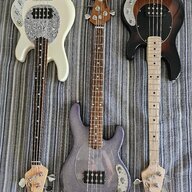
Interestingly, I had a short scale stingray in the first year they came out (it was a metallic cobalt blue color), but I ended up returning it because it just didn't have enough "beef" in the tone for me. It was just too thin sounding. Not the case with this one. Very punchy and I hear the difference for sure between the single, parallel, and series. I generally keep it in single coil (very quiet for a single coil) with the tone rolled back a bit and once in awhile parallel when I want a more Stingray sound.

As for the size, yes it is smaller than any other short scale I've had. But in my opinion that is the way it should be. That's why I even want a short scale. So, as far as I'm concerned the short scale Stingray is the only short scale bass (that I know of) that is designed optimally as far as the dimensions and ergonomics are concerned. There are short scales out there that are as big as a standard scale. Mainly because there is too much real estate between the rear edge of the body and the bridge. What is the point of that? I think the SS Stingray and close second Fender Mustang are about the best designs ergonomically out there. Sandberg is good too. But as for the Squier Rascal copy, the G&L, and a few others... although they are great basses, they just feel too much like a full scale for my tastes. At that point I'll just reach for my Jazz, Stingray (full scale) or Precision or other full scale bass.

Also, I've gotten more compliments from band members and other musicians on the tone of the short scale Stingray than any other bass, even in the short time I've owned it. It just sits in the mix perfectly. It doesn't have as much snappy high end as an active Stingray, but I can push the contour and bright buttons on my amp and it sound very close to my Retro 70s Stingray... and three pounds lighter! :bassist:

As for that Mono case, looks to be a decent fit for the short scale. I really don't like the Mono case for my Retro 70s Stingray because it is just too big. There is way too much pointless space above the end of the headstock. It's like three inches longer than any of my hard cases and way longer than my gig bags.
 
Last edited:
It is interesting watching this thread... I'm not sure whether I'm just seeing a difference in the way we each hear and describe sound, a difference from one instrument to the next, or has there been a change in the pickup design or tone control over the years of production? My Starry Night is the only EBMM SS that I've played so I have no reference for other individual examples. I certainly hear a large difference in the three pickup settings and in the sweep of the tone control on my Starry Night and even on my two Sterling SS's. I would describe that passive circuit as providing a pretty wide variety of sounds.
 
It is interesting watching this thread... I'm not sure whether I'm just seeing a difference in the way we each hear and describe sound, a difference from one instrument to the next, or has there been a change in the pickup design or tone control over the years of production? My Starry Night is the only EBMM SS that I've played so I have no reference for other individual examples. I certainly hear a large difference in the three pickup settings and in the sweep of the tone control on my Starry Night and even on my two Sterling SS's. I would describe that passive circuit as providing a pretty wide variety of sounds.
Definitely a distinct difference in sounds on mine as well (with the coil switching).

I'd say,
* parallel: the closest to traditional "Stingray sound." Without amplifier EQ filters and tweaking it's more of a "solid" sound than typical Stingray with more low-mid beef and less top end. With EQ tweaking/filters, I can pretty much nail the traditional "slap sound" the Stingray is famous for. I use this for funky, disco-ish, rhythmic/percussive type music. Chic, Sade, etc.

* single coil: thinner sound, more defined in the upper registers and less "tubby." This is actually my favorite setting with the tone rolled back to about 60%. It's a very versatile usable sound in many genres of music.

* series: thickest sound of all. Similar to the parallel sound with more low/low mid beef. Slightly less high end. Very punchy. This is the sound I use for the more rock/hard rock type stuff.

Nice thing about this bass is that it is SO easy to play and really can sound great for pretty much any genre you want to throw at it. I was playing Kiss Detroit Rock City with it last night. :smug: Gene Simmons never played a sparkly bass to my knowledge, but hey...
 
Yep. I get that. I’m surprised they didn’t offer another Short Scale model. Mine is my favorite 4 string bass I’ve ever owned .

If they had offered a 5 string , I would be placing my order .
But I guess Tim doesn’t play 5 string .
I’m not that familiar with him. Just like the features on my Short scale .

It is interesting watching this thread... I'm not sure whether I'm just seeing a difference in the way we each hear and describe sound, a difference from one instrument to the next, or has there been a change in the pickup design or tone control over the years of production? My Starry Night is the only EBMM SS that I've played so I have no reference for other individual examples. I certainly hear a large difference in the three pickup settings and in the sweep of the tone control on my Starry Night and even on my two Sterling SS's. I would describe that passive circuit as providing a pretty wide variety of sounds.

Definitely a distinct difference in sounds on mine as well (with the coil switching).

I'd say,
* parallel: the closest to traditional "Stingray sound." Without amplifier EQ filters and tweaking it's more of a "solid" sound than typical Stingray with more low-mid beef and less top end. With EQ tweaking/filters, I can pretty much nail the traditional "slap sound" the Stingray is famous for. I use this for funky, disco-ish, rhythmic/percussive type music. Chic, Sade, etc.

* single coil: thinner sound, more defined in the upper registers and less "tubby." This is actually my favorite setting with the tone rolled back to about 60%. It's a very versatile usable sound in many genres of music.

* series: thickest sound of all. Similar to the parallel sound with more low/low mid beef. Slightly less high end. Very punchy. This is the sound I use for the more rock/hard rock type stuff.

Nice thing about this bass is that it is SO easy to play and really can sound great for pretty much any genre you want to throw at it. I was playing Kiss Detroit Rock City with it last night. :smug: Gene Simmons never played a sparkly bass to my knowledge, but hey...
🎯😉
 
  • Like
Reactions: Djadja
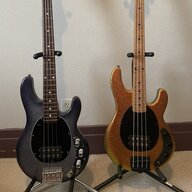
My Goldbar arrived today. I changed out the pickguard for a clear one, tuned it up, and it's absolutely perfect. Compared to my Starry Night Short Scale Stingray, I'd say they're almost 100% identical, but the Goldbar seems to have a touch more high end spank, probably because of it's maple fretboard vs. the Starry Night's rosewood. The Goldbar came with the new Mono case, which is really thick (a tad over 6 inches), but it still takes up less room than the molded hardshell case that came with my Starry Night. The Mono case could easily protect against a long fall, so I'm happy with it.

I've owned 5 different P Basses over the years, 4 Jazz Basses, 2 Warwicks, 2 Hofners, 4 Ibanezes, 4 Stingrays (long scale), 5 EBMM Sterling models, 3 Gibsons (SG, EB0, EB3), 3 Guilds, 2 Steinbergers, 3 Gretsches, and 4 very spendy custom basses, and these EBMM Short Scale Stingrays are BY FAR my favorite basses of all time.

Short Scale Stingray Goldbar 1.png
Short Scale Stingray Goldbar 2.png
 
My Goldbar arrived today. I changed out the pickguard for a clear one, tuned it up, and it's absolutely perfect. Compared to my Starry Night Short Scale Stingray, I'd say they're almost 100% identical, but the Goldbar seems to have a touch more high end spank, probably because of it's maple fretboard vs. the Starry Night's rosewood. The Goldbar came with the new Mono case, which is really thick (a tad over 6 inches), but it still takes up less room than the molded hardshell case that came with my Starry Night. The Mono case could easily protect against a long fall, so I'm happy with it.

I've owned 5 different P Basses over the years, 4 Jazz Basses, 2 Warwicks, 2 Hofners, 4 Ibanezes, 4 Stingrays (long scale), 5 EBMM Sterling models, 3 Gibsons (SG, EB0, EB3), 3 Guilds, 2 Steinbergers, 3 Gretsches, and 4 very spendy custom basses, and these EBMM Short Scale Stingrays are BY FAR my favorite basses of all time.

View attachment 7085800View attachment 7085802
Very nice !!! You really captured the green hue color flip .
I enjoy my short scales. just as much as my StingRay 5’s. What I’ve discovered is that I prefer the short scale on the 4 string specials . I keep ti flats on my starry night and slinky rounds in my active short scale.

EBMM makes great basses.
 
Very nice !!! You really captured the green hue color flip .
I enjoy my short scales. just as much as my StingRay 5’s. What I’ve discovered is that I prefer the short scale on the 4 string specials . I keep ti flats on my starry night and slinky rounds in my active short scale.

EBMM makes great basses.
That's what I'm doing as well: TI Jazz Flats on my Starry Night, and rounds on my Goldbar.

I think the quintessential 5 string bass is the Stingray 5, and the 34" scale is needed for that. Otherwise, for 4 strings, I prefer shorties.

Your active shorty is the Tim Commerford signature in gloss natural?
 
Last edited:
  • Like
Reactions: LadyLoveStingRay5
My Goldbar arrived today. I changed out the pickguard for a clear one, tuned it up, and it's absolutely perfect. Compared to my Starry Night Short Scale Stingray, I'd say they're almost 100% identical, but the Goldbar seems to have a touch more high end spank, probably because of it's maple fretboard vs. the Starry Night's rosewood. The Goldbar came with the new Mono case, which is really thick (a tad over 6 inches), but it still takes up less room than the molded hardshell case that came with my Starry Night. The Mono case could easily protect against a long fall, so I'm happy with it.

I've owned 5 different P Basses over the years, 4 Jazz Basses, 2 Warwicks, 2 Hofners, 4 Ibanezes, 4 Stingrays (long scale), 5 EBMM Sterling models, 3 Gibsons (SG, EB0, EB3), 3 Guilds, 2 Steinbergers, 3 Gretsches, and 4 very spendy custom basses, and these EBMM Short Scale Stingrays are BY FAR my favorite basses of all time.

View attachment 7085800View attachment 7085802
I LOVE the color of this bass.

And I agree with you and @LadyLoveStingRay5 regarding these basses. They simply work as close to perfectly as any bass I’ve played.

I wonder whether that slight difference in spank might be a difference in the strings…
 
  • Like
Reactions: LadyLoveStingRay5
I LOVE the color of this bass.

And I agree with you and @LadyLoveStingRay5 regarding these basses. They simply work as close to perfectly as any bass I’ve played.

I wonder whether that slight difference in spank might be a difference in the strings…
Possibly. They are the same strings, but the ones on the Starry Night are three weeks old. Didn't even consider that. Thanks.
 
  • Like
Reactions: LadyLoveStingRay5
My Goldbar arrived today. I changed out the pickguard for a clear one, tuned it up, and it's absolutely perfect. Compared to my Starry Night Short Scale Stingray, I'd say they're almost 100% identical, but the Goldbar seems to have a touch more high end spank, probably because of it's maple fretboard vs. the Starry Night's rosewood. The Goldbar came with the new Mono case, which is really thick (a tad over 6 inches), but it still takes up less room than the molded hardshell case that came with my Starry Night. The Mono case could easily protect against a long fall, so I'm happy with it.

I've owned 5 different P Basses over the years, 4 Jazz Basses, 2 Warwicks, 2 Hofners, 4 Ibanezes, 4 Stingrays (long scale), 5 EBMM Sterling models, 3 Gibsons (SG, EB0, EB3), 3 Guilds, 2 Steinbergers, 3 Gretsches, and 4 very spendy custom basses, and these EBMM Short Scale Stingrays are BY FAR my favorite basses of all time.

View attachment 7085800View attachment 7085802

Yes, I think they are my favorite overall as well. They look great, sound great, are super easy to play and the ergonomics/design is about as good as it gets. What I like most about the design is the bridge being right up against the heel of the body about as far back as it can go. For those of us with a small "wingspan" (short arms), this is SO much more comfortable to play. Very, very few basses are designed like that, no matter the scale (other than headless designs). For instance, I think Spector basses are killer, but I can't play them. It's too painful/tiring because of long left arm reach (due to the bridge being so far away from the heel of the body and the short upper horn). It just makes the balance and reach crazy for us small people. Same problem with Warwick thumb bass--awesome bass, but the bridge position and short upper horn make it a no-go for me. The short scale Stingray is the easiest playing bass I've ever had (I've had hundreds over the years).

I have a Fender Precision, Jazz, Mustang, full scale Music Man Stingray, Rick 4003, two Rick 4004s, and overall, the short scale Stingray has quickly become my favorite overall. I love my walnut Rick for some things, but it's so much harder to play. I wish Rickenbacker would make a short scale 4003 with a downsized body and bridge against the heel of the body. THAT would be cool. They did make a limited edition 4003 short scale a few years back, but it was just the standard body with a short scale neck. I'm sure that would be even harder to play than the full scale version because of the bridge being even farther toward the neck which screws up the balance and reach.

Music Man did it right with the design of the short scale Stingray--they kept the great look of the full scale stingray but reduced EVERYTHING in size as much as possible without getting crazy and redesigned the whole thing to be a REAL short scale bass that takes advantage of all that a short scale can be that makes it superior in playability to a full scale. Very few short scales actually do that and are most often just an afterthought redo of a full scale. The Fender Mustang is decent in that regard, but some of the other popular shorties just do NOT even feel like a short scale when you play them.
 
Yes, I think they are my favorite overall as well. They look great, sound great, are super easy to play and the ergonomics/design is about as good as it gets. What I like most about the design is the bridge being right up against the heel of the body about as far back as it can go. For those of us with a small "wingspan" (short arms), this is SO much more comfortable to play. Very, very few basses are designed like that, no matter the scale (other than headless designs). For instance, I think Spector basses are killer, but I can't play them. It's too painful/tiring because of long left arm reach (due to the bridge being so far away from the heel of the body and the short upper horn). It just makes the balance and reach crazy for us small people. Same problem with Warwick thumb bass--awesome bass, but the bridge position and short upper horn make it a no-go for me. The short scale Stingray is the easiest playing bass I've ever had (I've had hundreds over the years).

I have a Fender Precision, Jazz, Mustang, full scale Music Man Stingray, Rick 4003, two Rick 4004s, and overall, the short scale Stingray has quickly become my favorite overall. I love my walnut Rick for some things, but it's so much harder to play. I wish Rickenbacker would make a short scale 4003 with a downsized body and bridge against the heel of the body. THAT would be cool. They did make a limited edition 4003 short scale a few years back, but it was just the standard body with a short scale neck. I'm sure that would be even harder to play than the full scale version because of the bridge being even farther toward the neck which screws up the balance and reach.

Music Man did it right with the design of the short scale Stingray--they kept the great look of the full scale stingray but reduced EVERYTHING in size as much as possible without getting crazy and redesigned the whole thing to be a REAL short scale bass that takes advantage of all that a short scale can be that makes it superior in playability to a full scale. Very few short scales actually do that and are most often just an afterthought redo of a full scale. The Fender Mustang is decent in that regard, but some of the other popular shorties just do NOT even feel like a short scale when you play them.
I couldn't agree more. Pretty much the perfect design.