

Enjoy the benefits of a premium membership!
Upgrade Account
-
TalkBass has been independent since 1998. Add your voice.
Create a free account to reply to discussions, view embedded media, and browse with fewer display ads.
Join free Log in
Want zero display ads or expanded classifieds tools? Compare plans.
You are using an out of date browser. It may not display this or other websites correctly.
You should upgrade or use an alternative browser.
You should upgrade or use an alternative browser.
New EBMM Special Stingray 4HH Bridge Saddle Issue
- Thread starter bdplaid
- Start date
More options
Who Replied?

I would have assumed a bass as well built, engineered and in its price range should NOT have to be shimmed with a piece of sandpaper by the end user !
Absolutely. On a £2400 instrument all adjusters should function within all reasonable ranges, and that includes accomodation of all manufacturing tolerances. This really is poor from EBMM, IMHO. I wonder if @Scott Ball would care to comment, or let us know what EBMM is doing about it?

Have tried tightening the truss rod a little? That help me lower the action on mine.
Oh yes. That's how I got it as good as it is.
Just shorten the screw with a file. It will take one minute.
I could easily do that but for some reason I don't on a brand new bass.
Never played a custom shop but comparing this to usa Fenders the mm is way better.But, but.. I thought these were at least as good as Fender custom shop?.

The E and the G saddles are able to be adjusted down closer to the plate- because they have shorter screws. Simply request that EBMM, send out some of the shorter screws to you?
I find that the stock longer screws on the A and the D saddles tend to bottom out/stop travel at just about the right height, to prevent the strings from excessive buzzing and fretting out in the higher registers. Likewise, with all other adjustments being in tolerance within factory spec.
You could just try temporarily swapping the shorter screws from the E and the G saddles to the A and the D saddles to see if you would actually like the lower tolerance of the shorter screws for all the saddles?
I find that the stock longer screws on the A and the D saddles tend to bottom out/stop travel at just about the right height, to prevent the strings from excessive buzzing and fretting out in the higher registers. Likewise, with all other adjustments being in tolerance within factory spec.
You could just try temporarily swapping the shorter screws from the E and the G saddles to the A and the D saddles to see if you would actually like the lower tolerance of the shorter screws for all the saddles?
I agree with you. It seems all EB basses action is a little high for my preference. You shouldn't have to tighten a lot. But I do understand if you don't want to. I've gotten used to adjusting and re-adjusting all my basses.Oh yes. That's how I got it as good as it is.
I could easily do that but for some reason I don't on a brand new bass.
Absolutely. On a £2400 instrument all adjusters should function within all reasonable ranges, and that includes accomodation of all manufacturing tolerances.
They do, function within all reasonable ranges that include accommodating all manufacturing tolerances.
The OP wants to adjust out of recommended spec.
Some folks like to lay the strings down to within a hairs breadth of the frets.
This often results in excessive string buzz and the notes fretting out and choking out.
Most folks prefer to have the fretted notes ring out clear and true.
And it has already been noted in post#10 of this thread, that adjusting the saddles so low to where they contact the plate is bad juju for another reason.
To me, this attention to detail is not poor on EBMM's part- it's quite the opposite actually.
It’s just a lighthearted jab at a post currently on the board proclaiming just that.Never played a custom shop but comparing this to usa Fenders the mm is way better.
They do, function within all reasonable ranges that include accommodating all manufacturing tolerances.
The OP wants to adjust out of recommended spec.
...
To me, this attention to detail is not poor on EBMM's part- it's quite the opposite actually.
Manufacturers do not dictate players requirements for set-up, it's the other way around.
Generally I would agree with you on the attention to detail of EBMM, but here I think they've dropped the ball (no pun intended). It's also an easy fix, but it's their fix, not the players', IMHO.
They do, function within all reasonable ranges that include accommodating all manufacturing tolerances.
The OP wants to adjust out of recommended spec.
Some folks like to lay the strings down to within a hairs breadth of the frets.
This often results in excessive string buzz and the notes fretting out and choking out.
Most folks prefer to have the fretted notes ring out clear and true.
And it has already been noted in post#10 of this thread, that adjusting the saddles so low to where they contact the plate is bad juju for another reason.
To me, this attention to detail is not poor on EBMM's part- it's quite the opposite actually.
The idea that I want something out of spec riles me... perhaps it's baggage from what Warmoth, from whom I no longer buy anything, did to me...
I ordered a custom neck from Warmoth with bells and whistles, but the most basic thing was a jazz bass 1.5" width. It arrived with a nut on it cut for a P-bass string spacing. I complained and wanted another nut sent to me. Their response: "Sorry, it's within tolerances."
So now we have a bass that someone says is "within tolerance." I call total BS. How can someone say something like string heights are within tolerance, when there is no standard in the industry for such a thing? Even more importantly, they have no idea what my playing dynamics are like? If one plays like a beast, that demands high string-to-fret distance; but if one plays lightly and taps, etc, that demands low string height.
One of the problems mechanically with the EBMM saddles is that if one wants to get the height low by lowering the strings, it's possible to jam the screws so tightly into the bridge that they will never come out. Then you're stuck with what you've got, and God help you if the neck pitch changes or you want different string gauges.
"It'll buzz." So what? I actually like a little string buzz in my sound. Gives me a grind through effects that I think is cool.
So please don't talk to me about tolerances in a production bass for mass market and what the manufacturer - who never laid eyes on me - wants. It's not their decision to tell me how I want my bass set up.
For the record, I don't think EBMM is dictating anything. I think they simply made a production decision that IMO doesn't work, at least not for me, and I was just trolling for a solution, not to rag on the bass. I actually really, really like the bass. The fretwork is so good that one can the strings super low without much buzz - too bad the saddles get in the way of that.
And BTW, I'm not alone. Over on the Caprice/Cutlass page, I discovered that guys talked about this and have changed their screws so they can lower the bridge. Tolerances be damned.
So I have solved the problem. I did as the Caprice/Cutlass players did and changed the screws. Although I'm not totally happy with the result:
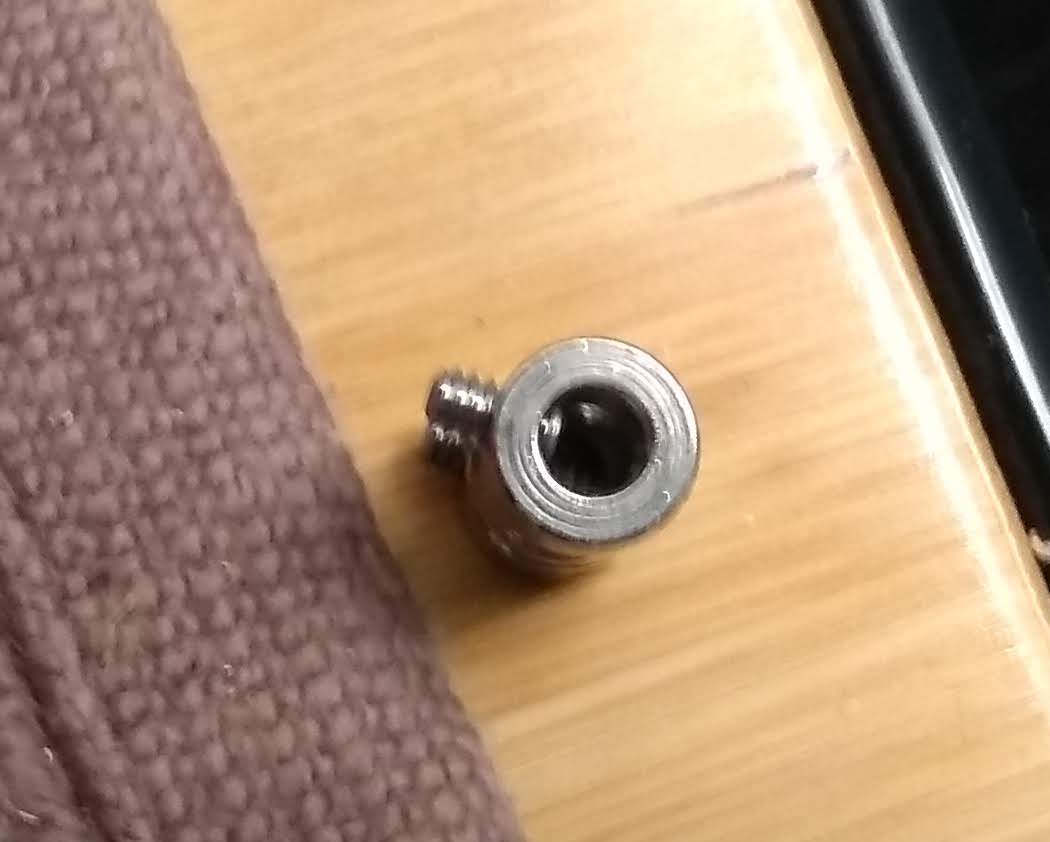
The problem is that IMO the screw is too short. But it's all I could get locally.
BTW, it's 6-32 thread pitch.
I think the long term solution is to thread the upper hole as well, and I'll try that when I get the urge. But for now, It works.
The bass is killer. The price i paid for it was about the same as for a Fender USA Elite. This is so much better in workmanship and overall quality I'm not sure I have words. It's on-par with a custom boutique instrument. The various sounds that come from it sit SO well in a mix. It doesn't sound like a P, not like a J, but because of the way it sits in a mix I don't care.
And surprisingly, I actually think the compensated nut makes a difference. The notes just sound "different."
The only wish I have is for a 1.5" width neck. Hold the P-spacing.

The problem is that IMO the screw is too short. But it's all I could get locally.
BTW, it's 6-32 thread pitch.
I think the long term solution is to thread the upper hole as well, and I'll try that when I get the urge. But for now, It works.
The bass is killer. The price i paid for it was about the same as for a Fender USA Elite. This is so much better in workmanship and overall quality I'm not sure I have words. It's on-par with a custom boutique instrument. The various sounds that come from it sit SO well in a mix. It doesn't sound like a P, not like a J, but because of the way it sits in a mix I don't care.
And surprisingly, I actually think the compensated nut makes a difference. The notes just sound "different."
The only wish I have is for a 1.5" width neck. Hold the P-spacing.
...
I think the long term solution is to thread the upper hole as well, and I'll try that when I get the urge. But for now, It works.
...
Without wishing to state the blindingly obvious, dont forget to tap through the existing thread to ensure that the two sections of thread are in alignment...


Really you shouldn't have to do that on a so called "Special Bass" that costs over £2k to buy. Yet another failure by the crew over at EB!


I still don’t get how this is preferable to shimming the neck.
I agree. Plenty of EB basses come and have come from the factory with factory installed shims.
Without wishing to state the blindingly obvious, dont forget to tap through the existing thread to ensure that the two sections of thread are in alignment...
Already ahead of you on that one! But appreciate it, it would have been a "Duh" moment!
I still don’t get how this is preferable to shimming the neck.
Way easier to just do the screws, as the neck and strings don't have to come off, then do trial and error getting the right shim in, plus I don't have a proper shim and would have to wait for EBMM to send me one, plus the neck angle is already great.
Really you shouldn't have to do that on a so called "Special Bass" that costs over £2k to buy. Yet another failure by the crew over at EB!
I agree I should not have to do it, but to call it a "failure" is way overstatement. The guys at EBMM said something along the lines they were doing as they had done older basses, and I got the impression it was a nod to tradition. But, there is a reason why some traditions don't last...
 .
. You already have the darn things out chuck them up in a drill press, mike the allen and drill a clearance hole, problem solved.
I actually don't even think I need to drill a hole for the threading, but in any event I was just lazy. I had to go out for the right tap anyway, and the screws were there, so...
Just FYI -
I heard from EBMM. They said what we already know - the A and D string saddle screws are longer, by design. I was offered additional shorter screws for the A and D saddles if I wanted, and I accepted.
Yes, EBMM has great customer service. And I'm still loving the bass!
I heard from EBMM. They said what we already know - the A and D string saddle screws are longer, by design. I was offered additional shorter screws for the A and D saddles if I wanted, and I accepted.
Yes, EBMM has great customer service. And I'm still loving the bass!


