
Enjoy the benefits of a premium membership!
Upgrade Account
-
TalkBass has been independent since 1998. Add your voice.
Create a free account to reply to discussions, view embedded media, and browse with fewer display ads.
Join free Log in
Want zero display ads or expanded classifieds tools? Compare plans.
You are using an out of date browser. It may not display this or other websites correctly.
You should upgrade or use an alternative browser.
You should upgrade or use an alternative browser.
New Headless in the works.
- Thread starter Pep
- Start date
More options
Who Replied?






Legitimate question: Is the point of a headless bass to decrease overall weight? To obviate neck dive? Combination of those two factors and perhaps others? I never saw the appeal, but then again I've never played any headless instrument so I'm curious as to why they're so popular with some folks.
I have a house gig every Thursday and the set-up area is very tight. If I use a normal bass the headstock is too close the drummer’s head.


Headless basses won't necessarily be light, but the weight will be concentrated in the body, not the headstock, so it's not just neckdive but the balance in general. Taking the headstock off changes the resonance of the neck (and thus moves the dead spot), helps it fits in a guitar bag so it's easier to fly with... Looks can factor into it, either for or against.Legitimate question: Is the point of a headless bass to decrease overall weight? To obviate neck dive? Combination of those two factors and perhaps others? I never saw the appeal, but then again I've never played any headless instrument so I'm curious as to why they're so popular with some folks.
I dunno. I think they look cool. I'd rock one but the right one never came along at the right time.


reduce neck dive, yes. also, easier to tune i.m.o. and tends to hold tune longer. 'straight-line' tuning is another plus, as it should eliminate the possibility of twisted strings. simply a better-engineered arrangement overall.Legitimate question: Is the point of a headless bass to decrease overall weight? To obviate neck dive? Combination of those two factors and perhaps others? I never saw the appeal, but then again I've never played any headless instrument so I'm curious as to why they're so popular with some folks.
as far as overall weight, they tend to weigh more due to the heavier hardware; still, it ain't necessarily so ~

I have a house gig every Thursday and the set-up area is very tight. If I use a normal bass the headstock is too close the drummer’s head.
....and how's that a problem?!?
Great looking project! What's the hardware-in-play? I use Bogart and Mensinger headless 5's to keep the weight and balance in-check.
Riis

I’m considering building a 5 string. Certain Warmoth necks can be ordered as paddle heads which not only makes the clamp placement easier but it allows me to shape however I want.
This is second one I’ve built. I’ve included a pic of the first one which turned our great and is a dream to play.
I purchased all of the hardware from Amazon. The brand is Guyker and it comes with a head clamp. The neck is a 32” Short Scale Warmoth Warhead. I couldn’t use the Guyker head clamp because it was too wide so I went with an OVSAL and it fit this neck perfectly.
I’ll need to eventually cut a new nut, but just to get this together I widened the string grooves. Here are links to the parts I’m using.
Remember you won’t necessarily need a different head clamp than what is furnished with the Guyker.
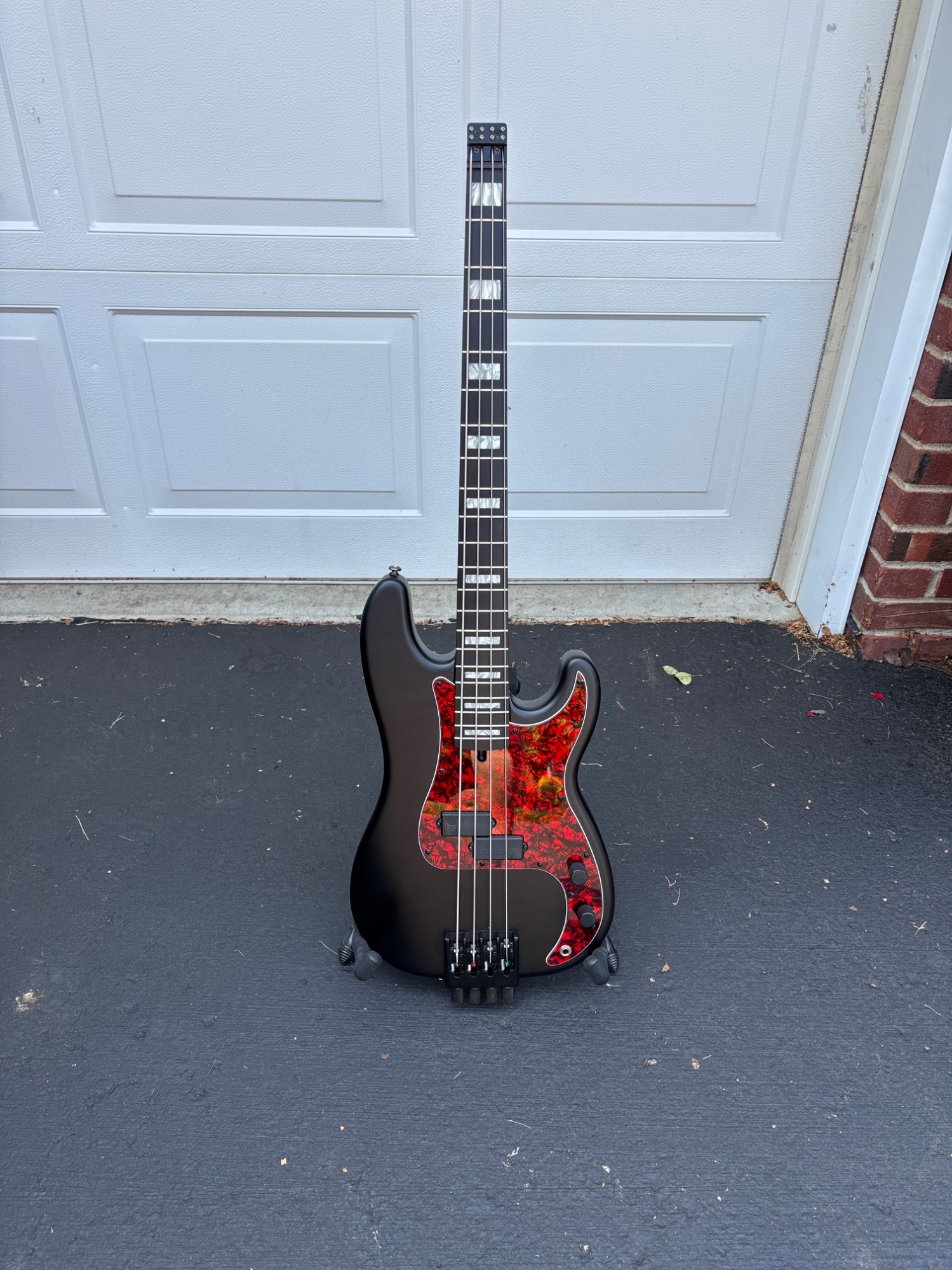
This is second one I’ve built. I’ve included a pic of the first one which turned our great and is a dream to play.
I purchased all of the hardware from Amazon. The brand is Guyker and it comes with a head clamp. The neck is a 32” Short Scale Warmoth Warhead. I couldn’t use the Guyker head clamp because it was too wide so I went with an OVSAL and it fit this neck perfectly.
I’ll need to eventually cut a new nut, but just to get this together I widened the string grooves. Here are links to the parts I’m using.
Remember you won’t necessarily need a different head clamp than what is furnished with the Guyker.
Amazon.com: Guyker 4 String Headless Bass Bridge and Bridge String Lock, Slightly Adjustable String Spacing Base CNC Processing, WB004, Black : Musical Instruments
Buy Guyker 4 String Headless Bass Bridge and Bridge String Lock, Slightly Adjustable String Spacing Base CNC Processing, WB004, Black: Bridges & Bridge Parts - Amazon.com ✓ FREE DELIVERY possible on eligible purchases
www.amazon.com
Last edited:
As an Amazon Associate, TalkBass may receive commissions from qualifying purchases made via links on this site.
Looks good, headless without the modern shapes so many use. I'm building my first headless right now, hopefully ready for finish next week. Also used Guyker hardware, but I went with the one that tunes from the top with a hex wrench. Yeah, I know, there will be a hex wrench crisis day in my future. I'm thinking I sew a little pouch onto every strap I own and put one in each, and maybe as an ultimate backup put one inside the control cavity.
Question - with the tuning knobs out from the body end like that have you ever had issues with bumping and bending one? Or are they strong enough to handle that? Or are you just a lot less bump-prone than me?
Question - with the tuning knobs out from the body end like that have you ever had issues with bumping and bending one? Or are they strong enough to handle that? Or are you just a lot less bump-prone than me?

Definitely change the location of the dead spot.Headless basses won't necessarily be light, but the weight will be concentrated in the body, not the headstock, so it's not just neckdive but the balance in general. Taking the headstock off changes the resonance of the neck (and thus moves the dead spot), helps it fits in a guitar bag so it's easier to fly with... Looks can factor into it, either for or against.
I dunno. I think they look cool. I'd rock one but the right one never came along at the right time.
This is great, i always thought you had to scoop tail by the strap buttop to get clearance but apparently not.
The tuners on legator headless guitars were pretty fragile(mine was 2018, possibly they've upgraded), when i was looking for replacemtns there's a few places to get them but $$

 hipshotproducts.com
 abm-guitarpartsshop.com
The tuners on legator headless guitars were pretty fragile(mine was 2018, possibly they've upgraded), when i was looking for replacemtns there's a few places to get them but $$
Bass Headless
bass guitar, fan-fret, bass bridge, B-bender, guitar bridge, tremolo, bass machine heads, bass tuners, multi-scale, tuners, bridges, headless, vibrato, hardware
hipshotproducts.com
Suchergebnisse
abm-guitarpartsshop.com
No problems with that so far. I also carry it in a heavily padded soft case.Looks good, headless without the modern shapes so many use. I'm building my first headless right now, hopefully ready for finish next week. Also used Guyker hardware, but I went with the one that tunes from the top with a hex wrench. Yeah, I know, there will be a hex wrench crisis day in my future. I'm thinking I sew a little pouch onto every strap I own and put one in each, and maybe as an ultimate backup put one inside the control cavity.
Question - with the tuning knobs out from the body end like that have you ever had issues with bumping and bending one? Or are they strong enough to handle that? Or are you just a lot less bump-prone than me?
The Guyker is almost identical to the Hipshot, but probably cheaper components.This is great, i always thought you had to scoop tail by the strap buttop to get clearance but apparently not.
The tuners on legator headless guitars were pretty fragile(mine was 2018, possibly they've upgraded), when i was looking for replacemtns there's a few places to get them but $$
Bass Headless
bass guitar, fan-fret, bass bridge, B-bender, guitar bridge, tremolo, bass machine heads, bass tuners, multi-scale, tuners, bridges, headless, vibrato, hardware
Suchergebnisse
Can't search and link right now but there's a previous post on Luthier's Corner comparing the two.The Guyker is almost identical to the Hipshot, but probably cheaper components.

I've owned several headless in the past and the general method of protecting the tuner knobs was either to build an arch in the bass butt and the 'butt cheeks' would protrude out a little further than the tuners and thus protect them (Figures 1, 3 and 4). Ibanez has a notch that protects the knobs but can retain the full rounded body look. Not sure how easy it would be to access the knobs for tuning though, especially the G string (Figure 2).Question - with the tuning knobs out from the body end like that have you ever had issues with bumping and bending one? Or are they strong enough to handle that? Or are you just a lot less bump-prone than me?
I feel the most exciting development in headless hardware has been the relatively recent introduction of top mounted tuners like NS Design and Riviera. My headless uke bass from Lignum has the Riviera hardware and it is much easier to tune and looks great. I suppose the hard part about such top mounted hardware is the extra routing that is probably required. But I like big round full bass butts.

Well, it AIN't neck-heavy NOW.
Why no one does this with Thunderbirds is beyond me, would be Numero Uno on my short list.
Why no one does this with Thunderbirds is beyond me, would be Numero Uno on my short list.
Here's the comparison thread I mentioned earlier:The Guyker is almost identical to the Hipshot, but probably cheaper components.

I have a Hipshot 4 string headless bridge for a build and wanted to compare it to the Guyker headless bridge that is obviously a clone. I just received the Guyker unit today. Both units are 19mm string spacing with a little adjustability due to being able to slide the grooved rod in the saddle (more on that in the details). Lots of pictures at the end of this post.
First off, the dimensions of the two units are nearly identical when viewing the product details. So I thought I need to give the Guyker a shot due to the price difference. I have used a few Guyker parts in the past and...
First off, the dimensions of the two units are nearly identical when viewing the product details. So I thought I need to give the Guyker a shot due to the price difference. I have used a few Guyker parts in the past and...
- lowbass68
- Replies: 15
- Forum: Hardware, Setup & Repair [BG]
I just read the entire comparison. As mentioned in my post, and in the comparison/review, the Guyker includes the headstock clamp bracket. If you order the Hipshot with the headstock clamp you’re looking at $462 while the Guyker set is $80.99.Here's the comparison thread I mentioned earlier:
I have a Hipshot 4 string headless bridge for a build and wanted to compare it to the Guyker headless bridge that is obviously a clone. I just received the Guyker unit today. Both units are 19mm string spacing with a little adjustability due to being able to slide the grooved rod in the saddle (more on that in the details). Lots of pictures at the end of this post.
First off, the dimensions of the two units are nearly identical when viewing the product details. So I thought I need to give the Guyker a shot due to the price difference. I have used a few Guyker parts in the past and...
- lowbass68
- Replies: 15
- Forum: Hardware, Setup & Repair [BG]
For $381 difference I’ll sort through a few Guykers if needed to end up with a good one.
What’s ironic about this is the one I received was fine. No issues at all. The one in this new build will be dialed on Monday and I’ll report the findings.
The reason the tuners extend beyond the body is that since this is a 32” scale, the body and neck are obviously shorter, and in order to get enough adjustability for proper intonation I had to mount it as it is. I would imagine on a 34” scale I would have a bit more room to work with.
Last edited:


