• TalkBass has been independent since 1998. Add your voice.
    Create a free account to reply to discussions, view embedded media, and browse with fewer display ads.
    Join freeLog in
    Want zero display ads or expanded classifieds tools? Compare plans.

New mesa subway amps and cabs!

The only thing that I can think of, and I don't know the Rumble 40's specific architecture, is that acoustic energy from the 212's speaker is vibrating the Rumble's speaker causing it to back-feed enough energy into the power amp (class D?) causing the power supply rail to raise just enough to cause a small current to flow through the LEDs. This is just a guess, could be tested by disconnecting one of the two speaker wires and trying again.

The mechanism for this is that the vibrating voice coil is sitting within a static magnetic field and generating a small voltage.
 
The only thing that I can think of, and I don't know the Rumble 40's specific architecture, is that acoustic energy from the 212's speaker is vibrating the Rumble's speaker causing it to back-feed enough energy into the power amp (class D?) causing the power supply rail to raise just enough to cause a small current to flow through the LEDs. This is just a guess, could be tested by disconnecting one of the two speaker wires and trying again.

The mechanism for this is that the vibrating voice coil is sitting within a static magnetic field and generating a small voltage.

Thanks for your reply again! Was thinking of putting my phone near it to see if it would charge ;)
 
The only thing that I can think of, and I don't know the Rumble 40's specific architecture, is that acoustic energy from the 212's speaker is vibrating the Rumble's speaker causing it to back-feed enough energy into the power amp (class D?) causing the power supply rail to raise just enough to cause a small current to flow through the LEDs. This is just a guess, could be tested by disconnecting one of the two speaker wires and trying again.

The mechanism for this is that the vibrating voice coil is sitting within a static magnetic field and generating a small voltage.

Could it be that if the speakers are close enough together, there's a magnetic field coupling? Effectively turning the speakers in the 2x12 into one side of a transformer, and the speakers in the rumble cabinet being the other side?
 
Could it be that if the speakers are close enough together, there's a magnetic field coupling? Effectively turning the speakers in the 2x12 into one side of a transformer, and the speakers in the rumble cabinet being the other side?
Probably not, the modulated magnetic fields (including the return path) are pretty tightly coupled.
 
Ok. Maybe somebody could help explain this. off topic a little but...
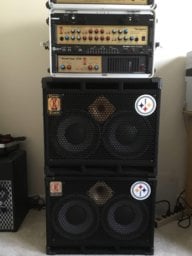
2x12 Cab is sounding great. Recently really turned it up, the cab powered by the WD800.
Sounds loud! and clear. But this I dont understand. I have my Fender Rumble 40 sitting next to the
2x12. 0 wires connected to the Rumble, now when I play loud the Rumble's power and overdrive light
are lighting up. How can this happen ?
Thanks for any electric enlightenment,

Mesa Watts. 'nuff said...

:bassist::bassist::bassist:
 
Calling Dr. Aged Horse

What does the Pasive Mid Control on the New WD-800 Subway do for your sound? I have the parametric EQ function down from using my Eden gear, but not quite sure what passive mid control does. Please advise. Thanks.

DB
It's part of the voicing network, it's a different mid character, different filter shape.
 
  • Like
Reactions: kobass and dbsfgyd1
Calling Dr. Aged Horse

What does the Pasive Mid Control on the New WD-800 Subway do for your sound? I have the parametric EQ function down from using my Eden gear, but not quite sure what passive mid control does. Please advise. Thanks.

DB

I've found it to be the "Cut Through The Mix" knob myself.

I've played around with it to see how it affects my tone. I usually find my sound with it between 12 and 1. If I need help sitting in the mix (and my overall volume doesn't need a boost), I just bump it up and I'm there.