this is much better said that I could have ever put it.A body hangs on you with the halfway point between the two attachment points centered between your shoulders - gravity ensures that. Where the scale isd relative to that determines the reach. On a Fender shaped bass, the scale starts at the bridge saddles (about 2" from the right attachment point). The nut is 34 inches to the left of that. The upper horn is the other attachment point on most designs, and on a Fender, it's at the 12th fret, which is 17 inches from the bridge saddles, or 19 inches from the butt end.
If you want a short scale that has 4 inches less reach, you use the same body shape and size, and start the scale at the same place. That will put the nut at 30 inches from the same point relative to your body. As the scale has been shortened, the upper horn will now land at the 10th fret. I've got a bass where the geometry was done this way, the reach is 4 inches less, and I think that's the way to do it - it takes full advantage of the shortened scale to give the player less reach. But noone else does that.
On some short scales the body is shortened, so the upper horn has been moved to the right, which means the center point between attachment points, when it's centered on your body, is moved to the left. If the bridge is still at the butt end of the body, and the upper horn is at the 12th fret, given the 4 inch shorter scale, the upper horn (being at half the scale length from the bridge saddles) is 2 inches closer - half scale is now 15, not 17 inches, so the attachment points are 2 inches closer to each other. The body still centers itself on the mid point, so the bridge (where the scale starts) has moved (relative to your body) a single inch to the left. That gives a minor shift (about an inch), but it is still a shift that increases reach a bit. that design gives you 3 inches less reach than a full scale - not ideal as it could be 4, but it's close.
On this Ric design, the bridge has been moved to the left - the scale starts much further to the left. Looks like it's a 4 or 5 inches of shift. If the body were full sized, that would mean the nut is 4 or 5 inches further out than it could be - about the same as a full scale, but here the body is also downsized, so add an inch more .The nut on this is actually further to the left when hung on your body than it is on a full scale instrument. It's simple geometry.
Yes, I'm a nerd (Physicists are by and large all nerds), but I have really thought about this. If you ponder it enough, and understand geometry, You'll get it.
if you want to try a practical example, next time youre at a music store, play a short scale stingray and then a squier rascal and youll notice the difference bridge position makes.




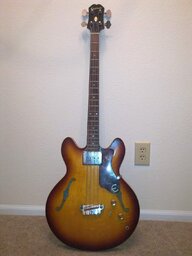


 At least, on these 4002 inspired Ricks…..