

Enjoy the benefits of a premium membership!
Upgrade Account
-
TalkBass has been independent since 1998. Add your voice.
Create a free account to reply to discussions, view embedded media, and browse with fewer display ads.
Join free Log in
Want zero display ads or expanded classifieds tools? Compare plans.
You are using an out of date browser. It may not display this or other websites correctly.
You should upgrade or use an alternative browser.
You should upgrade or use an alternative browser.
New Model Rickenbacker Bass!?!
- Thread starter nixdad
- Start date
More options
Who Replied?
Bridge pickup right next to the bridge so all it outputs are tinky-tinky-tinky tones.
Neck pickup right next to the neck heel so all it outputs is mud.
Brilliant.

Neck pickup right next to the neck heel so all it outputs is mud.
Brilliant.

Sounds great actually. Hot toasters by the way.Bridge pickup right next to the bridge so all it outputs are tinky-tinky-tinky tones.
Neck pickup right next to the neck heel so all it outputs is mud.
Brilliant.
View attachment 7452134

Consider me a nerd as well! I tutor math professionally, which includes teaching teenagers middle school and high school level geometry. What I love about physics in general is that it's (mostly) applied math.A body hangs on you with the halfway point between the two attachment points centered between your shoulders - gravity ensures that. Where the scale isd relative to that determines the reach. On a Fender shaped bass, the scale starts at the bridge saddles (about 2" from the right attachment point). The nut is 34 inches to the left of that. The upper horn is the other attachment point on most designs, and on a Fender, it's at the 12th fret, which is 17 inches from the bridge saddles, or 19 inches from the butt end.
If you want a short scale that has 4 inches less reach, you use the same body shape and size, and start the scale at the same place. That will put the nut at 30 inches from the same point relative to your body. As the scale has been shortened, the upper horn will now land at the 10th fret. I've got a bass where the geometry was done this way, the reach is 4 inches less, and I think that's the way to do it - it takes full advantage of the shortened scale to give the player less reach. But noone else does that.
On some short scales the body is shortened, so the upper horn has been moved to the right, which means the center point between attachment points, when it's centered on your body, is moved to the left. If the bridge is still at the butt end of the body, and the upper horn is at the 12th fret, given the 4 inch shorter scale, the upper horn (being at half the scale length from the bridge saddles) is 2 inches closer - half scale is now 15, not 17 inches, so the attachment points are 2 inches closer to each other. The body still centers itself on the mid point, so the bridge (where the scale starts) has moved (relative to your body) a single inch to the left. That gives a minor shift (about an inch), but it is still a shift that increases reach a bit. that design gives you 3 inches less reach than a full scale - not ideal as it could be 4, but it's close.
On this Ric design, the bridge has been moved to the left - the scale starts much further to the left. Looks like it's a 4 or 5 inches of shift. If the body were full sized, that would mean the nut is 4 or 5 inches further out than it could be - about the same as a full scale, but here the body is also downsized, so add an inch more .The nut on this is actually further to the left when hung on your body than it is on a full scale instrument. It's simple geometry.
Yes, I'm a nerd (Physicists are by and large all nerds), but I have really thought about this. If you ponder it enough, and understand geometry, You'll get it.
Everything you're saying makes total sense!

Interesting decision to make a guitar scale bass... I would play one as a piccolo bass, but not a regular bass. I tune to D Standard, so the physics of tuning a whole step down would not work with a 24.75 inch scale length. It works beautifully on my two 4003s with heavy gauge strings.Same size as a 330
I will say that I really appreciate the ingenuity, creativity, and risk from Rickenbacker with this new model!
Last edited:
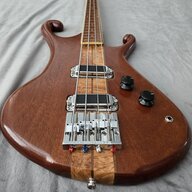
That makes sense to us artsy fartsy musicians, but this would go against the time honored Rickenbacker tradition of not adding extra steps or inventory and reusing as much existing processes/steps/inventory as possible before doing anything different.I am saying Rick should put the OP [...] pickups at least where the bridge pickups are in the basses in your pictures, not closer.
If we look at the body and neck this new model looks exactly like the 330 guitar next to it, with the exception of the tuning peg holes in the headstock. One might go so far as to conclude that the holes getting drilled into in the headstock is the last step done to the wood body/neck so they can use the exact same stock for both, so if the bass version is a flop and they have a bunch of in-process stock they can feed into the very popular guitar line that they know sells well

Don't forget Ric's tradition of charging a huge premium over standard models. Wouldn't be surprised if that's the case here as well.That makes sense to us artsy fartsy musicians, but this would go against the time honored Rickenbacker tradition of not adding extra steps or inventory and reusing as much existing processes/steps/inventory as possible before doing anything different.

I agree with the sentiment, but in order for my plucking hand to be where it would be functional on this bass,A Ricky without all the nonsense in the way of your plucking hand? Good stuff.
I’d have to wear it down by my knees.


Way to oversimplify it. ;-)A body hangs on you with the halfway point between the two attachment points centered between your shoulders - gravity ensures that. Where the scale isd relative to that determines the reach. On a Fender shaped bass, the scale starts at the bridge saddles (about 2" from the right attachment point). The nut is 34 inches to the left of that. The upper horn is the other attachment point on most designs, and on a Fender, it's at the 12th fret, which is 17 inches from the bridge saddles, or 19 inches from the butt end.
If you want a short scale that has 4 inches less reach, you use the same body shape and size, and start the scale at the same place. That will put the nut at 30 inches from the same point relative to your body. As the scale has been shortened, the upper horn will now land at the 10th fret. I've got a bass where the geometry was done this way, the reach is 4 inches less, and I think that's the way to do it - it takes full advantage of the shortened scale to give the player less reach. But noone else does that.
On some short scales the body is shortened, so the upper horn has been moved to the right, which means the center point between attachment points, when it's centered on your body, is moved to the left. If the bridge is still at the butt end of the body, and the upper horn is at the 12th fret, given the 4 inch shorter scale, the upper horn (being at half the scale length from the bridge saddles) is 2 inches closer - half scale is now 15, not 17 inches, so the attachment points are 2 inches closer to each other. The body still centers itself on the mid point, so the bridge (where the scale starts) has moved (relative to your body) a single inch to the left. That gives a minor shift (about an inch), but it is still a shift that increases reach a bit. that design gives you 3 inches less reach than a full scale - not ideal as it could be 4, but it's close.
On this Ric design, the bridge has been moved to the left - the scale starts much further to the left. Looks like it's a 4 or 5 inches of shift. If the body were full sized, that would mean the nut is 4 or 5 inches further out than it could be - about the same as a full scale, but here the body is also downsized, so add an inch more .The nut on this is actually further to the left when hung on your body than it is on a full scale instrument. It's simple geometry.
Yes, I'm a nerd (Physicists are by and large all nerds), but I have really thought about this. If you ponder it enough, and understand geometry, You'll get it.

4 paragraphs of (somewhat) technical explanation is "oversimplified"?Way to oversimplify it. ;-)

My GOD!!!! please bring back the 4002 and or a redesigned 5 string!!!!

I see any bass, from any company, with the bridge pickup THAT close to the bridge and I instantly ignore it. WHY do that? This bass has two essentially useless pickups, at least with the 4001/4003 the bridge is usable, but basses like this, and non-Club Hofners etc, with the bridge pickup slammed against the bridge are no-go for me.
Mine was a 75th Anniversary 660. Previously to that I had a 660/12.

It was a joke, hence the wink face I typed.4 paragraphs of (somewhat) technical explanation is "oversimplified"?
My GOD!!!! please bring back the 4002 and or a redesigned 5 string!!!!
Pretty please!!!!
I had a thought... A few months ago Ric made a run of new 4030S basses for Europe only. Does anyone think this new bass could also end up as a foreign market only item? Another thought... Every year around this time some of the USA dealers (Willcutt, Andy B., etc) get to order limited custom runs of guitars or basses. Does anyone think there is a chance this could be a limited run for someone?
No and no. This isn't planned as a limited edition. Also, don't expect a price tag that breaks the bank.I had a thought... A few months ago Ric made a run of new 4030S basses for Europe only. Does anyone think this new bass could also end up as a foreign market only item? Another thought... Every year around this time some of the USA dealers (Willcutt, Andy B., etc) get to order limited custom runs of guitars or basses. Does anyone think there is a chance this could be a limited run for someone?
Any hints on colors that will be offered? Please make some nice primary crayon colors, the brighter the better...lolNo and no. This isn't planned as a limited edition. Also, don't expect a price tag that breaks the bank.
So can anyone actually confirm this is officially a super short scale bass? Approximately a 25” (635mm) scale length? Or is that photo misleading or photoshopped?
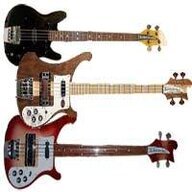
Maybe something like one of these:Any hints on colors that will be offered? Please make some nice primary crayon colors, the brighter the better...lol


