
• TalkBass has been independent since 1998. Add your voice.
    Create a free account to reply to discussions, view embedded media, and browse with fewer display ads.
    Join freeLog in
    Want zero display ads or expanded classifieds tools? Compare plans.

New Tool Day: CNC Router!

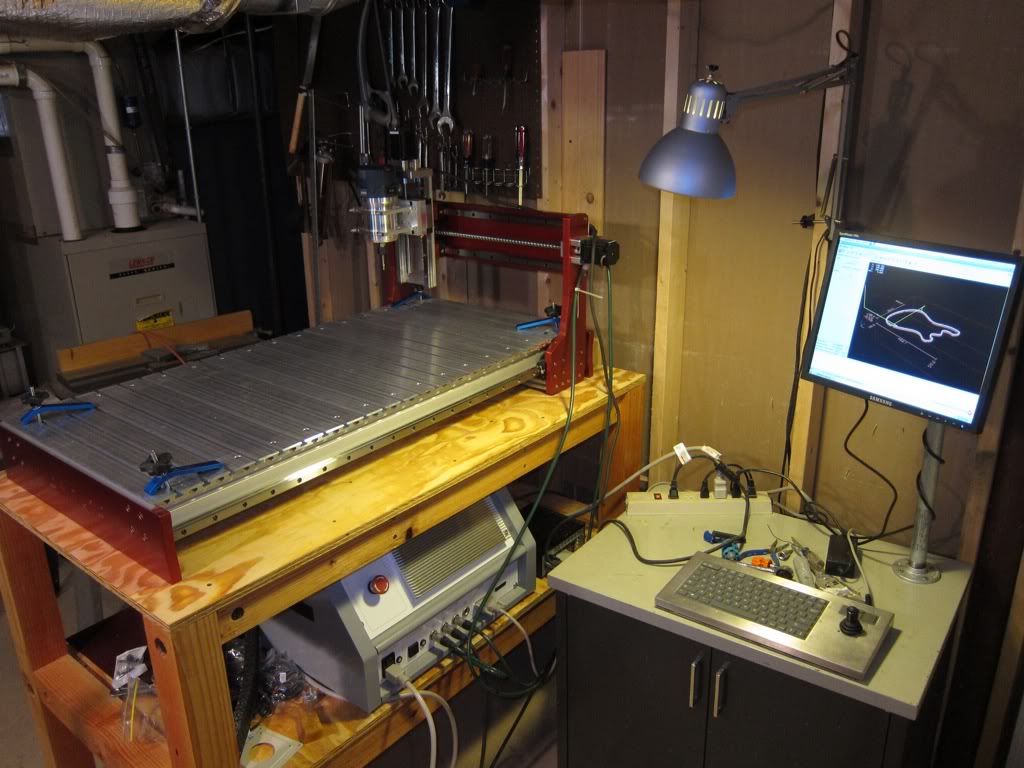
Victory! I'm done with the basic assembly.
d9c2e873.jpg


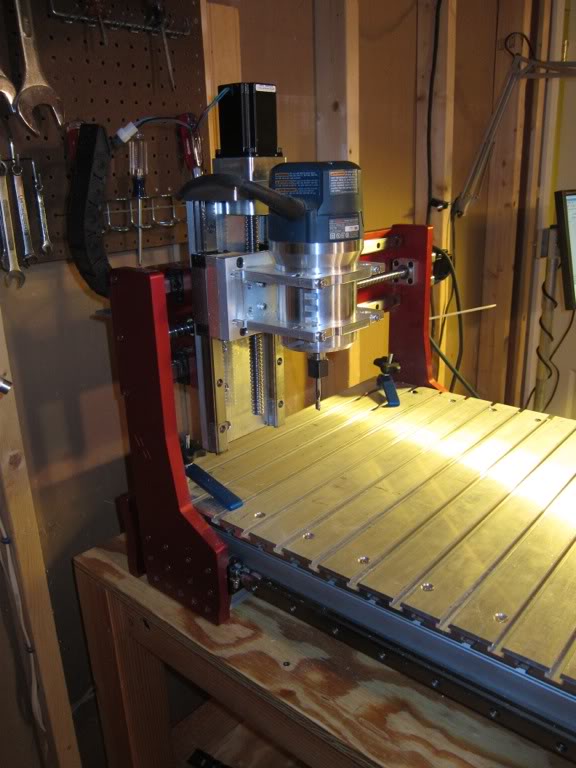
Was having problems with that little Bosch Colt, and realized pretty quickly that it was just too tiny for this application. My trusty Bosch 1617 is now mounted up:
baa65c9e.jpg


Yeah, yeah, I hear you - shut up and let's see it go!

First cut on YouTube!

Yes, I'm running it super slow - better safe than sorry. Spending half of my life in industrial environments tends to make me a little cautious.

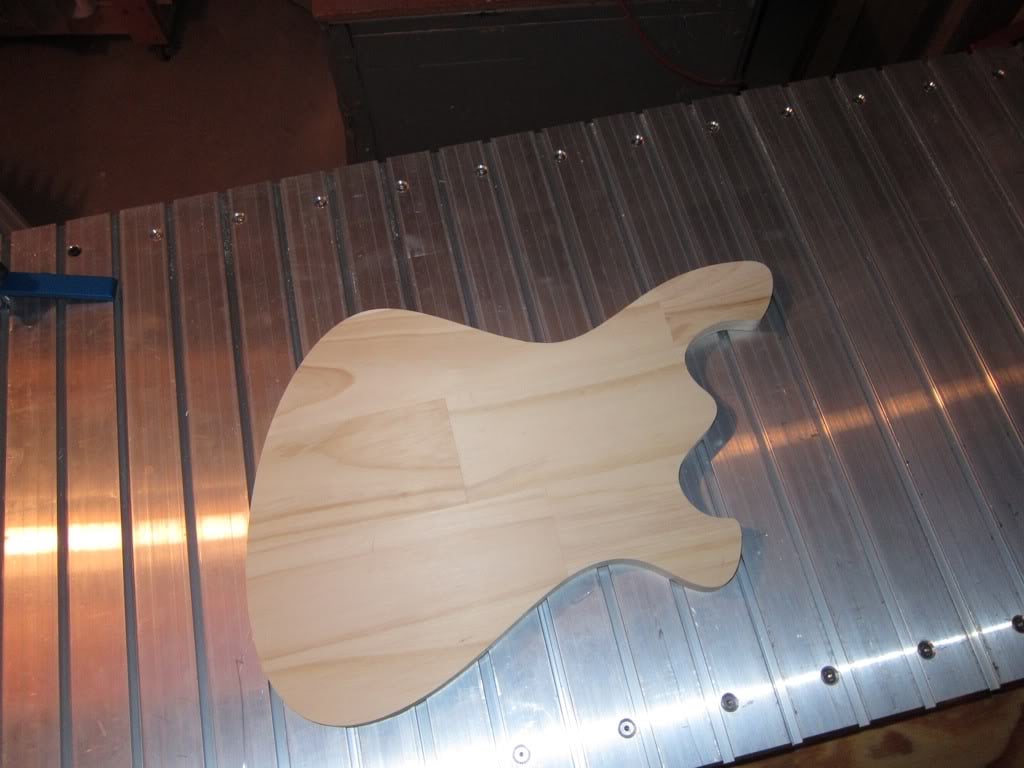
Cut out an outline of my "shape of things to come" in aspen from Lowe's:
d5b78efd.jpg


And now, after much giddiness, ringing ears, and sweeping, it's time to relax.

2b1bf673.jpg


I gave MeshCAM a try, but it's the wrong philosophy for what I need to do in defining tool paths. MeshCAM treats the entire design as if it were a simple surface...for guitar/bass design we're really utilizing a lot of 2-1/2D type CAD and machining ...

I bought MeshCam primarily on it's 3D merits, and realized really quickly that, like you said, it's not very good at 2.5D. So I started demoing other CAM programs that are good for profiling/pocketing, and I'm pretty stoked on CamBam. The routine in the video was made in CamBam. At around the same price as MeshCam ($150), I think I'm going to get this one. Haven't tried CamBam for 3D yet, but with how easy MeshCam is, I see a place for both in my process.

Thanks for watching, everyone! I'll continue to update this thread as I upgrade the machine, I have some more tasks, including installing proximity switches, making and flycutting more permanent spoilboard, and installing a pendant.
 
Thanks everyone!

iamlowsound said:
Awesome! Is that going to turn into an actual bass? Also, are you using a vacuum table to keep the wood in place?

lowsound

That is just a profile in cheapo lumber of a, aherm, piccolo 6 string I'm designing for a friend. An old neglected bass build thread of mine may get some attention soon though. As far as securing the work, the lumber is screwed into the spoilboard at the corners, and the CNC routine includes little tabs that keep the work attached until I cut it free.
 
Here's that piccolo 6 I'm working on. The machine cuts like a dream! Still learning about CAM, and figuring out the best speeds and orders of operations, but I'm getting there:

a04bf146.jpg


6732db4b.jpg


ea71f828.jpg


c46a9dcb.jpg


IMG_2598.jpg


I really like that shape. How does it compare to your Habanero in terms of size?

It's a little bigger than the hab. I have a bass version in the works!
 
I like that body shape.
I have to offer my congratulations to you for what you have accomplished here.
Really, really cool.

And yes, not to be the bad guy, but that neglected build thread is calling you...

:D

wraub

Thanks! And don't worry, that neglected build thread will get my full attention very soon. :)
 
Barnacle -

Beautiful CNC you've put together there, and beautiful work you're already doing with it. I have a ViperXZ on order from George at XZero and have a couple of questions on your setup if you don't mind.

1) Have you affixed your Raptor to the table in any way? Does it shake around when milling at all?

2) Are you using any limit or home switches?

3) It looks like the anodizing didn't cause any problems; I'm planning to do similarly (thanks for the inspiration!) and wanted to confirm that you didn't encounter any changed dimensions or anything in the close-tolerance parts after anodizing.

4) How is the small form factor, fanless PC working out? I'm likely going to be using Mach for my controller so I'm a little hesitant to go with anything but a full-on Intel CPU (i.e. worried about an Atom), but going fanless would sure be nice...

Thanks very much for any commentary you're willing to offer.

-John
Seattle
 
Barnacle -

Beautiful CNC you've put together there, and beautiful work you're already doing with it. I have a ViperXZ on order from George at XZero and have a couple of questions on your setup if you don't mind.

Hi John, thanks for checking out my thread! Congrats on going with XZero, it's amazing what George is delivering for the money. (And if anyone is wondering, I don't know him, I am just a very happy customer.)

So to answer your questions:

1) Have you affixed your Raptor to the table in any way? Does it shake around when milling at all?

It is not affixed to the table, yet. I am still making adjustments and modifications (that I will post here soon), so I haven't secured it yet. I run it at 120IPM max (much slower than it is capable of, but I'm not in a hurry), it doesn't move at all. It's very heavy, and the table I built is very solid.

2) Are you using any limit or home switches?
Not right now. I bought 5 proximity switches from George, with the intention of using them for homing and limiting, but I haven't installed them yet. I may only install 3 of them, for homing x/y/z. Right now I home X and Y using an index hole in the table, and I set Z height with a 1" block. Close enough for the stuff I am doing.

3) It looks like the anodizing didn't cause any problems; I'm planning to do similarly (thanks for the inspiration!) and wanted to confirm that you didn't encounter any changed dimensions or anything in the close-tolerance parts after anodizing.

No dimensional problems with the anodizing. The anodize shop used an etchant, they took off a few thousandths, then put it back on with the anodize. All of the slots for the linear guides, and the holes for the pins, were spot-on. What color are you going with? I wanted orange, but all I could get without a setup fee was red.

4) How is the small form factor, fanless PC working out? I'm likely going to be using Mach for my controller so I'm a little hesitant to go with anything but a full-on Intel CPU (i.e. worried about an Atom), but going fanless would sure be nice...
The PC is working great. EMC2 sends step/direction signals via serial port to the drivers in real time, and does it well. I don't have anything else on the computer except EMC2, and all unnecessary Linux features are disabled. As I understand Mach, the PC talks to a step pulse generator, which in turn sends signal to the drivers. I think the fanless Mini-ITX setup I have could run Mach just fine if you wanted to go that route, it is especially snappy with the SSD and 4gig RAM.
 
Professor Beauchene -

Thanks for your comprehensive response to my previous set of questions. I'm about to get my Viper components anodized and was wondering if you finish sanded yours prior to anodizing. Just chatted with George and he mentioned that if you sand them to a shine prior to anodizing you'll remove the (minor in my opinion but certainly present) extrusion marks for a more attractive finish. Any thoughts/recommendations based on your experience? Thanks,

-John
 
Professor Beauchene -

Thanks for your comprehensive response to my previous set of questions. I'm about to get my Viper components anodized and was wondering if you finish sanded yours prior to anodizing. Just chatted with George and he mentioned that if you sand them to a shine prior to anodizing you'll remove the (minor in my opinion but certainly present) extrusion marks for a more attractive finish. Any thoughts/recommendations based on your experience? Thanks,

-John

I didn't finish sand, I just knocked off the tool marks with steel wool. You can still see scratches beneath the anodize, but it doesn't look bad.

In retrospect- I wouldn't anodize any of your parts that contain threaded holes. When I had mine done, the anodize shop etched the parts back a few mils, before putting on the anodize layer; I've had problems with the threads stripping out on those pieces, where the thread of the hole literally pulls out in a spiral. No problems on the big parts with no threaded holes.

I'll post some stuff I've done with the machine on here really soon. I'm still getting my technique and workflow down, but I'm making good parts now- necks, bodies, pickup bobbins, even built a pickup winder!
 
In retrospect- I wouldn't anodize any of your parts that contain threaded holes. When I had mine done, the anodize shop etched the parts back a few mils, before putting on the anodize layer; I've had problems with the threads stripping out on those pieces, where the thread of the hole literally pulls out in a spiral. No problems on the big parts with no threaded holes.
That's strange. I worked for more than one automation design/build house, and have designed and had fabricated thousands of aluminum parts with threaded holes, and there was never a problem. Did you specify an electropolishing etch before anodizing or something? In my experience, the only concern would be screw holes tightening up due to the anodize layer addition.
 
That's strange. I worked for more than one automation design/build house, and have designed and had fabricated thousands of aluminum parts with threaded holes, and there was never a problem. Did you specify an electropolishing etch before anodizing or something? In my experience, the only concern would be screw holes tightening up due to the anodize layer addition.

On the one threaded piece I had anodized, two of the six threads have pulled out in little curly q's of aluminum. I did have the shop etch it back before anodizing to keep the holes from getting tight, not sure what exact type of etchant they used though. No threads have pulled out in the non-anodized aluminum. I'm not saying that correlation is necessarily causation, but it is the experience that I've had here.
 
Either the taps were wrong before anodizing, or some part of the process was wrong - but there is no reason you can't anodize tapped aluminum. Thousands of holes, with clear or black anodizing, don't lie.

Also keep in mind a socket head screw into aluminum can't be torqued anywhere close to what it can be when tightened into a steel plate. That goes for plain or anodized aluminum. You'll strip out the aluminum plate -- even if it is a structural ("aircraft") grade such as 6061-T6 or 7075-T6.
 
Either the taps were wrong before anodizing, or some part of the process was wrong - but there is no reason you can't anodize tapped aluminum. Thousands of holes, with clear or black anodizing, don't lie.

Also keep in mind a socket head screw into aluminum can't be torqued anywhere close to what it can be when tightened into a steel plate. That goes for plain or anodized aluminum. You'll strip out the aluminum plate -- even if it is a structural ("aircraft") grade such as 6061-T6 or 7075-T6.

I defer to your experience. I didn't use a torque wrench, but I applied reasonable hand torque to the bolts- nothing crazy. The ones that stripped hold the Z axis to the Y axis, so those six bolts under a lot of strain. I'll probably drill and tap them the next size up.
 

Latest posts