I just got my new B3n. Yet, I have not yet replaced my modified B3s and MS60Bs. They are well integrated into my setup and I need first to get the B3n fully going before I am willing to replace my B3s from my proven setups.
First impression is that the B3n is indeed quite a big, I'd say even very big step forward compared to the B3. IMHO there are only a few drawbacks that may not matter for others at all.
First I believe the idea of the two basic modes (MEMORY vs. STOMP) is excellent and there is no need now to modify the B3n as I saw absolutely necessary for my B3s for gigging (see
B3 modfication with stompbar or
B3 modfication with stompbar #741, page 38 as used on
Invalid Link Removed). Zoom's solution to this problem with having 6 stomp buttons and the two modes is excellent and opens up many more avenues that did not exist with the B3. I like in particular also the fact that in STOMP mode I can read which patch is on, even without bending down to my feet. There was nothing comparable on the B3 and during gigs I often found myself to use my stompbar to switch back and forth between two patches just to make sure I was currently on the right one (the B3 shows the patch name when activating a patch, but for a few seconds only). The B3n solution showing the patch names all the time is like heaven compared to the B3.
--- The only drawback I found in STOMP mode is that on my B3n all bank switches generate a short distorting whistling sound. For me this means a bank switch in the middle of a song is a complete no go. Do others get that too? Or does anyone know a fix for this?
Second I am very happy that the B3n offers up to 7 slots for effects. On
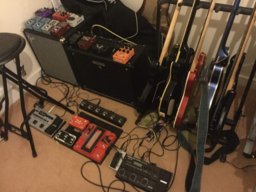
Invalid Link Removed I have currently in series a MS60B and a B3. The MS60B serves me to overcome the limitation of the B3 (offering only 3 effect slots). I typically use the MS60B for ZNR noise reduction. Now, BTW, as a quick comment on some of the concerns others raised above, in blind tests I cannot hear a difference whether the signal is once more AD-DA converted or remains digital within a unit such as the B3, B3n, or MS-60B. Therefore I believe such concerns can really be dropped today and one can easily daisy chain digital effects without risking to get noise or other signal deterioration, of course only if all settings are made optimal (e.g. unity gain at every stage, making good use of headroom etc.). Nevertheless, being able to switch now patches within the same unit with a single stomp push, is a setup I very much more prefer. Thus I guess I will soon replace happily my MS-60B-->B3 setup to avoid having to hit two stomps (stompbar AND MS-60B) when switching patches. On last tour in one gig I forgot to turn off the ZNR of the MS-60B for a patch on the B3 using also ZNR. During a quiet part of the song two ZNRs in series were really too much of noise reduction and I could not play that passage at all or then too loud (was quite embarrassing actually and my band mates were not happy with me at all

).
--- There is also a small drawback that comes with the much bigger flexibility of the B3n: Amp and cabinet simulations use two slots, while in the B3 they occupy only 1 slot. Moreover, I use my pedal FP02 for volume control in almost all my patches (MIN 75, MAX 100, the MIN being always at unity gain) for a small reserve boost during gigging. Again in the B3n this uses up a slot (out of the 7) while the B3 throws this in "for free". But all in all as I said before, I very much prefer the flexibility of the B3n. Well done Zoom engineers!
These my main initial impressions and my first attempt to summarize them a bit, hoping this might be of some interest to some of you, notably to those interested in comparing the B3 with the B3n.
Cheers,
Andreas flf
P.S.: Perhaps I might have one of my stomp-bar enhanced B3s for sale soon (but not sure yet by when and whether at all, the B3 with a stomp-bar being still a very fine unit

). Will see...



 CAREFUL!