
Enjoy the benefits of a premium membership!
Upgrade Account
-
TalkBass has been independent since 1998. Add your voice.
Create a free account to reply to discussions, view embedded media, and browse with fewer display ads.
Join free Log in
Want zero display ads or expanded classifieds tools? Compare plans.
You are using an out of date browser. It may not display this or other websites correctly.
You should upgrade or use an alternative browser.
You should upgrade or use an alternative browser.
Newbies and Nice Basses
- Thread starter Dr. Cheese
- Start date
More options
Who Replied?

So, with all that said (and many more reasons noted in this thread), I think it's a mistake to recommend that newbies start with a boutique whenever possible. I'm not saying it's WRONG to do so, but it's unnecessarily expensive. In most cases it's better for the newb to start in the low to mid range, and move up later.
Fender American Jazz Standard comes to mind. It's not ultra expensive, and not ultra cheap. If the OP has a complex about playing something too cheap, he can be rest assured that a lot of pros use the MIA Jazz.
I actually started on a Yamaha RBX765A. It was a 5-string, which I played in a band for a few years. If I recall, it was only around 600 bucks or something at the time. I was a guitar player that was asked to play bass for a band. So, I used my tax return and went with a rent to own option. It worked well for me until I learned more about basses and what I was really looking for.

IMHO it's silly to think that an expensive one would somehow hinder a beginner.
As noted I can see how a beginner could get confused** by a fancy onboard preamp (present on many boutiques). A beginner's first priority should be proper technique, which is their quickest path to good tone. I don't believe that tone is ALL in the fingers, but technique is arguably the biggest factor. IMO advanced tone sculpting is for those who have already acquired some degree of competence with technique.
**The hindrance would be not knowing how to set the preamp flat, accidentally dialing in extreme settings that prevent him from getting decent tone from the instrument regardless of how well he plays

This isn't particle physics. A cheap bass that is set up well can surely satisfy, both in terms of tone and playability. However, IMHO it's silly to think that an expensive one would somehow hinder a beginner.
Some basses are very transparent and highlight bad technique. MTD has a reputation of exposing bad technique, and I have heard the same about some other high end basses. If a novice has a great teacher and the discipline to develop a clean technique, the bad sound will be overcome, but my guess is that more quickly hearing improvement on a less demanding instrument would be more gratifying. I compare it to a novice biker getting a super fast bike with hair trigger brakes and clutch before learning to ride.
Some basses are very transparent and highlight bad technique. MTD has a reputation of exposing bad technique, and I have heard the same about some other high end basses. If a novice has a great teacher and the discipline to develop a clean technique, the bad sound will be overcome, but my guess is that more quickly hearing improvement on a less demanding instrument would be more gratifying. I compare it to a novice biker getting a super fast bike with hair trigger brakes and clutch before learning to ride.
I can see your point, theoretically, but IMHO a pricey bass is just as likely to inspire and help a new player as it is to discourage him/her. I would not tell a beginner not to buy a nice bass because it might confuse him or discourage him by making his weaknesses easier to hear. I would, however, tell him that his tastes will likely change throughout his bass playing life and that he should keep that in mind before selling a kidney to buy a shiny new bass.

Newbies today have it too good. When I started playing back in the late 60's you basically had a choice of some garbage non-branded POS at the department store or a real Fender. Today a newb can spend $300 on a Squire J or P and have a damn nice playing, sounding and looking bass. And that's about $50 in 1969 money.

I Spent over $500 on a new bass that came in Friday of last week. You know what brand it was? Hofner yes I bought a HCT 500/1 and it sounds a plays great, I have been I guess you could say fiddling with bass for about 2-3 years, I play bad because I don't want to take lessons from some guy who wants to teach me his way of playing. We all have our own style of playing and if me learning myself and learning off my mistakes means im a newb then I guess we are all newbs. That isnt my first bass though my first bass was a Gretsch Electromatic with terrible action and needed a neck reset. I never did fix that guitar. Second guitar was a starfire violin bass for free with good action and minor fret buzz now im here with my Hofner playing at levels i thought would never be possible.

IMHO whether you are a newbie or not, buy the best instrument that you can afford.
The better the instrument is the more likely that you will be inspired to play it frequently.
And the more you play, the better you will become.
++

I like to think i don't totally suck as a bassist (been playing for a 3 or 4 years now).
I also like to think my basses don't totally suck (USA peaveys and a MIJ Ibanez)
I started out on a Silvertone P from walmart, and I do believe it hindered my technique. It had a wide and super shallow neck, and the fretwork was adequate. The action, however, was stupid high, and thats where i feel my technique was affected. I was able to use the right hand technique of a behemoth without getting string clack. Now that i prefer my action at a usable height, I have to really work at not getting string clack that dampens the vibration of the string. The bass also had stupid wide string spacing at the bridge, which i really had to work to get out of. And don't even start about the tone... Wimpy wimpy wimpy. So all in all, I feel beginning instruments do not have to be the most playable, or the best sounding, or even the most well made. Because it is all just a learning experience. Something to cut your teeth on. Ever notice "cutting your teeth" sounds kinda painful? Well, its not always easy to learn something new. Its a bass. Learn to play it. We didn't all start out taking derivatives of tangent functions in math, did we? No, we started with the basics, using basic tools and building upon them. Its a growing process like anything else.
I also like to think my basses don't totally suck (USA peaveys and a MIJ Ibanez)
I started out on a Silvertone P from walmart, and I do believe it hindered my technique. It had a wide and super shallow neck, and the fretwork was adequate. The action, however, was stupid high, and thats where i feel my technique was affected. I was able to use the right hand technique of a behemoth without getting string clack. Now that i prefer my action at a usable height, I have to really work at not getting string clack that dampens the vibration of the string. The bass also had stupid wide string spacing at the bridge, which i really had to work to get out of. And don't even start about the tone... Wimpy wimpy wimpy. So all in all, I feel beginning instruments do not have to be the most playable, or the best sounding, or even the most well made. Because it is all just a learning experience. Something to cut your teeth on. Ever notice "cutting your teeth" sounds kinda painful? Well, its not always easy to learn something new. Its a bass. Learn to play it. We didn't all start out taking derivatives of tangent functions in math, did we? No, we started with the basics, using basic tools and building upon them. Its a growing process like anything else.

Newbies today have it too good. When I started playing back in the late 60's you basically had a choice of some garbage non-branded POS at the department store or a real Fender. Today a newb can spend $300 on a Squire J or P and have a damn nice playing, sounding and looking bass. And that's about $50 in 1969 money.
+1. I wish I had access to some of today's "cheap" basses back in the 70s when I started playing. A Gibson Grabber was my first good bass back then and I chuckle when I see them now being desirable. It was an OK bass but not as good as some of today's affordable gear.
The odds of being great as a player if your sole or main focus is gear are pretty low.
This is a lesson all of us who spend too much time on TB need to learn!

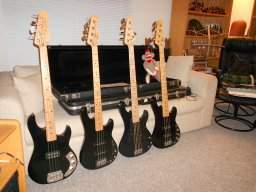
This is a lesson all of us who spend too much time on TB need to learn!
self awareness doesn't equal an end to therapy.... GAS is endless!

GAS is endless!
I know. I've got really nice gear... Sadowsky, Smith, Carvin, Warwick, yet these forums still make me feel like I'm missing out on something because I don't own a Fodera, MTD, F bass, etc.


What is a newbie? Learning? First gig at high school? Home player that doesn't gig? 1 year, 2 years playing? Honest question here.
Have to chime in here sorry, I have been playing for many years and have owned a multitude of different basses.....went to guitar center one day, played an expensive american p bass, then tried the Pete Wentz squire, they felt the same to me, and the tone coming out of the squire was very good, I bought one, 299, compared to the 1200 for the american made, I think the squire basses are great and would recommend them to a beginner, its all about how it feels, you dont even have to be a Pete Wentz fan to appreciate the craftsmanship on the bass ( Pete Wentz plays the squire himself, not like Gene Simmons trying to push those garbage Cort basses down his fans throats, when he himself plays a much more expensive version)

I would say that it would be beneficial to a new player for the strings to be as low as possible, as the strength and dexterity in their fretting hand is going to be significantly less than an experienced player. By having the action low, they can focus on technique early on and not so much on having to overcome the resistance from high action. It also will teach them to use a light touch with their plucking hand from the beginning as opposed to having to tackle that later on. Fundamentally, it makes sense from every aspect of learning the instrument that the action be as low as possible, in combination with proper intonation and good fret work so the beginner isn't fighting the bass while learning.
Unless of course you're trying to teach someone through belittling their attempts at progress by comparing it to some cliche about how hard the old timers had it, and how easy those kids have it now, or some other equivalent approach to pedology.
Poorly set up guitars with high actions have caused more kids to quit playing than anything else in my estimation. Give a kid an instrument that isn't painful to play and they'll be a heck of a lot more likely to stick with it. My first instrument was some rickety POS with an action so high I practically had to stand on it. Just when I was about to give it up a friend's dad showed me his perfectly set up 1972 Jazz bass. It was like a different instrument. I convinced my parents to buy me something I could actually play, which turned out to be a Jazz bass copy that had to weigh 12 pounds, but played way better than the POS. I played it until I was good enough to prove that I needed to take a step up in quality, which got me a 78 P Bass. But if I never got my hands on a decent quality instrument with low action I may have given it up.
What is a newbie? Learning? First gig at high school? Home player that doesn't gig? 1 year, 2 years playing? Honest question here.
In short, a beginner. I define that as someone just starting out, but it could also include someone who has owned an instrument for awhile, but does not play it regularly, has not taken (m)any lessons, has spent very little time learning about technique, theory, or the instrument itself.
Gigs are irrelevant. One can become an excellent musician without playing professionally.

Really this applies to advanced as well as beginners:- buy a bass that is most comfortable and right for your play style. There are some that invest in a more expensive bass as more of a collector than to actually play it daily. Nothing wrong with that either- some people collect cars that are super fast but are not economical commuter cars. The Ferrari is not the car they used on a daily basis.
How this applies to the op's question is that it's okay for the beginner to appreciate finely made basses but realize that what is fantastic (and I assume more expensive) is not necessarily the right instrument to play on. I have been playing for 30 years, I have a $3000 bass, my current favorite bass is one that costs under $300 new. I don't care what the name on the headstock says (Sterling Sub), truth is I play better on it than my more expensive bass because the neck, the action is ideally suited for me. I can slap super fast on it- noticeably faster than on most other basses to the point where people tell me to keep an extra Sub handy- heck with the Fender. If you sound good on it, isn't that all that matters? I love and appreciate Fender basses, they're not the kind of bass I would play best on so they stay in my rack.
There was an article in a book I was reading about how Stanley Clarke instantly noticed he could "go places where he couldn't go before" when he first tried his Alembic. Finding the right bass makes a difference.
How this applies to the op's question is that it's okay for the beginner to appreciate finely made basses but realize that what is fantastic (and I assume more expensive) is not necessarily the right instrument to play on. I have been playing for 30 years, I have a $3000 bass, my current favorite bass is one that costs under $300 new. I don't care what the name on the headstock says (Sterling Sub), truth is I play better on it than my more expensive bass because the neck, the action is ideally suited for me. I can slap super fast on it- noticeably faster than on most other basses to the point where people tell me to keep an extra Sub handy- heck with the Fender. If you sound good on it, isn't that all that matters? I love and appreciate Fender basses, they're not the kind of bass I would play best on so they stay in my rack.
There was an article in a book I was reading about how Stanley Clarke instantly noticed he could "go places where he couldn't go before" when he first tried his Alembic. Finding the right bass makes a difference.
Some basses are very transparent and highlight bad technique. MTD has a reputation of exposing bad technique, and I have heard the same about some other high end basses. If a novice has a great teacher and the discipline to develop a clean technique, the bad sound will be overcome, but my guess is that more quickly hearing improvement on a less demanding instrument would be more gratifying. I compare it to a novice biker getting a super fast bike with hair trigger brakes and clutch before learning to ride.
This is an interesting line of reasoning but flawed in the motorcycle comparo. As a lifetime rider, I have intimate knowledge of that which you reference. There is nothing life threatening about playing a $1000 bass instead of a $150 bass.
My point is that a good action is probably wasted on someone who really has not yet developed a touch. Although getting a nice bass is great for those with the money, a newbie needs to actually learn how to play before he or she can really get something out of a nicer bass.
I guess I agree to a certain point with the op except this line. Good action is never wasted even for a beginner if it makes learning the bass easier on a properly set up bass. In fact, regardless of the cost of the bass, I would go so far as to say, it has to be set up with good action in order to get the most out of it. Why make things harder for a beginner with a badly setup one?


