• TalkBass has been independent since 1998. Add your voice.
    Create a free account to reply to discussions, view embedded media, and browse with fewer display ads.
    Join freeLog in
    Want zero display ads or expanded classifieds tools? Compare plans.

Nitro P-Bass Build

Time has been a little tight, recently. But I'm hoping to finish up the bass very soon.

As for recording it? That's another story entirely. I don't have a A/D interface for my computer. And I fear that my iPhone and HD Flip don't have the ability to adequately capture the tone. That's another project entirely!
 
I took this week off from work. I had some time off that I was able to carry over, and it provided me enough time to get some things done at home and get the infamous project P-Bass wired up! So, what does it ACTUALLY involve?

First, getting the pickup mounted in the body. The pickup I went with is the Seymour Duncan Antiquity II Precision pickup. It's got the old-school type of tone that I wanted for this bass. Mounting it is fairly straightforward. There's a mounting plate that sits underneath the pickup magnets, and glued to that are strips of foam. Those provide some of the springiness to the pickup that let you dial in your pickup height.

020_zpse63262f5.jpg


Four screws go through the pickup covers and into pre-drilled holes in the body. This is where using a parted out body is helpful, since the pickup screw mounting holes have already been drilled. Otherwise, you might have to use the pickguard as a template for mounting the pickup.

Coming from the pickup are two leads from the pickup. Because wiring schemes can vary from bass to bass, Seymour Duncan leaves these wires fairly long so that they can reach controls in a variety of positions. In an attempt to recreate the same materials that you would see in a vintage instrument Duncan wrapped the wires in a cloth jacket. You're very likely to see this kind of cloth wrap in a Fender vintage reissue as well. The one hitch? The cloth wrap makes stripping the wire a little more labor intensive.

022_zps52aa1a6d.jpg


So what next? It's time to break out the soldering iron! Because the only good way to connect your pickup to the volume and tone controls is through solder joints. Thankfully, both Seymour Duncan and Stewart MacDonald (where I got the pots, output jack, capacitor and additional wire) provide schematics on how to wire a P-Bass.

021_zpsbb1ea521.jpg


Then, the soldering begins. That means tinning every surface that's going to get soldered. Simply stated, that means applying solder to the wire ends and connection points on the pots and output jack.

023_zps64804a5f.jpg


024_zpsbdb0c62a.jpg


027_zps1367a338.jpg


...to be continued!
 
A little more from my work on the P-Bass. So, it turns out that soldering is something that takes some focus. Hence, fewer photos.

026_zpsc1a5df53.jpg


The leads on the pots as well as the wire ends need to be tinned in advance. It makes joining the wire to the pots far easier.

028_zpsa30b2ab9.jpg


Some significant things to keep in mind? First, mount the pots on the pickguard. This might seem kind of obvious, but doing this helps to keep everything in the position it will be in when you attach the pickguard to the body. And you need to keep your wire runs very neat given the tight nature of the control cavity.

030_zps9c1b2eb6.jpg


If you don't keep those wire runs neat? It's very possible that you might wind up with some excess wire that could end up under the pickguard and it won't mount flush.

029_zps7d49960d.jpg


Also important? Grounding the strings and bridge. Most modern basses have a hold drilled for a ground wire. That wire runs from the body of the volume pot through a hole in the body that ends up under the bridge. Be sure to strip back the wire enough at the bridge end so that it will spread out somewhat under the bridge plate.

031_zps1125960a.jpg


When all the wirings done? Slap on the pickguard and get it fastened down. From here it's a matter of mounting the bridge and then getting the instrument strung.

032_zps686ec1c6.jpg


Sorry, no images right now of the bass with the bridge and strings. And none for at least a few more days. Why? It's about knowing your limits. I can do the rough work of basic parts assembly. Fastening on the tuners, bridge and other hardware is simple if you've got rudimentary skills with a screwdriver. Wiring up the bass is pretty easy too, if you have some basic training with a soldering iron and the schematics.

But adjusting a neck that hasn't been used for months? That can take a little more training and experience. I can tweak a truss rod for some basic adjustments, but the neck on the project P-Bass needed a little more attention than I could give it. So I brought it over to my favorite musical instrument shop for a setup. I think it will be money well spent in the long run.
 
Cool build! I am interested in seeing your progress, has it been completed? I am attempting my 1st build too with a P. Waiting on the body to arrive and then my g.a.s. will be in full effect! I found a body made by Texas Customs, a solid body mohog. I am still uncertain of the look she will have, kinda waiting until I find a good deal on a neck and take it from there. I may complete a Tex Cust build, their controls are just sick, but expensive. Those Geezer EMG's are calling my name too! Decisions decisions... Send us an update!
 
Thanks for the feedback, guys.

This is where the project stands: the bass has been completely assembled. However, the neck did not have proper tension on it for some time due to the ammount of time I needed to get the assembly completed. When I finally got the wiring done and the bridge fastened I was able to get the bass strung. However, the action was far from perfect. So I started adjusting the truss rod. But it looked like the neck had developed some back-bow. As a result I brought this bass into my local repair guy so that they could address the neck relief. At this time I'm still waiting to hear back that the bass is ready to be picked up.

@GeezerEntwistle: Actually, NO.

The neck is an Allparts (licensed by Fender) 4 string Jazz bass replacement neck. It was finished in Nitro by Dan Atkinson. The body was from a Invalid Link Removed which was parted out. That instrument is also a 4 string. BTW, the Jazz neck fit surprisingly well in this P-Bass's neck pocket.
 
that's odd, did you loosen the truss rod nut while it was not strung/under tension? I have left necks for years with no tension and they return to proper relief once they are set up. Could be a bum neck

The truss rod was actually left exactly as I received it from the TB seller who I bought the neck from. They reported having no issues of any sort when I purchased the neck a few months back.

The possibility that this neck could be a lemon has crossed my mind. But I think it's still entirely possible that the neck might be able to get into proper relief given the correct sort of attention. I should hear something back from the repair tech tomorrow.
 
@GeezerEntwistle: Actually, NO.

The neck is an Allparts (licensed by Fender) 4 string Jazz bass replacement neck. It was finished in Nitro by Dan Atkinson. The body was from a Invalid Link Removed which was parted out. That instrument is also a 4 string. BTW, the Jazz neck fit surprisingly well in this P-Bass's neck pocket.

OK- I had an old pbass and know the strings go through the body at the bridge... and Im counting 5 on yours. No doubt ignorance on my part for something. yep it is, just looked and its not through the body, those are pilot holes for the bridge.

whats the cost difference in the build up versus mod'ing an existing pbass?
 
OK- I had an old pbass and know the strings go through the body at the bridge... and Im counting 5 on yours. No doubt ignorance on my part for something. yep it is, just looked and its not through the body, those are pilot holes for the bridge.

whats the cost difference in the build up versus mod'ing an existing pbass?

No worries! Yes, those are the screw holes for mounting the bridge. They had already been drilled since this was a bass which was parted out. Thanks for doing that work, Fender!

As for cost? Good question! The only thing that's comparable to what I've been trying to build would be a Fender AVRI 62 P-Bass reissue. Roughly, this bass cost me about $750 to build. As for putting this particular bass up against something comparable? From a finish standpoint, the quality of the pickguard, pickup and tuners, I would have to compare it with an AVRI 62 Precision. Now, if I could find a black AVRI P-Bass that would cost me between $1000 - $1300 on the used market. And then to get a Jazz bass neck for this bass? That could be anywhere from $200 - $400.

Even though I've invested a fair amount in this bass, I think I'm still doing okay from a financial standpoint. And I don't have to go through the trouble of trying to track down the exact used bass I want for this project, which might have some pre-existing issues. And then there's the matter of the neck. Sourcing a specific neck can be a little difficult. And then if I had gone to the point of buying a whole AVRI 62 P-Bass, what would I do with THAT neck? There are lots of those considerations to keep in mind in the whole process.
 
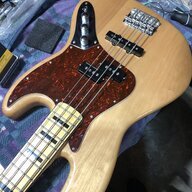
This project has taken longer than I thought. But earlier this week I was able to pick it up from my local tech who managed to get the neck relief on this bass just right. I decided to go with medium action because I dig in a fair amount. And after plugging the bass in I'm definitely pleased with the results. But what about pics? This post is useless without pics! So here they are:

071_zps5142e005.jpg


072_zpsaa9728af.jpg


080_zpscf4cfaee.jpg


073_zpsbc6dfd9a.jpg


077_zps15c4d1c2.jpg


078_zps8dff6dbc.jpg


081_zpsdfdaba30.jpg


082_zps76aa3a8c.jpg


084_zpsa1926e18.jpg
 
Many thanks! This was my first build, and it was honestly a lot of fun. It took me a good deal longer than I had imagined. But with a toddler at home it's been a little tough to find the time to commit to the work.

Here's a rundown on the parts sourcing:

BODY: Dan Atkinson bought from eBay seller The Stratosphere. I chose this body specifically because of the black nitro finish. The body came with strap pins.

NECK: Allparts JRO Replacement Neck for Jazz Bass finished in nitro and reliced by TB Member Dan Atkinson, and bought from another member on TB. The neck came with a string retainer but no tuners.

PICKUP: Seymour Duncan Antiquity II Precision bass pickup purchased from NY area dealer the Music Zoo.

PICKGUARD: The pickguard wound up being custom cut for me by the fine folks at Chandler Music/Pickguard Heaven. I think that their 4-ply tortoiseshell was one of the best out there. Specifically, I went with their material number 41 Tortoise Shell (brown) 4-ply .095

HARDWARE: Pretty much all of the hardware is stock Fender, and sourced from Alto Music in New York's Hudson Valley.
BRIDGE: Fender P Bass/J Bass Vintage Bridge Assembly
TUNERS: Invalid Link Removed plus the Invalid Link Removed
KNOBS: AllParts MK-0110-010 Chrome Dome Knobs
THUMB REST: Invalid Link Removed

WIRING KIT: Stewart MacDonald Premium Wiring Kit for P-Bass. This kit features solid shaft CTS 250 K pots, a capacitor, the output jack and cloth covered wire.


All in all I was pretty pleased with the parts sourcing for this particular build. I might change the location on the tug bar, but I want to give it a little time in it's current position first.
 
In an attempt to recreate the same materials that you would see in a vintage instrument Duncan wrapped the wires in a cloth jacket. You're very likely to see this kind of cloth wrap in a Fender vintage reissue as well. The one hitch? The cloth wrap makes stripping the wire a little more labor intensive.

You don't have to strip the cloth, you cut the leads to desired length, then push back the cloth jacket to expose the bare wire for soldering

 
Bumping up this thread as I just ordered the neck that I had originally planned to get for this particular bass: a Fender Road Worn Jazz bass neck!

I've had a Road Worn Jazz since 2010 and it's a fantastic instrument. And I liked the neck so much that when I hatched the plan for this particular instrument I not only wanted this to be a P-Bass with a Jazz neck, but also a RW Jazz neck. The radius and nut width work for my hands far better than a traditional P-Bass neck. And the relic finish gives a level of comfort that's just hard to beat.

The new neck should be here soon, and at that point I'll be updating the thread. I'm also toying with the idea of a Spitfire tort pickguard, but I'm still on the fence about that. As for the sound of this bass? With the D'Addario Chromes that are well broken in combined with the Seymour Duncan Antiquity II P-Bass pickup, it's got that classic P-Bass tone that's hard to beat.
 
  • Like
Reactions: Osztertag2112

Latest posts