• TalkBass has been independent since 1998. Add your voice.
    Create a free account to reply to discussions, view embedded media, and browse with fewer display ads.
    Join freeLog in
    Want zero display ads or expanded classifieds tools? Compare plans.

Double Bass No nylon tailpiece hangers...ever!!!

Mario Lamarre usually puts the Kevlar 'Fabric cord' on all basses he sets up. In my experience, basses tend to sound louder, and more 'open' than steel cord.
Also the fact that Fabric cord is much more flexible than steel, there's more 'give' and you're bass might benifit from the reduced tension at the saddle/tailpiece/tail-gut area. It's possible to experience a looser more 'easy' feel on the hands with this material, which can be desired on some basses that are full of tension.
This material is super strong, and if properly installed will not fail on you.
The worst tail-gut I have experience with is the metal 'coat-hanger' type. It's not flexible, and it just eats up the sound of the bass. I had this on my plywood, and it was a bit of a drag.
Maybe the Nylon type is worse for structural integrity, but the 'coat-hanger' metal tail-gut is the worst for sound production IME.
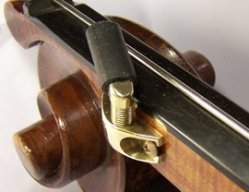
 
Invalid Link Removed
. Its rated strength is minimum 1600 lbs, average 1800 lbs, much higher than that of aircraft stainless wire cable, which I believe is about 350 to 500 lbs for 1/8" cable, from what I recall seeing in Lowes, Home Depot and a local hardware store.
I think you need to check again on the strength of aircraft stainless cable. I normally use 3/32" Invalid Link Removed and it is rated at 920 lbs. 1/8" cable is rated at 1720 lbs. I've never had one fail in 40 years of using this type cable.

BTW - The cable sold at Lowes, Home Depot, etc. is usually sold as garage door cable for the home and I seriously doubt if it is certified aircraft cable.
 
16th inch 133 strand stainless aircraft cable is rated at 460 lbs. That many strands make it plenty flexible, and since you're doubling it, you get 920 lbs. That's strong enough for me. Also, it's like two orders of magnitude cheaper than what you pay for synthetic from a music retailer, and I've never heard of a failure. Can't say that about synthetic. You guys do what you want, but Bob and I have a stainless-steel-clad argument!
Robobass
 
Invalid Link RemovedI think you need to check again on the strength of aircraft stainless cable. I normally use 3/32" Invalid Link Removed and it is rated at 920 lbs. 1/8" cable is rated at 1720 lbs. I've never had one fail in 40 years of using this type cable.

BTW - The cable sold at Lowes, Home Depot, etc. is usually sold as garage door cable for the home and I seriously doubt if it is certified aircraft cable.

I went by what the stores had the cable described as, and don't recall they were necessarily associated with garage door installation, but you're probably right.

Thanks for the link, I'll be ordering some cable from Wicks. In your setups, what do you use to secure the cable? Do you use the U-clamps also as Ken Smith uses? All the links that come up searching for Nicopress equipment are either in the UK, NL and China. Anyone have any sources here in the US for Nicopress stainless ferrules or stainless barrel connectors with set screws?

Lloyd Howard
 
I got a nylon Sacconi tailpiece wire with a tailpiece I ordered a few years ago. I took one look at the flimsy threading and connector on the end and tossed it into the garbage. I could not imagine it being strong enough to hold the tension from the strings.
I went with Lemur's brass ferrule with the screws for a while. It was fine but when I tried the Pecanic I was amazed at the improvement in the sound. More bass. More open sound.
Its been on my bass for a couple of years now without any problems.:hyper:
 
:mad: Last week,Against my better judgement, I decided to try something new. I decided to try a newfangled nylon tailpiece hanger on my bass. (not the Clef one upton sells, but one with a screw type fastener. Got it from (all hail!) Bob G. Not his fault, he didn't recommend it anyway, but it looked really cool... So anyway, I got it on, no problem, adjusted it to where I wanted it, no problem and set it up. Then it started s-t-r-e-t-c-h-i-n-g. A little miffed, i readjusted it, and tuned the bass up again. More stretching, and then SNAP! tailpiece flies up, bridge flies off, soundpost falls... Ticked off, I give it one more try with the same results..grrr...:mad:So this morning, I go to home depot get some old-fashioned cable and ferrule, and adjust it the old way and now it's fine. Sometimes new stuff isn't all it's cracked up to be. I've had enough stress for awhile....:hmm:

I had the bridge collapse and sound post fall once. I'll never forget the sound of the sound post falling and coming to rest at the bottom of the bass. But yours has to be the worst case scenario!

Still I don't agree with your conclusion "not ever" -- even though you have a lot of good company that seems to agree. Emotionally well founded though it may be, the conclusion just isn't correct in my experience.

I have two synthetic tailpiece cables, one on each bass, for about two years. Neither has the clasps, just string. Tied corrrectly (a good ol' square knot does the job), the string holds without any slippage at all. They stretch, yes, but don't slip.

Synthetic tailpiece strings (one Velvet and one Jonas Lohse) sound better to my ear. They allow the tailpiece to vibrate more freely than the old thick heavy steel wires with the clasp that came with both basses. The bass has more volume as a result.
Synthetic tailpiece string is like gut tailpiece string. Gut was used before the 1960s when steel strings (and with them, steel tailpiece wire) took over. But the synthetic strings are actually said to be stronger than steel, even though they are lighter and vibrate better.
 
I

Still I don't agree with your conclusion "not ever" -- even though you have a lot of good company that seems to agree. Emotionally well founded though it may be, the conclusion just isn't correct in my experience.
.

Okay, "not ever" was a bit drastic. You missed the allusion to "mommy dearest", though. Nylon probably isn't all bad, but I'm not planning on changing for quite a while.
 
:mad: Last week,Against my better judgement, I decided to try something new. I decided to try a newfangled nylon tailpiece hanger on my bass. (not the Clef one upton sells, but one with a screw type fastener. Got it from (all hail!) Bob G. Not his fault, he didn't recommend it anyway, but it looked really cool... So anyway, I got it on, no problem, adjusted it to where I wanted it, no problem and set it up. Then it started s-t-r-e-t-c-h-i-n-g. A little miffed, i readjusted it, and tuned the bass up again. More stretching, and then SNAP! tailpiece flies up, bridge flies off, soundpost falls... Ticked off, I give it one more try with the same results..grrr...:mad:So this morning, I go to home depot get some old-fashioned cable and ferrule, and adjust it the old way and now it's fine. Sometimes new stuff isn't all it's cracked up to be.
Anyway, in an unrelated question I am also thinking about getting a new bridge.. Anybody have any recommendations for that? I am not planning to install that myself, I'll let my luthier do it. I've
had enough stress for awhile....:hmm:

I've pulled them from the site-- oddly enough, we've literally sold hundreds over the past few years and I can only vaguely recall having one break. However, coincident with your post I've heard from two others, so it sounds like a bad batch escaped from the maker, the same maker who has supplied us from the beginning. I'll gladly replace any broken ones with steel (my preference) or a refund, just email me privately. Sorry for the inconvenience (not to mention the surprise!).

BTW, for those DIYers, I have a FAQ at Invalid Link Removed
with a hardware store solution entitled TAILPIECE CABLE: Tailgut (tailpiece hanger): Replacing with Stranded Cable
 
I know that sometimes names of materials can be used rather loosely. In the OP, nylon is mentioned. Nylon is an amazing material, but I would never use it as a hanger cord. It has a very great stretch capacity and in some applications, that's a good thing. I spent a number of years on active duty in the Navy and nylon line/rope is used for securing a ship to a pier, by ship, I mean ones greater than 200 feet long. Nylon can stretch up to 150% of its un-tensioned length (I might not recall the specs correctly, I may be stretching it a bit (pun intended)). So it doesn't make a good choice where minimum stretch is desired. Also, under highly stretched conditions, it can be extremely dangerous if it parts (breaks). Think of a giant rubber band, only with thousands of times more force when it parts. Of course, this is referencing line diameters greater than 1 1/2 to 2 inch for docking a ship. In 1/16 to 1/8 inch, it would still stretch depending on the tension it subjected to, making "nylon" unacceptable.

Kevlar rope is advertised as having no stretch, making it the preferred material for hanger cord. However, there seems to be some issue about the stretch properly: Invalid Link Removed and for the thread: Invalid Link Removed

Here's a couple nice links with a short descriptions of some common synthetic rope formulations.
http://www.us-rope-cable.com/rope.html
Link Removed

Lloyd
 
Well, the Sacconi is advertised as nylon, so we're calling it nylon. :)

Link Removed

And yes, it stretches, and yes, it snaps!

That's why we're discussing the AmSteel aramid fibre and other synthetics which also stretch but have load limits way beyond what a bass will place on them.
 
I have experienced this twice actually. The first one was on the bass at my school (chinese ply.) and it had nylon TG. It snapped the second day after it had arrived to the school!

Next up was my own bass. It happened overnight m
when I was NOT playing. I discovered my bass in the morning with the strings hanging loose with the tailpiece inte the end, bridge on the floor AND the soundpost failed when taking it to my luthier. My luthier was suprised and told me it must have some cheap stuff. He gave me a new nylon one made in germany. He told me it was of great quality, but I must say, I'm a little scared of it happening again... :ninja:

I'm thinking of going with Velvet tailpiece gut as I play Garbo strings...
 
I use the Clef tailgut on my bass. Very easy to install with a simple carrick knot. I added a square knot on each loose end, tightened against the carrick knot as extra insurance. Even though it's adverised as zero stretch cord, you still must account for the tightening of the knot. My tailpiece ended up about 3/4" farther north than I had planned, although it's fine where it ended up.

I would think that the amsteel cord or similar would work very well, and may even be the same cord material used as the Clef tailgut.
 

Latest posts