New to the 4 string bass. Fender J-Bass, Rotosound 77's; I have noticed that I have no resonance or sustain on the D played on the 1st string. This is the only position that this occurs. Is this normal?

Enjoy the benefits of a premium membership!
Upgrade Account
-
TalkBass has been independent since 1998. Add your voice.
Create a free account to reply to discussions, view embedded media, and browse with fewer display ads.
Join free Log in
Want zero display ads or expanded classifieds tools? Compare plans.
You are using an out of date browser. It may not display this or other websites correctly.
You should upgrade or use an alternative browser.
You should upgrade or use an alternative browser.
No sustain on D on 1st String
- Thread starter yetchtoo
- Start date
More options
Who Replied?

I'm guessing that you're referring to the 7th fret on the G-string. This is a widely-acknowledge dead spot on Fender necks, both Jazz and Precision, and is a design flaw that they've had pretty much forever. Quite a few other basses have a dead spot there too, such as my Warwick Pro Series Thumb, and there isn't really anything you can do.
If you really need to play that note and have a lot of sustain, play the 12th fret on the D-string. You'll get a slightly thicker timbre there so it'd probably be a more suitable place to play the note anyway. But in short, yes, it is normal. To the best of my knowledge, changing string brands, guages, or types doesn't fix this, but switching to flatwounds MIGHT help.
If you really need to play that note and have a lot of sustain, play the 12th fret on the D-string. You'll get a slightly thicker timbre there so it'd probably be a more suitable place to play the note anyway. But in short, yes, it is normal. To the best of my knowledge, changing string brands, guages, or types doesn't fix this, but switching to flatwounds MIGHT help.
Yes, I have RS flatwounds. I wonder if it could be something to do with the diameter of the string and the particular tone production at that specific point on the string? Did someone say that other bass's do this also?


- Apr 1, 2000
- 17,398
- 9,830
- Disclosures
- Endorsing Artist: Roscoe Guitars, DR Strings, Aguilar Amplification
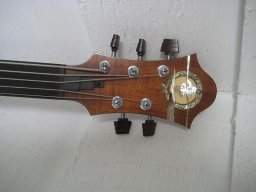
There are several ways around that, with varying degrees of efficacy. You can try a lighter/heavier gauge of string (I had a jazz that was cured by using .40s). Another way is to clamp something to the headstock (there's a rather elegant device called a Fat Finger) - this moves the dead spot between frets.
It's not accurate to say most basses are the same - however, it is a very common malady.
It's not accurate to say most basses are the same - however, it is a very common malady.
One of the advantages of adding carbon fiber reinforcement to necks - as Fender now does on their American Standard basses - is that, in addition to adding neck stability, it helps to eliminate dead spots. I say 'helps' because it's not an exact science.
Almost every bass I've ever owned, regardless of brand or construction method, has had a dead spot somewhere. Some were a lot more noticeable than others. The bummer is that it shows up in a very inconvenient spot on Fenders and fender-style necks.
I've never owned a bass with a fully carbon fiber neck, but I've been led to believe they are free from dead spots. I don't know if this is true.
Almost every bass I've ever owned, regardless of brand or construction method, has had a dead spot somewhere. Some were a lot more noticeable than others. The bummer is that it shows up in a very inconvenient spot on Fenders and fender-style necks.
I've never owned a bass with a fully carbon fiber neck, but I've been led to believe they are free from dead spots. I don't know if this is true.

This thread presents the most elegant solution I've seen yet. http://www.talkbass.com/forum/f8/dead-spot-removal-743976/
It adds mass (like the Fat Finger) but does it discreetly. of course, drilling holes in your headstock won't be for everyone.
Edit: The vibration frequency of a beam (neck here) is affected by the stiffness distribution, length, mass distribution, boundary condition (attachment to body) and loading (in this case, string and truss rod tension). Changes in any or all of these will move, reduce/increase or eliminate a deadspot. The goal is to change the natural frequency of the neck to something outside of the range of frequencies found on a bass neck. It's possible to find a solution analytically, but each neck is unique so trial and error is probably about as efficient as it gets. So, make sure your neck screws are tight and toy around with string changes, weights clamped to the headstock, drop tunings, truss rod tweaks. If the bass means enough to you, you could also look into adding CF rods to the neck to make it stiffer. That's a last resort though and probably not worth the effort and expense. An aftermarket neck with CF stiffening could take care of the problem.
It adds mass (like the Fat Finger) but does it discreetly. of course, drilling holes in your headstock won't be for everyone.
Edit: The vibration frequency of a beam (neck here) is affected by the stiffness distribution, length, mass distribution, boundary condition (attachment to body) and loading (in this case, string and truss rod tension). Changes in any or all of these will move, reduce/increase or eliminate a deadspot. The goal is to change the natural frequency of the neck to something outside of the range of frequencies found on a bass neck. It's possible to find a solution analytically, but each neck is unique so trial and error is probably about as efficient as it gets. So, make sure your neck screws are tight and toy around with string changes, weights clamped to the headstock, drop tunings, truss rod tweaks. If the bass means enough to you, you could also look into adding CF rods to the neck to make it stiffer. That's a last resort though and probably not worth the effort and expense. An aftermarket neck with CF stiffening could take care of the problem.


It is related to the "mass" of the neck, that's why adding weight helps to move it. you could try different tuners, ultra lights or heavy vintage style.
I always scratch my head to this one. Yeah, both my P's don't hold sustain on that fret as long as other notes on that string(a lot less noticeable on my MIA than my MIM), but does it really matter? Do you REALLY need to let THAT D ring out? Why wouldn't you use the 5th fret A string? Or the open D string? Or the 12th fret D string? All three of those will have more oomph and ring out much longer.
Maybe it's just me, maybe I'm the oddball. I know I have ocd, but this is one thing that doesn't bother me.
Maybe it's just me, maybe I'm the oddball. I know I have ocd, but this is one thing that doesn't bother me.

I used to have this problem to a degree on my 97 MIM Jazz when I got it. When I set it up, however, the neck had way more relief than it needed. After setting it up, it has a lot more sustain there. Has your bass been set up professionally? If not, I would start there and see if that cures the problem, because my bass has a headstock mark from one of those Fat Fingers installed by a previous owner, when in fact it didn't need one at all.
I always scratch my head to this one. Yeah, both my P's don't hold sustain on that fret as long as other notes on that string(a lot less noticeable on my MIA than my MIM), but does it really matter? Do you REALLY need to let THAT D ring out? Why wouldn't you use the 5th fret A string? Or the open D string? Or the 12th fret D string? All three of those will have more oomph and ring out much longer.
Maybe it's just me, maybe I'm the oddball. I know I have ocd, but this is one thing that doesn't bother me.
Depends what you are doing, I suppose. I like playing octaves so it annoys me when my C# or D octave on the G string is dead. The world doesn't stop, but I don't think it odd to want all the notes on my neck, especially those between the nut and twelfth fret to ring out with equal clarity.
Hawkbone has a great point here. I bought the whole bass, I should be able to play it anywhere on the neck I want to. 
I get it, I guess for me I've just never let a note on the G string just ring out alone. I'm either strumming them or using them in a fill. Never really just letting them ring.Depends what you are doing, I suppose. I like playing octaves so it annoys me when my C# or D octave on the G string is dead. The world doesn't stop, but I don't think it odd to want all the notes on my neck, especially those between the nut and twelfth fret to ring out with equal clarity.
I also did a little experiment today with my MIA. Barely noticed a different in sustain when playing.


