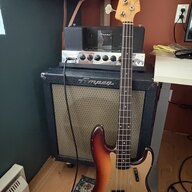
An amplifier either refers to a combo or an amplifier head.
An amplifier head has all the equalization controls and fancy knobs (this is the preamp section), as well as the power amplifier. It powers a speaker cabinet. Examples include the Ampeg SVT-CL, SVT-VR, Pro etc., Mark Bass Littlemark II, Mesa Titan V12, GK 800rb, insert favorite head here. Some people use a separate preamp and power amp.
A cabinet is a box with speakers in it. It's more complicated than that, but that's what it basically boils down to. Some of the most common configurations are 8x10 (that's eight 10" speakers), 4x10 (four 10" speakers), 6x10, 2x10, 2x15 (that's two 15" speakers), 1x15, 1x18, 2x12 (two 12" speakers), 4x12 (you get the idea).
A speaker cabinet will not work without an amplifier, because the power amp is what powers the speakers (hence the name). Cabinets generally do not plug straight into the wall. You plug the amplifier into the wall, and it sends power into the cabinet.
Amp head + speaker cabinet rigs are most often used for live gigging, though they can also be used for home practice. While one might think they'd be too loud, all amplifier heads have a volume (sometimes labeled as a "master") knob.
When putting together a head + cab rig, it is important to keep track of ohms. Ohms are a measurement of resistance, but I'll skip the detailed electrical engineering part because I'm not too solid on it myself. I just know how to use amps, not the details of how they work.
It is important that your cab or cabs' (if you're using more than one) be compatible with your head. If your head is rated for 4 ohm minimum load, it's usually a bad idea to run it with a 2 ohm load. The really weird part is that when you put two cabs together, the total ohm load actually decreases rather than adding up. Two 8 ohm cabs being powered by the same head will be seen by the head as a 4 ohm total load. Two 4 ohm cabs will be seen as a 2 ohm load. One 8 ohm cab and one 4 ohm cab being run from the same head will be a 2.67 ohm load.
Combos are simpler because basically they are an amplifier head and its speakers in the same cabinet box. All this ohm matching has already been done. Combos are good for practicing at home, though you still might want one bigger than the measly 15 watts I started on if you intend to use your combo for band playing as well. Since you've been playing for 10 months, a combo is probably what you'll be looking for. I haven't used a combo in years and my last one (Rogue 120 watt) was passable, but unreliable and nasal sounding. There are, however, some pretty good combos out there. They probably will be a bit more than the common $99 starter ones. Ashdown makes some combos, so does Mesa, and I tried one from Roland that was pretty good.
No one can tell you what the best amp, is, though. You should go to a bunch of music stores and try a bunch of different amps yourself and pick what you like the best.