
if i ever have to get surgery where they need to remove bone i will keep it and make a bone nut out of it. completely personalized bass

Enjoy the benefits of a premium membership!
Upgrade Account
-
TalkBass has been independent since 1998. Add your voice.
Create a free account to reply to discussions, view embedded media, and browse with fewer display ads.
Join free Log in
Want zero display ads or expanded classifieds tools? Compare plans.
You are using an out of date browser. It may not display this or other websites correctly.
You should upgrade or use an alternative browser.
You should upgrade or use an alternative browser.
Nut materials test
- Thread starter LilloEsquilo
- Start date
More options
Who Replied?



+1, yet TUSQ comes best if you're playing bass with tremolo bridge such as kahler or hipshotTusq has become my favorite because of the ease of making it.
- Jun 24, 2006
- 2,560
- 90
- Disclosures
- Endorsing Artist: MTD basses and strings; Bergantino Amps & Cabs
Recently I purchased a bass that is my "perfect" bass, in that it's perfect for me. I was satisfied with everything but the nut, which is your cheap plastic POS nut that so many basses get these days. So I've heard opinions on the best nut material, and know that people get extremely passionate about their nuts. Hummm well you know what I mean. But everyone has a different opinion on the "best" nut, and many even make the argument that it even depends on the individual pieces of the bass itself such as pickups, etc.
I tried reading all the online opinions, to get an idea, and I eneded up with more questions than answers that way. I came to the conclusion that the only way to know is to try them all and see. So that's what I did, and I wanted to share the results of that, it being of course what I heard and my opinion of hwat I heard.
The materials I tested on the bass were graphite, black Tusq (with the Teflon), brass, and bone. With each of these nuts, they were pre-slotted, and I filed them as needed for my strings and bass.
Graphite was kind of blah to be honest. I mean honestly, the tone was acceptable, though I felt maybe a better material could improve it. But it's a cheap material and it's going to wear probably the most of any of these nuts with time, and tuning pings are going to happen too as a result, despite the graphite. It was a bit more "pingy" than any of the other materials. I checked the slots and filed them and it was not bad, it was just the worst of the lot in terms of pings. Tone also as well as sustain.
Next I tried the Tusq. I noticed right away, it was far better in terms of tuning pings, sustain, and a slightly brighter and louder tone (the loudest of all the materials I tested, to my ears).
Not much more than the graphite, but for sure an improvement.
Third was the brass nut. This was great in that I had NO tuning pings to speak of, it just was completely smooth. Sustain was good, and the tone was a bit brighter. It was different though in ways I didn't much like as I prefer the kind of harsh P-bass duncan pickup tone and this seemed to mellow that in a way I didn't really care for.
Finally bone. Tuning pings were about the same as Tusq - very good, not an issue. But right away, I was blown away by the tone difference. It was very obvious and noticed from the first note I played. It was clearly the best tone of any of them and the sustain was up there with the best as well. Now, I know the reason why top end basses and guitars use bone nuts, and it's not just because that's what is expected, I actually heard it.
Who knows how they will wear. Brass is a soft material, and graphite is bound to be lousy as far as wear too. I don't have enough experience to comment yet on Tusq, but I've read online comments that they wear quickly. So it would seem that bone is a winner there.
Working with the materials as far as filing, graphite is easy, brass isn't much fun, and bone is pretty tough. I didn't have to file the Tusq, but I've read enough posts that say it's easy to work with that I'll take that as true. But brass and bone will give you the greatest workouts with the file.
So overall clearly bone is the winner based on the tone. It's a huge improvement over any of the other materials I tried. And that's really what I was looking for. I also think it will last a long time. I would rate the materials based on tone/wear potential/ease of working with as follows:
1. Bone
2. Tusq
3. Brass
4. Graphite
I hope this information helps some of you who are wondering about these materials as nuts. Again please bear in mind that it's my experiences and opinions I wish it was strictly scientific and "just the facts ma'am" I've tried to give that because I have no incentive to push one over the other and came in with an open mind, but bone just blew me away with the tone.
Finally I'd like to wrap up by saying now I know why luthiers use "Tite bond" wood glue. I had been using Elmer's and this stuff just blows it away. Just an FYI and again an opinion but that's what I'll roll with from now on.
a zero fret. Sounds just like a fretted note...consistent sound all the way down.
The genius of Michael Tobias brought this back from obscurity in the 80's....
Cheers,
Cameron

I vote "balderdash."
Like Bassflute said, by this logic all guitars would have a zero fret, since only a fret can duplicate the sound of a fretted string. As for whether or not nut material effects the sound of fretted notes, double balderdash....anecdotes begone: Provide recorded evidence proving that.
Like Bassflute said, by this logic all guitars would have a zero fret, since only a fret can duplicate the sound of a fretted string. As for whether or not nut material effects the sound of fretted notes, double balderdash....anecdotes begone: Provide recorded evidence proving that.

- Feb 16, 2008
- 21,240
- 23,633
- Disclosures
- John K Custom Basses
i've hand made 10's of thousands of nuts on guitars and basses since '73 , from just about every material you can think of, i.e. bone, ivory, tusq, graphite, micarta, corian, plastic, nylon, ebony, rosewood, brass, aluminum, and steel. my favorite on a fender bass is and has always been fender's cyclovac nut (synthetic) but probably still considered plastic.
while some may be able to hear a difference on a fretted note, IMO, it's pretty much nil, unless it's made of something really soft, like the super cheap soft plastic ones.
IME, tusq, ivory, bone, cyclovac, micarta, and corian all sound very close to the same. all you have to do is take a large nut blank (like an uncut classical guitar sized one) and drop it on a dense hardwood surface and listen to them. a brass or an aluminum one will go thud, a steel one will ring, and the others will have a similar resonance (tone) to them. personally, i think that corian, cyclovac and micarta are the best to use since they have perfect uniform density, whereas bone has grain with soft and hard spots on it.
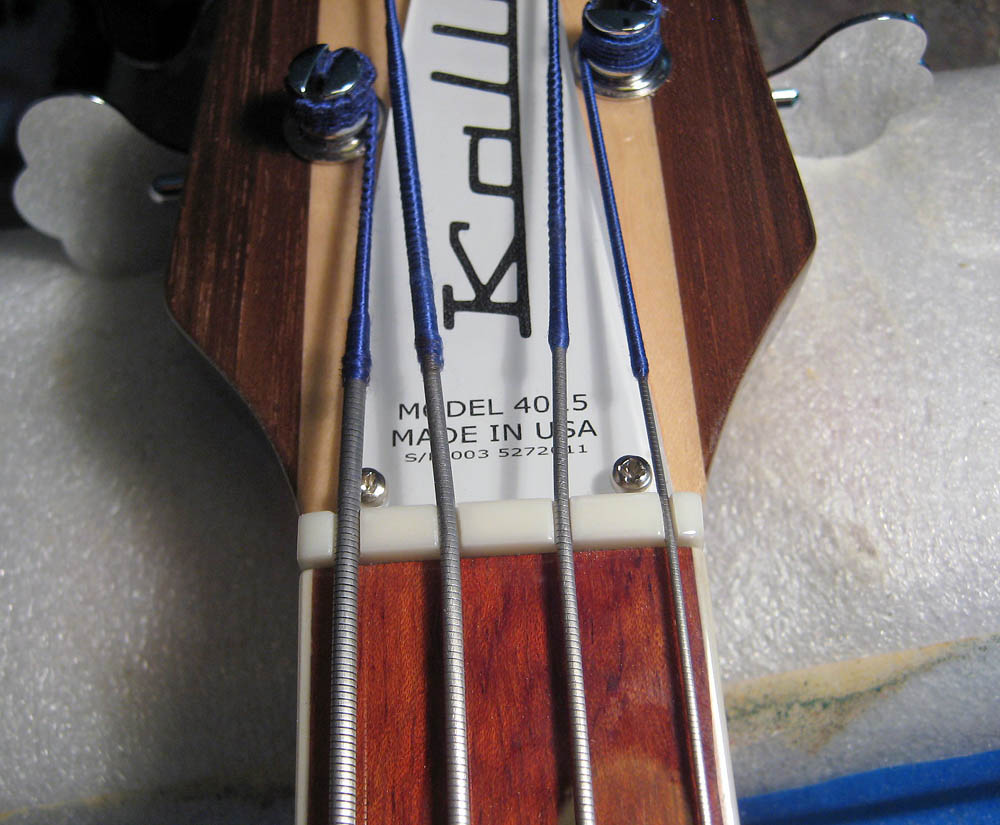
here's a pic of polished ivory colored corian one that i use on my custom '4025' ric style bass. IMO, they sound great:
while some may be able to hear a difference on a fretted note, IMO, it's pretty much nil, unless it's made of something really soft, like the super cheap soft plastic ones.
IME, tusq, ivory, bone, cyclovac, micarta, and corian all sound very close to the same. all you have to do is take a large nut blank (like an uncut classical guitar sized one) and drop it on a dense hardwood surface and listen to them. a brass or an aluminum one will go thud, a steel one will ring, and the others will have a similar resonance (tone) to them. personally, i think that corian, cyclovac and micarta are the best to use since they have perfect uniform density, whereas bone has grain with soft and hard spots on it.
here's a pic of polished ivory colored corian one that i use on my custom '4025' ric style bass. IMO, they sound great:
I don't know about the outstanding tone benefits to a brass nut, but they sure look cool. I spent a whole afternoon making my last one. Nut slots fitted perfectly to the width of my strings. Slot depths set to within one thousandth of an inch. Nut thickness finely honed so the nut would push snuggly into the neck groove with two thumbs. Polished with compound so the finish glittered like gold. And when it was finally installed, truly a masterpiece. Then came the moment of truth, the tone test. I played on it for about an hour. And dammit.........I couldn't tell the difference between the brass nut and the bone nut that it replaced!!! Then I got to looking at the bass. Everything metal on it is either chrome or stainless steel. No gold. Not only did the brass nut not sound better, but the shiney gold color looked tacky. I don't know if I should pop it out and get it chromed or just replace it with the Fender PLASTIC nuts that I have used to replace the bone,tusq and brass nuts on all my other basses. l
l
l
While you may use almost any animal bone, The United States has specific laws pertaining to the use of HUMAN bone in anything other than religious ceremony.But it's YOUR bone, and YOUR bass.
But, at your own risk, do what you want and I'll bid you "good luck with that."

I think a graphlon nut would be good... great even, im not an expert on nuts but wount you want your open note sound like a fretted note just to keep the sound consistent across the board? i feel with bone nuts when you play open string notes they sound slightly woody to the fretted notes on the other strings, but hey thats just my opinion i mean after all tone is subjective to each individual, what i may be hearing, might not even be noticeable to some people
So overall clearly bone is the winner based on the tone. It's a huge improvement over any of the other materials I tried. And that's really what I was looking for. I also think it will last a long time. I would rate the materials based on tone/wear potential/ease of working with as follows:
1. Bone
2. Tusq
3. Brass
4. Graphite
I hope this information helps some of you who are wondering about these materials as nuts. Again please bear in mind that it's my experiences and opinions I wish it was strictly scientific and "just the facts ma'am" I've tried to give that because I have no incentive to push one over the other and came in with an open mind, but bone just blew me away with the tone.
Finally I'd like to wrap up by saying now I know why luthiers use "Tite bond" wood glue. I had been using Elmer's and this stuff just blows it away. Just an FYI and again an opinion but that's what I'll roll with from now on.
Very interesting result from "TB LABS". I have run my own tests from time to time and though I didn't test bone, I came to the conclusion that Tusq was best. This was based on a couple of things. First was I was trying to eliminate the "stickiness" when tuning. Tusq did a great job at that. Next was the fact that Tusq nuts come in a wide choice of preformed sizes and string counts that usually mean I can adapt one with minimal shaping and filing. And lastly I thought the tone was a notch above other materials. All in all has made me pretty happy with the results.
Until now! And you tell me that bone tone actually blows them all away! I find that result very interesting. And in spite of it meaning I'll probably have to file my own nut and it remains to be seen how "sticky" a bone nut is when tuning, I am nevertheless anxious to test "bone tone" on one of my Tusq basses!
Yeah, great test!

I use Tusq; I've only replaced plastic with it, but it's an easy install and sounds good to the ear.
f!
f!


