• TalkBass has been independent since 1998. Add your voice.
    Create a free account to reply to discussions, view embedded media, and browse with fewer display ads.
    Join freeLog in
    Want zero display ads or expanded classifieds tools? Compare plans.

Nut on my Rickenbacker 4003 - too low?

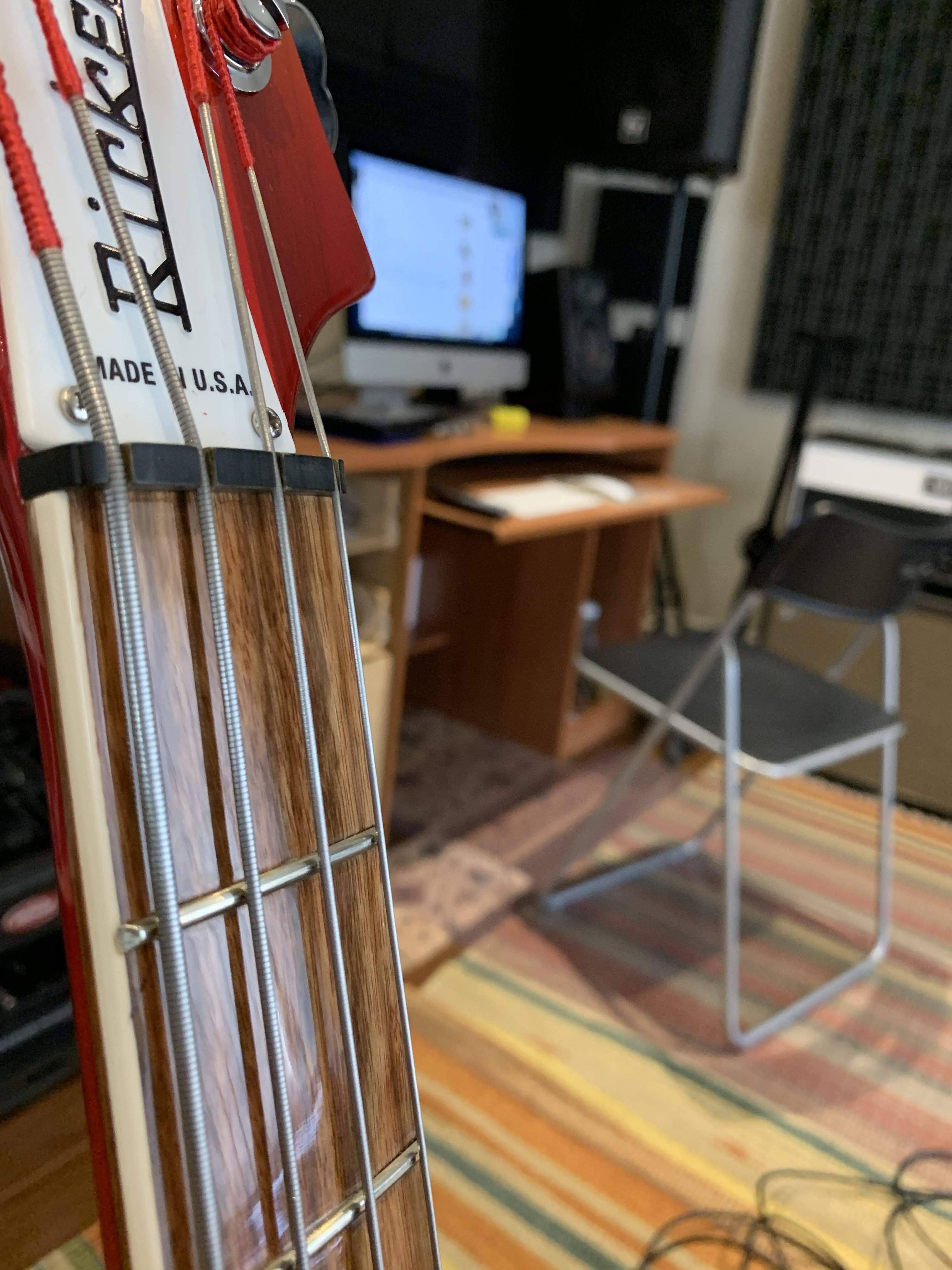
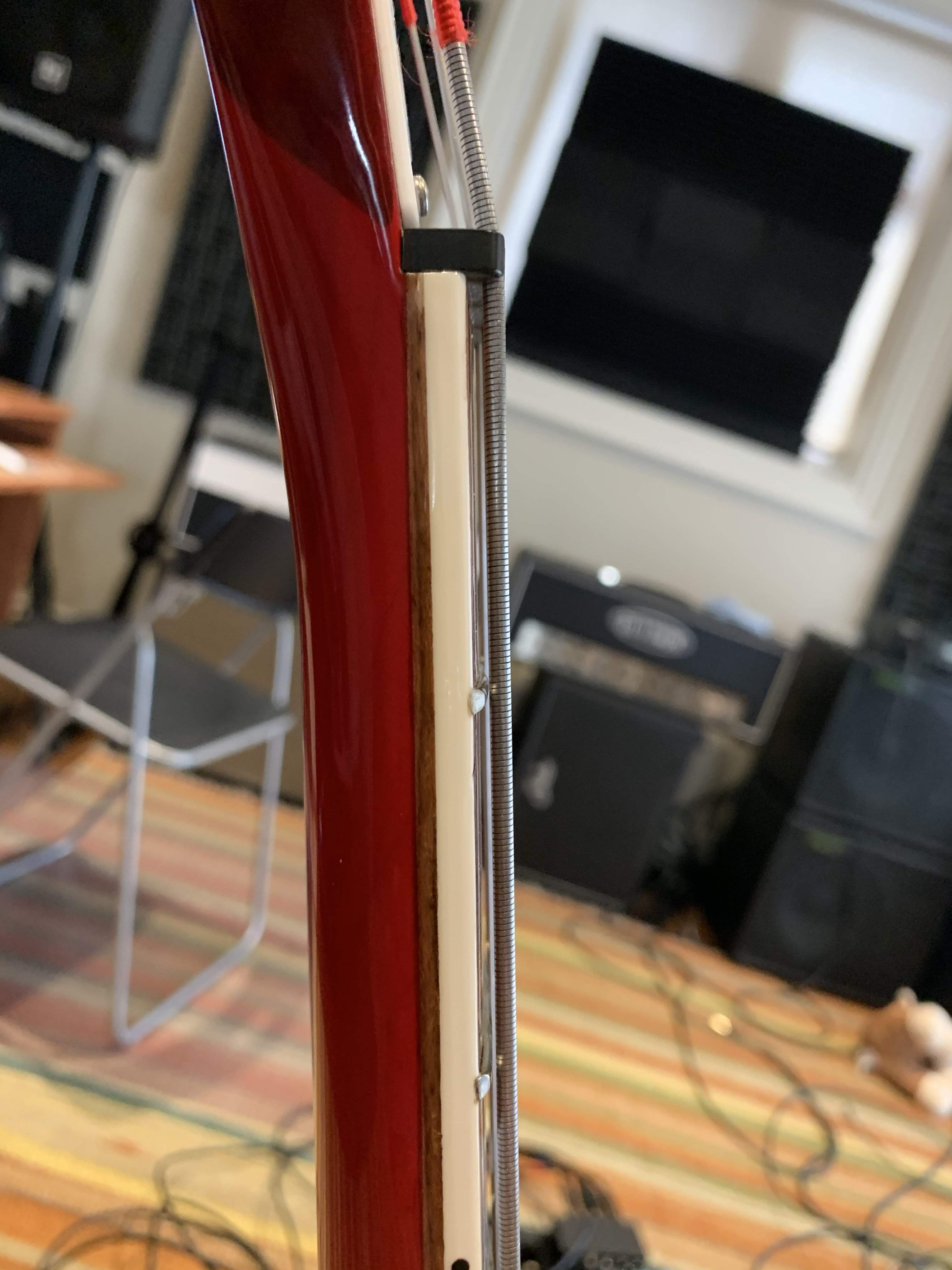
Hi all. Recently acquired a 2017 Rickenbacker 4003 in beautiful Fireglo and absolutely luvin' it! However, despite a good amount of neck relief and not crazy low action at the bridge, there continues to be quite a bit of buzzing primarily with open strings and at the first few frets. Worst with the E string, almost absent with the G string. In looking at it and doing some measurements, I believe the nut was trimmed by a previous user and the strings are now resting too low to the fretboard - see photos.

The way I see it, my options are either to fill with super glue / baking soda or attach a new nut. Since the nut is black, I'd guess the super glue / baking soda will look messy, and I'm not sure I trust my ability to do it without messing things up. Plus, it sounds like it's mostly just a temporary fix. My other option - and the one I'm currently favouring - is just to order a new nut (the standard 4003 bass nut, part number 033031). Question is...how difficult is it to remove the nut on there and install a new one?

Let me know what y'all think! Thanks!
IMG_1285.jpeg
IMG_1287.jpeg
IMG_1286.jpeg
 
Raising the nut will only affect open strings, not any fretted notes unless it is actually vibrating sympathetically behind them - I have actually had this happen with a 4003, took me ages to figure out that the buzz was below my fretted note and not above it. If it was me I would go baking soda and super glue, done properly you should not notice it and you can always rub a black sharpie over it. Again, I have done this successfully and easily on a 4003 with no issues. They come new from the factory with an incredibly high nut, so some user tweaking is to be expected.
 
  • Like
Reactions: HG1180
I'm not familiar with the baking soda/super glue remedy! I actually have a bass just sitting because the previous owner filed the nut slots down too much. I have basically the same problems as OP. Any good links anyone can provide would be great. In lockdown I'm doing all my own repairs/mods myself now anyway.
 
Raising the nut will only affect open strings, not any fretted notes unless it is actually vibrating sympathetically behind them - I have actually had this happen with a 4003, took me ages to figure out that the buzz was below my fretted note and not above it. If it was me I would go baking soda and super glue, done properly you should not notice it and you can always rub a black sharpie over it. Again, I have done this successfully and easily on a 4003 with no issues. They come new from the factory with an incredibly high nut, so some user tweaking is to be expected.
Yes I'm also guessing that the buzz may be from behind the fretted note. When I depress the 3rd fret and measure clearance at the first fret, there is barely any - almost none really. This is what makes me suspect the nut was filed too low.

Thanks for your insights!
 
I'm not familiar with the baking soda/super glue remedy! I actually have a bass just sitting because the previous owner filed the nut slots down too much. I have basically the same problems as OP. Any good links anyone can provide would be great. In lockdown I'm doing all my own repairs/mods myself now anyway.

Here's a good video:


Lots of others there on Youtube. This is the best one that I've come across for a bass - lots of others are for guitars but the principle is the same of course. I'd use some painter's tape above and below the nut to prevent spillage on the fretboard or head / truss rod cover.
 
Last edited:
  • Like
Reactions: Zymba
Yeah, looks pretty low from here. I'd do a new nut.
Tone Twins 2.JPG I'd have to agree. Ricks usually come from the factory with the slots cut way too high. RIC says that it's so you can cut them to your taste. Very thoughtful of them, if true... Yours, on the other hand, seems to have been "cut to taste" a little too much. Stock Rick nuts are... adequate, but nothing special, really; personally, I'd just replace it with a bone or (my choice) a Tusq one, cut for the 1st fret clearance you like. This Jetglo '73 4001 has a brass nut; 'cause, hey, that's just what you did back in the day...:cool:
 
  • Like
Reactions: mapleglo
View attachment 3829056 I'd have to agree. Ricks usually come from the factory with the slots cut way too high. RIC says that it's so you can cut them to your taste. Very thoughtful of them, if true... Yours, on the other hand, seems to have been "cut to taste" a little too much. Stock Rick nuts are... adequate, but nothing special, really; personally, I'd just replace it with a bone or (my choice) a Tusq one, cut for the 1st fret clearance you like. This Jetglo '73 4001 has a brass nut; 'cause, hey, that's just what you did back in the day...:cool:
Yeah I've thought of that too - but the issue is how do I find a Tusq one that is sized appropriately? I'm not THAT handy with this stuff, removing the current one and installing another of the same variety may be my limit LOL...
 
I'd suggest the zero dollar/easiest fix first, which is just to shim the nut from underneath. Especially if all the slots are too low, this is the easiest route.

Just knock the nut off the end of the neck gently with a flat piece of wood. Make a shim, clean the mating surfaces and glue it back on. You can use pieces of paper, business card, etc.

I've done this on one or two of my basses that I managed to cut too low and it works very well.

Roughing in a new nut is a big job, so saving the old one is going to be a lot easier....

L
 
I must be in the minority actually liking the Bakelite nuts, they polish up very nicely. Just wish Ric would do it in the factory, near as I can tell, they do no final nut work at all. If you have a feeler gauge handy, it should be about 20-22 thou clearance from top of first fret to underside of string, if it’s significantly less, the nut is too low. You can do it yourself with needle files, the correct nut slot files are outrageously expensive, not worth it unless you plan to do more nut work. It’s not hard, but you have to go very slowly, creeping up on the correct clearance.
 
I'd suggest the zero dollar/easiest fix first, which is just to shim the nut from underneath. Especially if all the slots are too low, this is the easiest route.

Just knock the nut off the end of the neck gently with a flat piece of wood. Make a shim, clean the mating surfaces and glue it back on. You can use pieces of paper, business card, etc.

I've done this on one or two of my basses that I managed to cut too low and it works very well.

Roughing in a new nut is a big job, so saving the old one is going to be a lot easier....

L
Yes I've thought of this too - although opinion seems to be mixed out there - the issue being I'd have to make sure that the shim is completely level...plus arguably less tone transfer and sustain through something like a business card between the two hard surfaces...

Oh and in terms of "roughing in a new nut" - the Rickenbacker part is already pre-slotted so all I might have to do is trim down the slots a bit as it seems they are a bit too high. But I wouldn't have to measure out and cut new slots.
 
  • Like
Reactions: Guzzi Toad
Yes I've thought of this too - although opinion seems to be mixed out there - the issue being I'd have to make sure that the shim is completely level...plus arguably less tone transfer and sustain through something like a business card between the two hard surfaces...

Oh and in terms of "roughing in a new nut" - the Rickenbacker part is already pre-slotted so all I might have to do is trim down the slots a bit as it seems they are a bit too high. But I wouldn't have to measure out and cut new slots.

There'd be no effect on the sustain or tone, even if you just jammed it in place under the strings with no glue at all and just played the bass like that for a few years.

Don't ask me why I know that.

But you'll glue it back onto the end of the fingerboard and down onto the headstock, under pressure of the strings tuned to pitch and let it sit overnight. It'll be nice and firm after that.

As for the shim being level, as long as the shim is adequately flat, like a piece of business card, it'll be at least as flat as it was without it. You might need to clean the old glue off it and true everything up but that;s an easy job, as long as you don't sand too much material off and change the shape of it.

It's not hard to do and is the cheapest fix, usually $0.00, if you have some slow cure cyanoacrylate or a good wood glue sitting around the house.

L
 
Hi all. Recently acquired a 2017 Rickenbacker 4003 in beautiful Fireglo and absolutely luvin' it! However, despite a good amount of neck relief and not crazy low action at the bridge, there continues to be quite a bit of buzzing primarily with open strings and at the first few frets. Worst with the E string, almost absent with the G string. In looking at it and doing some measurements, I believe the nut was trimmed by a previous user and the strings are now resting too low to the fretboard - see photos.

The way I see it, my options are either to fill with super glue / baking soda or attach a new nut. Since the nut is black, I'd guess the super glue / baking soda will look messy, and I'm not sure I trust my ability to do it without messing things up. Plus, it sounds like it's mostly just a temporary fix. My other option - and the one I'm currently favouring - is just to order a new nut (the standard 4003 bass nut, part number 033031). Question is...how difficult is it to remove the nut on there and install a new one?

Let me know what y'all think! Thanks!
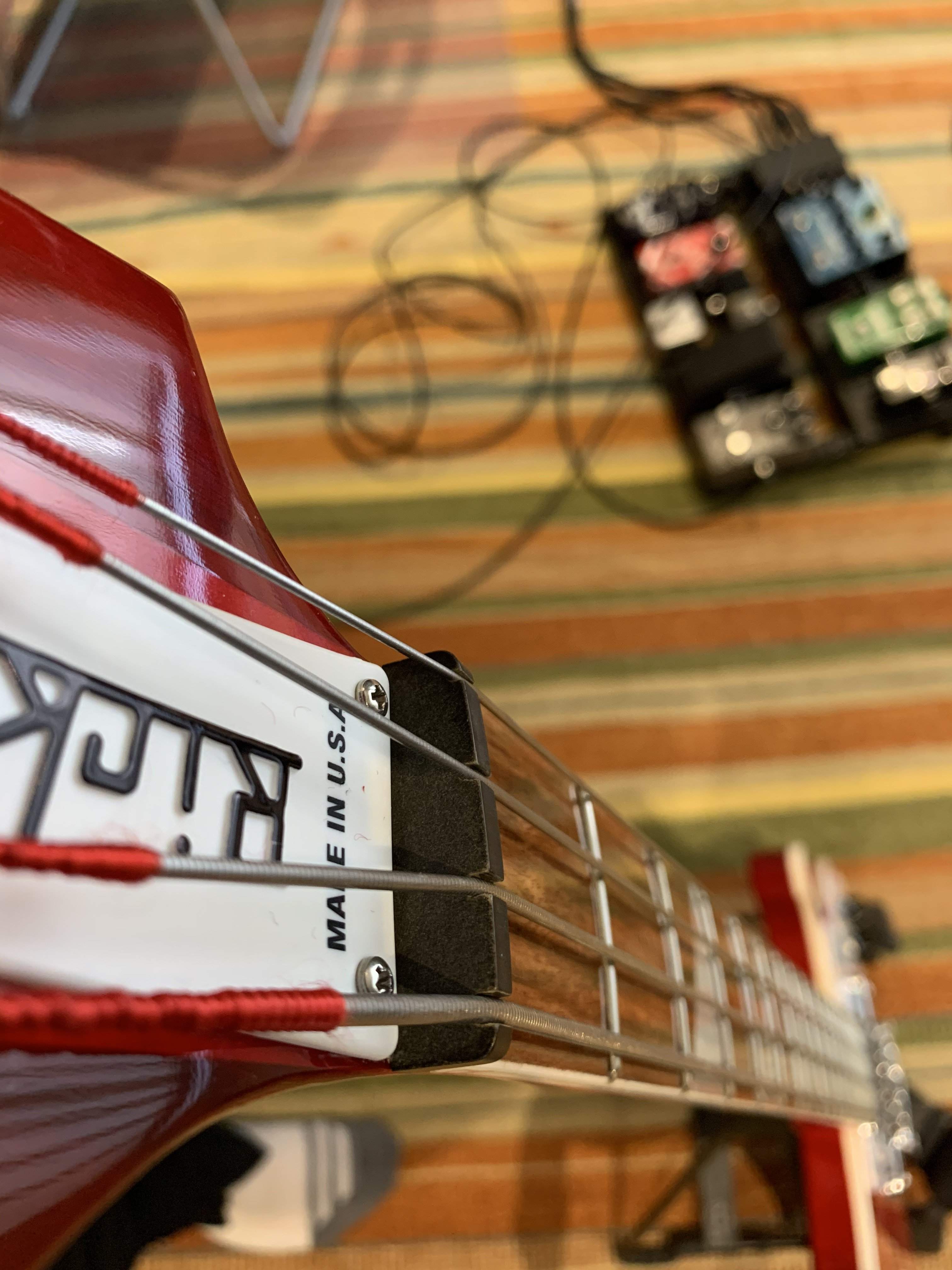
View attachment 3829010 View attachment 3829014 View attachment 3829017

Shim it with a wood coffee stirring stick
 
If you want to test whether raising the nut will give you the results you’re after, put a strip or two of something like notebook paper in the nut slots under the strings. I had a low G slot on my Dan Armstrong/Ampeg See Through, and a double layer of paper lifted it just enough to stop the buzz. I ended up leaving it that way for twenty-five years before I finally fixed it with baking powder and CA glue.