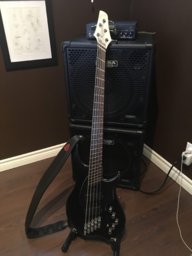
You seem to propose a spectrum of woodiness to beefiness.
Hmm. More like woodiness to sterility...though adjectives for sound are always chancy.

Pretty much, especially with that same neck, but a large body of dense ash, if it contributes much of anything at all, accentuates the "clean power" of the ATK.They use ash as the body wood. Would you say that they could have used any other wood and the end sound result would be very similar?
I'm no luthier, nor am i really familiar with how different woods will sound. someone say my koa 750 the other day, and after saying it was beautiful asked if the koa veneer made any difference in the tone. I had no idea. It definitely sounds different from my 305, but there are some other differences between the basses that could contribute to the change in sound.
Sure, like the heavier five-string neck, etc.
It's not the laminate. The reason that ornamental laminates are so common on active basses with high-mass bridges is because the bodies have become less important in how the instrument sounds. Skinned top laminates are considered by luthiers and advanced players as tonal negatives in common solid-body guitars, as an example, as they just amount to more layers of thick, sound-damping paint and glue and different wood that is not a native part of the body blank. Look at it this way: With a 750, you've taken a perfectly good, two-piece ash body and mashed a piece of plywood on top of it. Are three layers of dissimilar woods (maple, walnut and koa) and three layers of glue going to improve its resonance? Of course not, it would tend to dampen it and mute its resonances, making it a deader body, to the extent it did anything. Imagine adding all that on the top of a solid-top classical guitar, as an exaggerated example to demonstrate the premise.
But it doesn't matter on the 750 because the body is more isolated from the tonal equation by the presence of a massive bridge and heavy, rigid neck anyway.
That's why you see these $5000 basses made up of all these laminations of dissimilar but highly rigid woods and layers of exotic spalted whatnot on top. "Spalted," BTW, is just a euphemism for rotted, mildewed deadfall salvaged from the forest floor or old riverbeds. It's not tonewood, it's refuse. Because the rotting patterns look interesting, they inject it with resin or something to stabilize the wood enough to cut it and finish it. It's 100% ornamental and contributes nothing positive to the tonal qualities of the instrument -- but that no longer matters.
Some years ago I wrote a very long post on another board about the engineering and physical principles that determine sustain and how they were antithetical to what is perceived as good native tone in a guitar or bass. Maximum string sustain would be obtained by suspending the guitar string in a vacuum between two witness points of infinite density and infinite mass, then plucking it at the midpoint. The string would vibrate ("sustain") until the energy was transferred as heat from the flexing of the metal, and that would take a while. It also wouldn't sound like anything as we are in a vacuum and there's no resonator, like a guitar's soundboard, consuming that string's energy to generate sound.
So, the trick isn't so much to get sustain -- you just put the string between hard witness points rigidly suspended. I can remember about forty years ago when this quest for sustain and string power was producing experimental solid-body guitars using materials like aluminum and concrete (!). Sure, they sustained, but they sounded awful. Basses were more interesting, and this was when high-mass bridges and roundwound strings started arriving.
Modern basses are the grandchildren of those instruments.
Because clean fundamental string tone in bass frequencies "cut," some bassists were very attracted to this as a possibility for a more viable solo instrument. There were more metal and exotic materials used and we saw graphite necks, metal nuts, huge metal bridge assemblies, ultra-hard stainless frets, etc., etc. That thin, sharp sound that guitarists hated back then was more useful in lower notes.
If you wanted exotic sounds, that's what the new electronics were for -- stomps, onboard preamps, DSP, MIDI, exotic amps, etc. The electric bass was becoming less of an analog of the upright classical double bass than it was a pure note generator in an electronic process. This has remained the big division among basses and bass players for a couple of decades now.
With a '50s P at one end and the ultra-rigid graphite and metal active at the other, the ATK is somewhere in the middle, but its appearance is more traditional than its native tone.




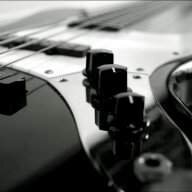




 When I said it was "jacked-up" I meant not only was the setup atrocious (the bass looked as though it had been assembled by a 5 year old--the neck bolts werent even seated all the way) but there were scratches on the pick guard by the truss wheel. This was by all means a damaged instrument that MF sent out.