
Enjoy the benefits of a premium membership!
Upgrade Account
-
TalkBass has been independent since 1998. Add your voice.
Create a free account to reply to discussions, view embedded media, and browse with fewer display ads.
Join free Log in
Want zero display ads or expanded classifieds tools? Compare plans.
You are using an out of date browser. It may not display this or other websites correctly.
You should upgrade or use an alternative browser.
You should upgrade or use an alternative browser.
Official Marshall Amp Club!
- Thread starter kissmybASS01
- Start date
More options
Who Replied?
My 18-month-old MB450h and MB410c. Got it at the beginning of September for my birthday. Prior to that, it'd been with a bassist in a punk covers band, so it was nicely broken in. Love the sound I can get, and love the volume....
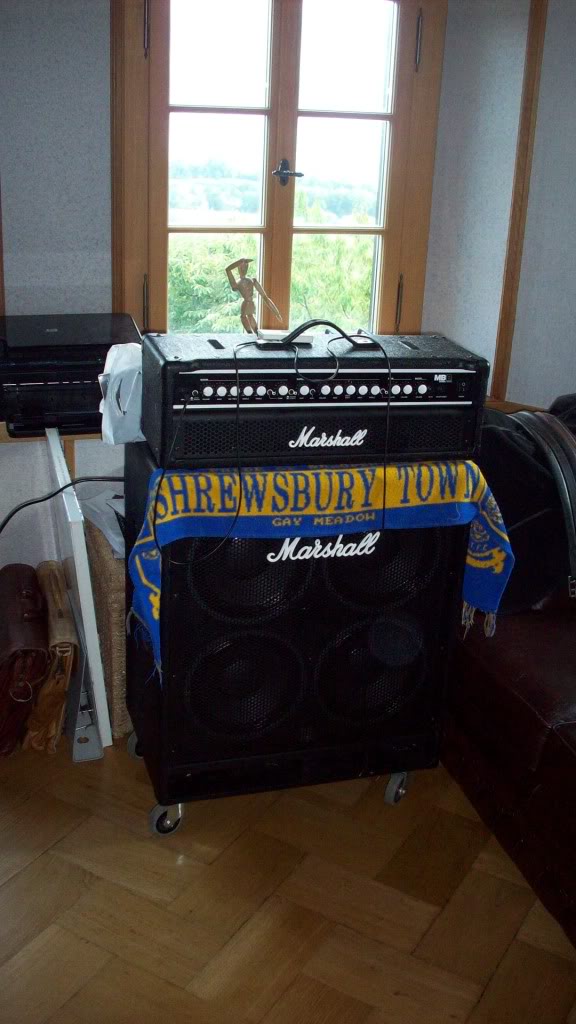
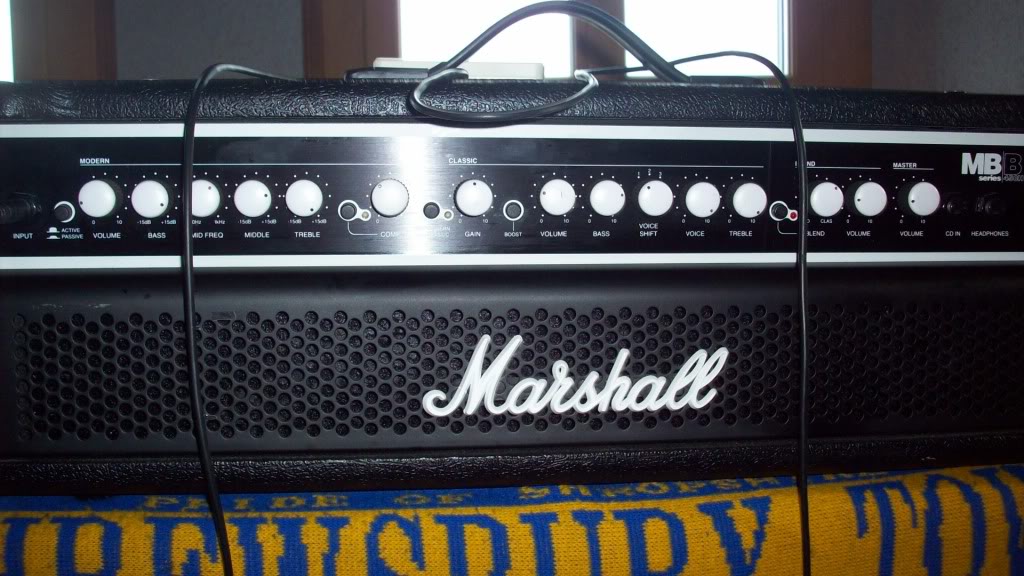
And here's how it sounds:
And here's how it sounds:


I feel like a blithering idiot but I never knew that Marshall made bass amplification models(at least not recently).
My guitarist buddy swears by his Marshall tube head and stack so I can only imagine they produce(produced?) some high quality low end gear.
Marshall Bass Amplification.
My guitarist buddy swears by his Marshall tube head and stack so I can only imagine they produce(produced?) some high quality low end gear.
Marshall Bass Amplification.

I have a Marshall EL34 100/100 monobloc power amp that comes stock with a 2 way selector switch for output resistance... 16 or 8. In the user manual, it indicates if you want to run it at 4 ohm you need to contact an authorized Marshall agent. I'm a musician who is quite competent at wiring up my own electronics. Is this something I can do at home? I have all the schems. If not, could someone please point me to a good tech in my area (Woodstock NY or Albany NY).
I'll obviously need a good 3 position switch.. but what and where to get it is a question Id like to put out to the forum.
Thanks for any help
Regards,
-Mick

I'll obviously need a good 3 position switch.. but what and where to get it is a question Id like to put out to the forum.
Thanks for any help
Regards,
-Mick
[Invalid or Expired Link Removed]
Not all Marshall, but anyway. 4x10" Marshall Silver Jubilee cab
Not all Marshall, but anyway. 4x10" Marshall Silver Jubilee cab
I dont mean to be annoying guys, but i asked for my number in Janurary and nobody has got back to me yet. Whos incharge of assigning numbers?

Here's a couple of updated pics of my Marshalls set up for the recording of our latest CD: Death Machine. As you can see, I put the original grills and logos back onto the cabs, and actually ran both amps for the recording. The '74 Super Bass was running the 1551 2x15 cab (on the left). The '73 Super Bass was running the 1520 4x12 cab (on the right). I am also running NOS RCA 12ax7s (in v2 and v3) and Mullard CV4024 (12AT7 in v1) in both amps. The 74 has JJ KT88s for power tubes, and the 73 has NOS Mullard xf2 EL-34s. The NOS glass made a HUUUUUUGE difference in the tone! I plugged my bass into the low input of Channel 2 on the 73 SB, and then daisy chained the high input of Channel 2 on the 73 into the low input of Channel 2 on the 74.


You can hear the rig from the recording of our CD (with my bass' booster cranked up to purposely get the crunch for the into to the song) here:
Cheers!
You can hear the rig from the recording of our CD (with my bass' booster cranked up to purposely get the crunch for the into to the song) here:
Cheers!

I already posted a picture a year or so back, but here is another one with my Rig at the Gig.

Have a question to Marshall owners and to guys who have experience of using tube amps in general.
I plan to purchase all-tube head for rehearsal and (hope so) for live performance.
Here we have four options overall:
1. Marshall VBA400
2. Hiwatt 200/400
3. Orange AD 200
4. Markbass Classic 300
At first I disregarded Marshall due to... hmm... Guitar amp maker builds bass amp?
Whereupon I started encountering quite rave reviews of this head here and there
My next concern was built quality and maintenance.
I read (mostly here, at talkbass) that point-to-point built amps are easier to repair than PCB based ones.
Thus I turned my head towards "Hiwatt".
While showing some pics of Reeves 225 to my father I asked him about truthfulness of above mentioned statement (point-to-point vs. PCB maintenance). He said that it was not necessarily so and that it mostly depended on schematics, as well as that he had built a couple of dozens of similar devices being young
I tend to believe him (secondary technical school, 2 years in Signal corps, Degree in Engineering and Electronics, hundreds repaired valve and solid-state TVs and radio-stations over the years).
Taking into consideration all above and finally there is money issue:
Marshall VBA400 goes for ~ 2180 USD
Hiwatt 200 ~ 4250USD Hiwatt 400 ~ 5900USD
Orange AD 200 data N/A
Markbass Classic 300 - data N/A, but taking into account that fact that LM III here goes for 1050USD it may be 3600 or something like that (our neighbors in Moscow, Russia, sell it for 4 750 U.S. dollars)
So now I start to think that 2k difference for hand-built Hiwatt may not worth it in a long run.
I would like to here Your opinion. My main concern is reliability.
Sorry for kinda muddled message
P.S. We play quite heavy metal (C, G, C, C).
P.S.S. Will VBC810 handle that tube 400W of VBA if I pull the trigger? It is rated only 640W and from what I understand 1 tube watt = 3 solid-state watt.
I plan to purchase all-tube head for rehearsal and (hope so) for live performance.
Here we have four options overall:
1. Marshall VBA400
2. Hiwatt 200/400
3. Orange AD 200
4. Markbass Classic 300
At first I disregarded Marshall due to... hmm... Guitar amp maker builds bass amp?
Whereupon I started encountering quite rave reviews of this head here and there
My next concern was built quality and maintenance.
I read (mostly here, at talkbass) that point-to-point built amps are easier to repair than PCB based ones.
Thus I turned my head towards "Hiwatt".
While showing some pics of Reeves 225 to my father I asked him about truthfulness of above mentioned statement (point-to-point vs. PCB maintenance). He said that it was not necessarily so and that it mostly depended on schematics, as well as that he had built a couple of dozens of similar devices being young
I tend to believe him (secondary technical school, 2 years in Signal corps, Degree in Engineering and Electronics, hundreds repaired valve and solid-state TVs and radio-stations over the years).
Taking into consideration all above and finally there is money issue:
Marshall VBA400 goes for ~ 2180 USD
Hiwatt 200 ~ 4250USD Hiwatt 400 ~ 5900USD
Orange AD 200 data N/A
Markbass Classic 300 - data N/A, but taking into account that fact that LM III here goes for 1050USD it may be 3600 or something like that (our neighbors in Moscow, Russia, sell it for 4 750 U.S. dollars)
So now I start to think that 2k difference for hand-built Hiwatt may not worth it in a long run.
I would like to here Your opinion. My main concern is reliability.
Sorry for kinda muddled message
P.S. We play quite heavy metal (C, G, C, C).
P.S.S. Will VBC810 handle that tube 400W of VBA if I pull the trigger? It is rated only 640W and from what I understand 1 tube watt = 3 solid-state watt.

Beskyd, I must first of all say that I am more familiar with guitar amps (building, repairing, maintenance), but I have one tube bass amp (Ampeg V4BH - disclaimer: I have NOT looked inside it...). I have been following the forums here during the last year when I have been playing bass, and what I have gathered of the models you mentioned in your post is that the VBA400 output is closer to 250 W RMS than 400 W. Also, the watts are "actual" Watts, they just "sound louder", thus giving you the impression that 1 tube amp Watt = 3 solid-state amp Watts. This is partly due to the distortion characteristics, and partly due to the natural compression of the tubes.
Now, regarding point-to-point wiring vs. PCB wiring with regard to the maintenance, I would say that since point-to-point amps are hand-built, they also can be hand-repaired more readily than PCB amplifiers. Today's PCB technology makes it difficult to service anything on component level. The service centers basically troubleshoot for a faulty PCB and replace the whole thing. With tube amps, it is important to look into the construction. Reliability is compromised when anything that is mounted on the front (and back) panel is directly soldered on the PCB as well. For instance, if you accidentally knock your amp over, the potentiometer knobs can transfer force to the contacts on the PC board and the board itself can crack. This will not happen on a P2P amp since the potentiometers connect to the wiring strip by leads. In addition, sometimes in PCB tube amps the tube sockets are soldered on the PC board. This again is a warning sign for reliablity.
I would advise you to try to get to listen to the amplifiers as much as you possibly can, then make your choice by what you hear. Hint: thomann.de has a great return policy...
Best of luck to your amp search.
Now, regarding point-to-point wiring vs. PCB wiring with regard to the maintenance, I would say that since point-to-point amps are hand-built, they also can be hand-repaired more readily than PCB amplifiers. Today's PCB technology makes it difficult to service anything on component level. The service centers basically troubleshoot for a faulty PCB and replace the whole thing. With tube amps, it is important to look into the construction. Reliability is compromised when anything that is mounted on the front (and back) panel is directly soldered on the PCB as well. For instance, if you accidentally knock your amp over, the potentiometer knobs can transfer force to the contacts on the PC board and the board itself can crack. This will not happen on a P2P amp since the potentiometers connect to the wiring strip by leads. In addition, sometimes in PCB tube amps the tube sockets are soldered on the PC board. This again is a warning sign for reliablity.
I would advise you to try to get to listen to the amplifiers as much as you possibly can, then make your choice by what you hear. Hint: thomann.de has a great return policy...
Best of luck to your amp search.
Now, regarding point-to-point wiring vs. PCB wiring with regard to the maintenance, I would say that since point-to-point amps are hand-built, they also can be hand-repaired more readily than PCB amplifiers. Today's PCB technology makes it difficult to service anything on component level. The service centers basically troubleshoot for a faulty PCB and replace the whole thing. With tube amps, it is important to look into the construction. Reliability is compromised when anything that is mounted on the front (and back) panel is directly soldered on the PCB as well. For instance, if you accidentally knock your amp over, the potentiometer knobs can transfer force to the contacts on the PC board and the board itself can crack. This will not happen on a P2P amp since the potentiometers connect to the wiring strip by leads. In addition, sometimes in PCB tube amps the tube sockets are soldered on the PC board. This again is a warning sign for reliablity.
I would advise you to try to get to listen to the amplifiers as much as you possibly can, then make your choice by what you hear. Hint: thomann.de has a great return policy...
Best of luck to your amp search.
rust_preacher, thanks for reply!
You've just described what I had ment regarding "P2P vs. PCB" issue. From what I understand in general 2P2 amp are easier to repair (in worst case you'll have to wait for spare PCB to arrive from manufacturer).
The thing is that combination of Marshall VBA400+VBC810 cost less than Hiwatt 200 head alone (matching Hiwatt cabinet also cost ~ 4200 USD)...
I do not plan to drag the head a lot and if I do, I'll take care of it myself

I'd love to try as much amps as I can but Marshall is the only head available here in Kyiv. Hiwatt, Orange and Markbass are not in stock (and I believe have never been imported here before) and must be ordered blindfolded.
Cannot go with thomann.de since I will have to import the amp and pay all custom duties that will skyrocket already hefty price-tag (I tried to import Hevos cab a couple years ago).
The Marshall VBA400 has a really nice tone, but it is fric'kn heavy too.
I am sure it does 400 watts RMS, it has a lot of output tubes in it..
I am sure it does 400 watts RMS, it has a lot of output tubes in it..

Engine207
Losing faith in humanity...one call at a time.
Nice sig, Gumtown! I have a Ric 4001 through the MB450/410/115 set-up. With it set to "Classic", gain boost, and some hard attack, it'll sound as Geddy as the player is good. Unfortunately, I my hands only get Geddy "extra-light". 
Beskyd, you really owe it to yourself to check out the MBs. Yeagh, they're hybrid, not all tube, but if consistent power output is a factor for you, a solid state 450 watts in 2Ω, and the preamp is tube. They'll probably be easier to find for demonstration purposes, as well. Only thing I'd do differently if this rig was stolen or destroyed is to go with 2 410s instead of the 410/115.
Beskyd, you really owe it to yourself to check out the MBs. Yeagh, they're hybrid, not all tube, but if consistent power output is a factor for you, a solid state 450 watts in 2Ω, and the preamp is tube. They'll probably be easier to find for demonstration purposes, as well. Only thing I'd do differently if this rig was stolen or destroyed is to go with 2 410s instead of the 410/115.

Best rig I ever played through! Marshall LEM1992 into a Berg NV610.

Michael
Michael
rust_preacher, thanks for reply!
You've just described what I had ment regarding "P2P vs. PCB" issue. From what I understand in general 2P2 amp are easier to repair (in worst case you'll have to wait for spare PCB to arrive from manufacturer).
The thing is that combination of Marshall VBA400+VBC810 cost less than Hiwatt 200 head alone (matching Hiwatt cabinet also cost ~ 4200 USD)...
I do not plan to drag the head a lot and if I do, I'll take care of it myself
I'd love to try as much amps as I can but Marshall is the only head available here in Kyiv. Hiwatt, Orange and Markbass are not in stock (and I believe have never been imported here before) and must be ordered blindfolded.
Cannot go with thomann.de since I will have to import the amp and pay all custom duties that will skyrocket already hefty price-tag (I tried to import Hevos cab a couple years ago).
I am glad if I have answered some of your "burning questions". If you cannot use an Euro source, then my advice would be to go with the Marshall if you can afford it and you get the factory guarantee. Then have a road case built and you ought to be safe. Also, get a cabinet or two that can use the impressive output power of the amplifier, you will then shake the walls with that setup.
Stating that PCB based amps are more difficult to repair does not imply that they would be unreliable in normal use. I have many PCB built tube amps that work just fine and sound great!
 )
)


