• TalkBass has been independent since 1998. Add your voice.
    Create a free account to reply to discussions, view embedded media, and browse with fewer display ads.
    Join freeLog in
    Want zero display ads or expanded classifieds tools? Compare plans.

OFFICIAL Steinberger Synapse club

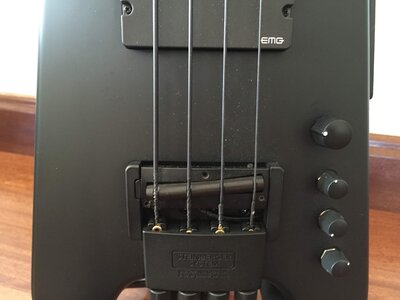
Finally, the Status Hot Wire bass strings are here. I've tried the 'hand wound, double-ball, black nylon' set first.
This is how the 908 mm (35 ¾") strings look on both ends. The balls are visible on the bridge side, yet I had no problems setting it up.
I like the black on black looks...

IMG_2067.jpg IMG_2068.jpg
 
  • Like
Reactions: HeavyDuty
Finally, the Status Hot Wire bass strings are here. I've tried the 'hand wound, double-ball, black nylon' set first.
This is how the 908 mm (35 ¾") strings look on both ends. The balls are visible on the bridge side, yet I had no problems setting it up.
I like the black on black looks...

View attachment 571237 View attachment 571238

Sweet! If I ever find a fretless Synapse five those are the strings I want to run on it - I really like the Status flats I have on my fretted five.
 
Any of you 5 string fretted Synapse owners notice if the jack on your bass is a TRS-styled jack? I just picked up a used one and found that mine has one under the battery cover. I'll have to root around to find a TRS cable to see if there's any difference between the two outputs.
 
Nope, just one output jack. But it's a TRS type. Instead of the output jack having two poles, it has three. So with a proper TRS cable, it looks like you could have two separate outputs. I'll try to post a picture tomorrow.
Could be wrong but I believe you'll find that's just the standard way the preamp power is wired. Plugging in a cable completes the circuit between the Ring and the Sleeve contacts.
 
Red synapse 5-string owner here... I bought a brand new one with a broken truss rod off ebay for $350 and spent and insane amount of hours plus another $150 on parts and luthier services to replace the rod (see this thread removing my phenolic fretboard: Steinberger Synapse truss replacement | TalkBass.com but a fully functional synapse will be mine in a few days once the luthier finishes with it...

Have medium sadowsky flatwound black labels on it.
 
I get a lot of body contact noise through mine. meaning if everything is quiet you can hear my body and even my hand moving through the amp. Kind of weird. Anybody else have this issue?
Always an issue with piezo's - they're strictly vibration transducers, and they don't know or care where the vibrations come from...
Dialing back the pickup blend to favor the magnetic EMG helps, but if your tone needs what the piezo is producing, there's only so far you can go with that - the piezo is there for a reason, and the reason is its distinctive tone...

To your other question:
Has anybody ever done a PUP or Preamp upgrade on one of these?
You can probably replace the EMG (mag) pickup but I'm guessing it's an active EMG so it's probably not just a straight plug-n-play swap. The pre could be a challenge since it's got the very high impedance section to deal with the piezo. I'd expect anything you'd be considering should have an input impedance in the tens of megohms range. The fDeck HPF does this, so that could be a useful avenue.
 
is there any reason why one of these 5 stringers cant be strung E-C?
If you're using double-ball strings there should be no reason.
There have been reports of string-slippage when using the standard single-ball strings and narrow-gauge B's; the adapter has a fairly narrow range.
It's "just" a machined bit and I'd expect making one with a tighter grip would be little more difficult than making a brass nut - but I haven't really looked into it.

The fretted versions use a zero-fret rather than a nut, so that's no issue; the fretless do use a nut but going smaller shouldn't be an issue.
 
If you're using double-ball strings there should be no reason.
There have been reports of string-slippage when using the standard single-ball strings and narrow-gauge B's; the adapter has a fairly narrow range.
It's "just" a machined bit and I'd expect making one with a tighter grip would be little more difficult than making a brass nut - but I haven't really looked into it.

The fretted versions use a zero-fret rather than a nut, so that's no issue; the fretless do use a nut but going smaller shouldn't be an issue.
so is that a yes or no? there will be no B string on this bass so im not concerned with b string slippage. it will be fretted and ill be using a thicker gauge c string than the rest of the set
 
so is that a yes or no? there will be no B string on this bass...
I got that.
My point was that even when stringing B->G with light-gauge strings, the adapter has had issues.

So I'll ask again, because it's a critical point:
Are you using double-ball strings?
If yes, no issues.

If you're thinking of using single-ball strings and the adapter, I'd expect (but cannot know) some slippage issues due to the fact that all the strings are a lot thinner than the adapter was originally designed for. Something to watch for and be aware of. The clamp has limits on how small the string retention holes will go. Overtightening the adapter won't make it grip more, it'll just break something.

What's the smallest string that can be securely used in each position? I don't know. I haven't ever seen it documented anywhere (I do not claim to have looked everywhere).
It should be a pretty easy thing to have a new adapter made, if that's what's needed.

I'd just pursue the double-ball path first if it were me, and eliminate the adapter issue altogether.
 
do they even make high C double ball strings?
I was sure I had seen at least one set when first I looked, but that's been a couple of years.
Probably Status is the hot setup these days. They have a few 5-string roundwound sets - the lightest has an 0.030" high string - I'd think you could tune that to C but I do not know for sure. The C in my 6-string sets is 0.032"