
• TalkBass has been independent since 1998. Add your voice.
    Create a free account to reply to discussions, view embedded media, and browse with fewer display ads.
    Join freeLog in
    Want zero display ads or expanded classifieds tools? Compare plans.

ohms and cabs and not enough noise

I was curious about the wattage at 8 ohms and found a manual online, here:

http://line6.com/data/6/0a060b316ac34f05934b940f8/application/pdf/LowDown Pilot’s Guide - English ( Rev F ).pdf

On p. 8, where it lists the various outputs, it says:

20. Speaker Outs (HD400 & HD750 only) -
Only use a 4 Ohm speaker cabinet when running in
mono. Only use 8 Ohm speaker cabinets when feeding
a pair. Warning! Do not plug two 4 Ohm cabinets
into either the HD400 or HD750 as it can result in
damage to the amplifier.​

So, if yours is the HD400, it seems that you aren't supposed to use a single 8-ohm cab with it at all.
 
Last edited:
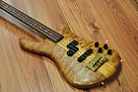
Hope we all do agree that attack and transients sound somewhat different from the steady tone. Hope we all do agree that different instruments with different dynamic characteristc do this 'effect' differently.
Although fret noise as well contributes to the sound, fret noise is only one piece in a puzzle of a set of variables.
 
Can one of you guys who knows more about this stuff than I do explain what I found and reported in post #21 above? I haven't owned all that many different amps, but they all have required a minimum load (usually 4 ohm), and their manuals give the wattage for both an 8-ohm and 4-ohm load. The Line 6 manual seems to be saying that this amp needs to see exactly 4 ohms. Why would that be? And more important, does OP run a risk of damaging either the amp or speakers by using the amp with a single 8-ohm cab?
 
Can one of you guys who knows more about this stuff than I do explain what I found and reported in post #21 above? I haven't owned all that many different amps, but they all have required a minimum load (usually 4 ohm), and their manuals give the wattage for both an 8-ohm and 4-ohm load. The Line 6 manual seems to be saying that this amp needs to see exactly 4 ohms. Why would that be? And more important, does OP run a risk of damaging either the amp or speakers by using the amp with a single 8-ohm cab?
My first thinking was there may be an 'misleading' issue with the manual.
May be the manual should read as:
In mono mode use only a speaker (cabinet) equal or greater 4 Ohm.

Never heard of ss amplifiers that don't tolerate twice the impedance than minimum rating.
Just in case to not run into troubles the OP should contact Line6.
 
My first thinking was there may be an 'misleading' issue with the manual.
May be the manual should read as:
In mono mode use only a speaker (cabinet) equal or greater 4 Ohm.

Never heard of ss amplifiers that don't tolerate twice the impedance than minimum rating.
Just in case to not run into troubles the OP should contact Line6.

The paragraph, section 19, discusses adding an 8 Ohm extension cab.
Section 20 by itself is not well written IMO.
19 and 20 taken together makes more sense to me.
If you are dealing with a combo here, this would imply an 8 Ohm internal speaker.
When you add an 8 Ohm extension, you have 4 Ohms loading the amp.
 
The paragraph, section 19, discusses adding an 8 Ohm extension cab.
Section 20 by itself is not well written IMO.
19 and 20 taken together makes more sense to me.
If you are dealing with a combo here, this would imply an 8 Ohm internal speaker.
When you add an 8 Ohm extension, you have 4 Ohms loading the amp.
The manual says that Note #19 applies only to the LD400Pro, which is a combo amp (and thus the reference to "external speaker" makes sense). OP doesn't have the combo: In the photo he attached his post, it looks like he has the HD400 head, which is what #20 in the manual explicitly refers to.

I understand that manuals are often not clearly written, and things can get even more confusing when the same manual is shared by several different models, but I'm reluctant to believe that "Only use a 4 Ohm speaker cabinet when running in mono" is just a badly written sentence.
 
Last edited:
  • Like
Reactions: Old Garage-Bander
The manual says that Note #19 applies only to the LD400Pro, which is a combo amp (and thus the reference to "external speaker" makes sense). OP doesn't have the combo: In the photo he attached his post, it looks like he has the HD400 head, which is what #20 in the manual explicitly refers to.

I understand that manuals are often not clearly written, and things can get even more confusing when the same manual is shared by several different models, but I'm reluctant to believe that the sentence
"Only use a 4 Ohm speaker cabinet when running in mono" is just a badly written sentence.
Got it! I missed that originally. Thanks.
 
I did a little Googling and found the Line 6 support-forum archive. In response to a related question, a Line 6 tech/support guy said:

When you have a 4 ohm output jack, it is possible to connect a single 8 ohm cabinet to the 4 ohm jack, but the output "efficiency" will not be as efficient as a 4 ohm cabinet. You won't damage the amp, but the output won't be as "loud."
So that's just what we all would have expected, even though the manual certainly seems to imply that using a single 8-ohm cabinet is not an option. I'm guessing that the manual doesn't mention this option because even though it is safe, the user is likely to be disappointed with the volume he/she gets out of it -- ergo, the problem OP is having now.
 
  • Like
Reactions: Gearhead17
It's something that happens with every modulation, RF engineers who know one or two things about modulation know well about this 'mirror' effect.
A similar effect is caused by the envelope of transients. These envelopes equal roughly an exponential function and come naturally with any kinds of audio signals. No, it's not a steady sine that equals audio.
On pro PA and audio engineering forums these effects are discussed in a more serious science way rather than call it commedian gossip.
Normally I don't respond to those 'artefacts' on MI forums cause it widely transcends generic plane level (science) knowledge of phase discussions.
Not sure those 'contradictions' can be limited to German MI forums only.
Non-linear leakage modes in an RF waveguide are one thing, but we're talking about non-bound, open-air propagation of sound waves. If you have any links to English language reference material I'd love to have a look.

But negativity frequency values? I have never heard of that.
 
Non-linear leakage modes in an RF waveguide are one thing, but we're talking about non-bound, open-air propagation of sound waves. If you have any links to English language reference material I'd love to have a look.

But negativity frequency values? I have never heard of that.
Just like you never heard sinewave production. I think he is just miffed we didn't get the joke and doubling down on the antihumour.
 
Non-linear leakage modes in an RF waveguide are one thing, but we're talking about non-bound, open-air propagation of sound waves. If you have any links to English language reference material I'd love to have a look.

But negativity frequency values? I have never heard of that.
I think we all agree that spectrum of an infinite steady sine 100Hz is of
upload_2017-3-12_2-37-51.png


A pulse 'envelope' is charcterized by
upload_2017-3-12_2-39-24.png

Try to imagine the spectrum also exists as mirror below 0Hz

Then it's understandable why the time limited (modulated) sine is of
upload_2017-3-12_2-43-39.png


I think the -f consideration is similar to the math of sqrt(-1) equals 'j'
Hope you enjoyed some German entertainment.;)
 
Last edited:
I think we all agree that spectrum of an infinite steady sine 100Hz is of
View attachment 1077864

A pulse 'envelope' is charcterized by
View attachment 1077866
Try to imagine the spectrum also exists as mirror below 0Hz

Then it's understandable why the time limited (modulated) sine is of
View attachment 1077868

I think the -f consideration is similar to the math of sqrt(-1) equals 'j'
Hope you enjoyed some German entertainment.;)
Well that at least makes some sense, but if you used RTA you would not get a huge spectral tail in the silence after a note. You get an empty spectrum, all spectral power at zero.

In a sense a pure impulse, like the crack of a snare, is exactly where FFT fails us. You always have to interpret the tools you use for their domain of best application.
 
  • Like
Reactions: ThisBass
Well that at least makes some sense, but if you used RTA you would not get a huge spectral tail in the silence after a note. You get an empty spectrum, all spectral power at zero.

In a sense a pure impulse, like the crack of a snare, is exactly where FFT fails us. You always have to interpret the tools you use for their domain of best application.
Correct,
Mainly I tried to refer to things that happen all around attack of a note and envelope duration around 0.2 seconds or similar. Sometimes it happens that especially the 'stroke' of a note does cause a lot of unwanted mud rather than a tone itself. I think lots of bass players know about this nasty effect a smallish guitar combo can produce. While guitar players may like this transient 'mud' but it's fatal for bass players.

At the end of the tail a violine sounds noticable different if the tone is slowly fade away or hard stopped.
 
I was curious about the wattage at 8 ohms and found a manual online, here:

http://line6.com/data/6/0a060b316ac34f05934b940f8/application/pdf/LowDown Pilot’s Guide - English ( Rev F ).pdf

On p. 8, where it lists the various outputs, it says:

20. Speaker Outs (HD400 & HD750 only) -
Only use a 4 Ohm speaker cabinet when running in
mono. Only use 8 Ohm speaker cabinets when feeding
a pair. Warning! Do not plug two 4 Ohm cabinets
into either the HD400 or HD750 as it can result in
damage to the amplifier.​

So, if yours is the HD400, it seems that you aren't supposed to use a single 8-ohm cab with it at all.

Basically in a short version of that mumbo jumbo. Its a 4ohm minimum head. That's all pretty simple its not 2 ohm stable that's all. It says only run 2 8ohms as a "pair" cause that is a 4 ohm load. Then it says not to use 4ohm cabs as a pair because that's 2ohms.

A 8ohm load is perfectly fine. And will actually not heat up the amp as much.

Likewise the solution to the ops problem is 2 things. Lower the bass eq or cut the bass more cause its eating up overhead

Likewise to get anywhere with drummer n guitar probably needs another matching 8ohm 410. The extra power don't do much. More speaker area more air is what needs to be moved.

Regardless of BS power ratings of cabs blah blah blah the average 410 cabinet with 4mm drivers is gonna poopy out at around 250/300 watts anyways. Dumping more power into a " 400" watt cabinet gets you nowhere. Need more speaker area to get clean overhead.
 
Last edited:
  • Like
Reactions: HolmeBass
I think we all agree that spectrum of an infinite steady sine 100Hz is of
View attachment 1077864

A pulse 'envelope' is charcterized by
View attachment 1077866
Try to imagine the spectrum also exists as mirror below 0Hz

Then it's understandable why the time limited (modulated) sine is of
View attachment 1077868

I think the -f consideration is similar to the math of sqrt(-1) equals 'j'
Hope you enjoyed some German entertainment.;)
'j' ... imaginary numbers.

Invalid Link Removed

This answers the OP's question perfectly. :woot:
 
'j' ... imaginary numbers.

Invalid Link Removed

This answers the OP's question perfectly. :woot:
Not OP's but may be some others.
With any science it's good practice to keep some j's in mind, also valid with electroacoustic science.
btw there are better derivations avaialble for complex 'j'
At the other hand side by default I assume that folks who refer to science know one or two things about basic science.
 
Last edited:
Invalid Link Removed
Not OP's but may be some others.
With any science it's good practice to keep some j's in mind, espcially with electroacoustic science.

With all due respect, you brought up the subject. You created those questions when you brought up below 0 Hz frequencies. We get it. You're the smartest guy on TB.

Do I need I j operators for biology? Or is that not good science? You know because it's all squishy and can't be neatly quantified or explained with imaginary numbers?
 
Invalid Link Removed


With all due respect, you brought up the subject. You created those questions when you brought up below 0 Hz frequencies. We get it. You're the smartest guy on TB.

Do I need I j operators for biology? Or is that not good science? You know because it's all squishy and can't be neatly quantified or explained with imaginary numbers?
What's the problem to refer to basic science?
there is no rational number that equals sqrt(-1)
there is a mirror below 0Hz that becomes a real thing with modulation
Basically the -f considerations relates to complex 'j'.

It's not my fault sometimes science exceeds imagination.
If in doubt it's on to you to disproof the math, you want see modulation graph shown above.
 
Last edited: