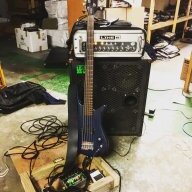
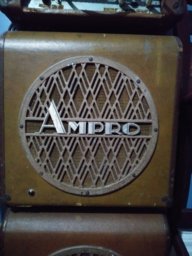
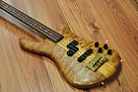
Guitarists usually stand right in front of their amps and turn them up so they can hear themselves with the side effect of deafening anyone stood across from their amp and swamping the bass. They don't seem to realise that knees and lower legs don't have particularly good hearing abilities.
Guitar amplifiers do a lot of noise that interferes with the very essential 2nd Harmonic of our bass guitar.
In addition every stroke of a string generates a wide spectrum that easily covers bandwith way below a Fundamental.
As guitar players often like it to have some 'bassy' feel at least at string stroke (the attack) there is always some contradiction with the bass guitar.
Another consideration is caused by some modulation of frequencies that is physically (naturally) located
below 0Hz.
Dependent on envelope of a note playing there is, more or less, additional spectrums generated above and below the funadamental that contribute to the sound. The mirror spectrum that appears below Fundamental is actually the spectrum that belongs to frequencies below (0-f)Hz for a sustained note at (0+f)Hz Fundamental.
With MI instruments there are some additional spectrums audible caused by the envelope that are inaudible for steady signals. Additional spectrums do not exist for steady signals,
Transient spectrums may be roughly considered kinda f<0Hz for any chords/notes/tones/sine spectrum which then come first into play like a 'transformed' f>0 only for transients (or envelopes).
Hope that's clear,
sorry, couldn't resist after undergo a bashing thread.
(Some science folks may got better what he desereved)
every 6-string does generate a lot of noise/spectrum below the fundamentals so besides loudness it's a good idea to EQ the 6-string first before doing any total loudness considerations. I'd hate it it to make a 6-string player unhappy due to pure sound versus loudness issues.
If everybody lefts some space in frequency bandwith and playing technique skills of the instrument as well then there is space for every musician to play.