• TalkBass has been independent since 1998. Add your voice.
    Create a free account to reply to discussions, view embedded media, and browse with fewer display ads.
    Join freeLog in
    Want zero display ads or expanded classifieds tools? Compare plans.

Ohms - Don't yell at me

Please don’t shoot the messenger;
Mackie’s take on this:

WHAT IS CLIPPING? | MACKIE
It's implied that their explanation applies to full range speakers with tweeters since they do not make bass amplifiers and bass speakers. The problem is that you are applying their explanation to a DIFFERENT application, in which case it's incorrect.

That pretty much confirms my explanation. Thanks!
Except that it's incorrect with respect to bass and guitar speakers.

😂😂😂 Yes, and you are smarter than the engineers at Mackie. I rest my case.
He's actually right. Their explanation was highly simplified for a DIFFERENT application which doesn't apply to bass and guitar speakers.

In this case yes, if that was even written by an engineer at all, which I highly doubt.
It may have been written by an engineer but then heavily simplified (or over-simplified) for THEIR APPLICATION while making it inaccurate for OUR APPLICATION.
 
  • Like
Reactions: bass player 53
The way I understand it is that when an amp clips it basically cuts off the top and bottom of the sine-wave arc. When it gets severe it cuts off so much that it resembles a square wave. If I’m correct that’s when it damages the speaker.

Now I don’t know if this only applies to just full tube amps or Class D as well. Someone please chime-in and let me know if I’m correct about clipping and if it’s universal to all amps.

A square wave is not DC.
 
Current flow is double at 4 Ohms compared to 8 Ohms at the same power.

If both the amp and speaker cabinet are matched at 4 Ohms, or both matched at 8 Ohms, that's safe. If the amp is rated a 4 Ohms and the speaker cabinet is rated at 8 Ohms, that's safe, but might not produce quite as much SPL.

If the amp requires an 8 Ohm load and the speaker cabinet is rated at 4 Ohms, then twice as much current will flow. If you crank it up, there's a risk of too much current causing damage.
 
It's implied that their explanation applies to full range speakers with tweeters since they do not make bass amplifiers and bass speakers. The problem is that you are applying their explanation to a DIFFERENT application, in which case it's incorrect.


Except that it's incorrect with respect to bass and guitar speakers.


He's actually right. Their explanation was highly simplified for a DIFFERENT application which doesn't apply to bass and guitar speakers.


It may have been written by an engineer but then heavily simplified (or over-simplified) for THEIR APPLICATION while making it inaccurate for OUR APPLICATION.
I stand corrected . So explain what constitutes clipping, how square waves affect speakers if they do.
 
  • Like
Reactions: Pulverizor
I stand corrected . So explain what constitutes clipping, how square waves affect speakers if they do.
Clipped hard enough (and it sounds pretty awful), the clipped sine wave will begin to look like a square wave. Square waves have twice the THERMAL power compared with a sine wave of equal amplitude. This means that a clipped signal will produce more heat, but generally an amp won't be able to reproduce a square wave for very long at 2x rated power and in practice this value will end up around 1.5x the rated sine wave power. As long as the speaker is chosen with this in mind, it's not a problem. JBL had a great explanation for manufacturers back in the day when they provided drivers to the MI industry addressing exactly this.
 
In this instance, the engineers at Mesa and QSC are.
@agedhorse confirmed your findings so I offer my apology. The explanation I offered was given to me by a sound engineer many years ago when i had blown 3 JBL D140 15s in 3 weeks driving them with a Fender Showman head.once he explained that I never blew a speaker again.
 
Last edited:
@agedhorse confirmed your findings so I offer my apology. The explanation I offered was given to me by a sound engineer many years ago when i had blown 3 JBL D140 15s in 3 weeks driving them with a Fender Showman head.once he explained that I never blew a speaker again.
It's likely the D140's didn't handle the power of a Showman in a single speaker cab, weren't 2x15 JBL cabs a more popular solution??

Anyways, I hope OP swaps his cab for the 8ohm version.
 
@agedhorse confirmed your findings so I offer my apology. The explanation I offered was given to me by a sound engineer many years ago when i had blown 3 JBL D140 15s in 3 weeks driving them with a Fender Showman head.once he explained that I never blew a speaker again.
No worries, we're all trying to learn stuff. I've certainly learned a truckload on this forum.
 
  • Like
Reactions: Pep
My car has a 300hp engine.

The speed limit between my house and the grocery store is always 45 mph or less.

Therefore it’s not safe for me to drive my car to the grocery store.

Did I get that right? 😇

It's perfectly safe. If you're not an idiot.

Just as the OP would be safe with the one 4-ohm cabinet, as long as the band played only in venues with posted signs: "90 dB SPL LIMIT --- STRICTLY ENFORCED".
 
Last edited:
I love your analogy. Not quite spot-on but I believe it gets the point across.

Please don’t try this but I once built a kinda combo amp made up of a Peavey MAX Preamp, a QSC RMX 2450 and two Madison Sound 10” drivers and bullet tweeter.
The speakers were rated a 400 watts RMS each and I bridged the amp at 2400 watts RMS. That is an accident waiting to happen. I sat it on a tall homemade table to get it up to my ears and had FOH support. I played it for 2 years and never blew the speakers. I was very careful but I wouldn’t do it again. I was young and dumb.

In that list of specs, the crucial one is "I was very careful." I mostly used a power amp that was rated at 1,200 watts RMS bridged and one 18" Carvin cabinet rated 500 watts RMS back when I played in a modern country band. No mishaps. Any rig is safe if you know what you're doing.

Exception: when a bass player from another band sits in to play some songs, as happened in that band a few times.

Fine with me. I don't mind being paid for doing nothing. But for that gig I was using the same cab and one of the Ampeg PF-500 heads known for breaking down at volume.

That bassist must have turned my amp up as soon as he hit the stage, because two minutes into the first song, the amp quit. I went out and got my spare amp from the car, but he just plugged into the PA. No apology forthcoming from him.
 
The issue of matching impedance between amp and cabinet(s) has to do with how much current flows. If the impedance of the cabinet(s) are at 4 Ohms but the amp needs an 8 Ohm load, then twice as much current flows. Too much current creates too much heat. So, the output stage of the amp is at risk, or a weak spot in the speaker coils.
 
It's likely the D140's didn't handle the power of a Showman in a single speaker cab, weren't 2x15 JBL cabs a more popular solution??

Anyways, I hope OP swaps his cab for the 8ohm version.
A single D-140 and a Showman would be risky venture imo.
 
  • Like
Reactions: Pulverizor
So, in conclusion....

Buy Peavey.

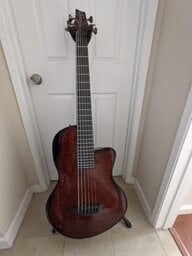
This one?

Image.jpeg