• TalkBass has been independent since 1998. Add your voice.
    Create a free account to reply to discussions, view embedded media, and browse with fewer display ads.
    Join freeLog in
    Want zero display ads or expanded classifieds tools? Compare plans.

Double Bass OK, HELP!

Status
Not open for further replies.
Is there a way to repair and/or reinforce the sag??? Without sacrificing tone obviously.

I should have the book tomorrow. I'm ready to reattach the top but want to read more first.

I must say this is not uncommon and the 'depression' is both shallow (more of a flattening than a droop) and VERY old. It appears to have also involved a crack which looks like the oldest repair on the table and both the sag and the crack are very stable - no weaker than anywhere else at this point.

I'd just like to keep from exacerbating the problem when I place the new bridge. I will experiment and see where the heel falls with various bridge locations. Maybe, with luck, it goes from a D to a Eb???
 
this is cool.

The sunken area is at the treble bridge foot and away from the bassbar altogether. That side is fine and the bar is part of the top itself. Either Voight or Geiger did a nice carving job as the top is pretty deep as they go.

I bet you could slowly bring it back but I'd have to remove the old crack repairs, build a frame jig just the right size and depth to let it sink back - then re-repair the old crack. May not be worth it and might even make matters worse.:rolleyes:
 
what happened to ken's post??? :D

hey pnchad, you might want to try and post this over at rockabillybass.com most of us are well qualified do it yourselfers and would be more than happy to help ;)

some pics would really help too

good luck :)
 
Hi Pnchad, I’ve got a V&G myself. It is a beautifully built and solid instrument, so I am surprised you need to do this work.

I am surprised that you have top sinkage. My top has flattened under the G-foot, but only by an incredibly small amount. Could it be that someone had super high tension on the bass? Had too short a post? Or, even worse, regraduated the top and left it too thin under the bridge? In this case, moving the bridge might just move the problem. If the wood is too thin maybe you should think about a top inlay.

What was the problem with the gears? Mine appear to be “german silver”. They are very solid. I started to polish them when I first got the bass, but decided it was a lot of work and wasn’t going to make me play more in tune…they work fine.

Why do you think the nut is too high? I like to keep my nuts as low as possible (please no obvious comments). Unless the FB is badly shaped, I see no reason to have the string come off the nut more than a business card thickness above the board (I am bracing myself for the barrage of tomatoes).You could always shim the nut if you want it higher.

Anyway, good luck with the project. But, I must say, I have done work like this on plywoods, but would never attempt it on a bass like this.

Robobass
 
pnchad said:
I still have the question of trying to reduce the mensure length. The prior setup had the bridge at almost exactly 42".

A straight line from ff ticks through the old setup's bridge feet were about 1/3 back from the leading edge (toward to neck)of the bridge foot. If I reduce the mensure by 0.5" would it be making a mistake or effect playablity, etc?

My recent purchase, a 100 year old Bohemian bass had a 42" mensure before its new set up. I was expecting to add an extended nut to bring it to 41.5" but my luthier just moved the bridge (and post, I assume) north and everything is working and sounding fine.
 
Robobass - I'd like to see pics of your V&G. Of course it doesn't really exist, you know, according to some around here.
Probably made in a cheap German factory!:ninja: Just kidding.

No, the only real reason for this project was to clean up the bass, get ALL the seams evenly closed and improve playability with a new setup. Nothing extreme.

I have had this bass about 15 or 16 years and I rescued it from a bad (humid) environment in south Florida. I re-learned to play DB on it over a 10 year period but several times had to close seams in different areas. It was just abused for so long.

But, while it's apart I want to do whatever I am capable of doing to 'restore' it and get it to where I enjoy playing it. The tuners are 2 piece (actually 4 piece when totally disassembled). Everything is brass except for the peg stems which are steel. They were actually rusted with a good 1/16" build up. Man, you should see them now - gorgeous but with 70 years of age marks!!

I am also just enjoying the learning process. I have a shop in the garage obstensibly to build EBGs but I just love DBs too much not to be curious.

I agree also about changing mensure. I've been reading that there are several different reasons one might want or need to do it so we'll see where the button falls!:bassist:
 
pnchad--since the bass is apart, and you want to do your best to put it in good shape, I suggest you don't rush to get the top back on. Spend some time poking around for loose or misaligned components. Check that 1) all the linings are tight to the ribs, 2) there are no loose spots where the blocks join, 3) all patches are completely tight, 4) there are no rib bulges.
I'm sure other luthiers here can give you more things to look out for. I can tell you that every time I think I'm ready to close up an instrument, I always find something that needs attention if I look closely enough.

Another thing--I don't understand all the nay-sayers posting on this thread. You own this instrument, and you are learning about repairing it. Obviously, you are trying to do things right, or you would not have posted here for advice. 20 years ago I was in a similar position, but there was no such thing as posting on-line to get free expert advice. Heck, there was no internet! I say good on ya...:)
 
I am not rushing to put the top back. I have cleaned up everything, glued a couple of small cracks in the blocks, cleated and aligned a crack in the ribs, etc.

I decided to make a set of clamps also since I only have about 35 commercial ones and those violin style big enough for a bass cost $6 - 8.00 each from supply houses. So, we got dowels and threaded rod last night and started to make up 50.

Got 'the book' this week and want to check out the new endpin, bridge & wire which should be here today. Oh, BTW does anyone know about the accuracy of the concept of a 'wood' endpin having a substantial effect on sound?

I also want to rough fit the post and check neck angle (someone shimmed it at some point but I'm not sure if it was necessary) too while I have access. Kind of do a dry fit to see where I'm at.

I appreciate the encouragement.;)
 
pnchad said:
Got 'the book' this week and want to check out the new endpin, bridge & wire which should be here today. Oh, BTW does anyone know about the accuracy of the concept of a 'wood' endpin having a substantial effect on sound?

"And now, ladies and gentlemen, step right up!! Be enthralled and amazed as pnchad opens this heavy duty can of worms with one simple, innocent question!"
 
arnoldschnitzer said:
Another thing--I don't understand all the nay-sayers posting on this thread. You own this instrument, and you are learning about repairing it. Obviously, you are trying to do things right, or you would not have posted here for advice. 20 years ago I was in a similar position, but there was no such thing as posting on-line to get free expert advice. Heck, there was no internet! I say good on ya...:)

Amen! I'll probably never take my bass apart but this is the most interesting thread going on TB at the moment. I just wish there were pictures.
 
pnchad said:
Oh, BTW does anyone know about the accuracy of the concept of a 'wood' endpin having a substantial effect on sound?
There is no simple Yes or No answer to your question. In most cases, I would say that it does not make a "substantial effect on sound". It may very well do something positive for some instruments, but I don't recall anyone here giving it a "real" test other than sticking a dowel or a drum stick in the existing endpin socket that was made to accomodate a steel rod. Maybe someday when I have lots of free time, I'll get out my lathe and make a few wood endpins for a real test. When I was young, most basses had wood endpins with a removable larger diameter "peg". I personally prefer the convenience that an adjustable steel or CF rod offers, but I am not going to try to convice a great player like Ron Carter that he is not gaining anything by using that all wood endpin on his bass.

There are many things in the world of doublebasses that have camps of players swearing one way or the other. Some players praise replacing the tailpiece wire with special rope. I tried it on several instruments and IMO, it is just expensive BS and I would not recommend it to my customers. But - if the player "thinks" it improves their instrument, who am I to tell them otherwise.
 
I played on a bass that was labelled Geiger, and sounds like
it was built on the same thinline concept. Asking price was
$9500. Take your time and treat it like a fine investment,
you may be playing with more $$ than you know. This one
had a Eb neck that was fender slim and about 6-7" ribs
For such a little bass it had great sound.

As for end pins and sound, sorry if this is a hi-jack, but
here goes. I built up a new CF fixed design this weekend
and tryed it out. My 42" german bass was literally shaking
the floor. I used inferior CF tube and it snapped. No
floor shaking with old Mr Steel back on the job.

A new CF tube was fabbed this week and is in the mail.
No more snappy! When I cut and refit it, I will turn on
the dB meter and make measurements. I will report them
in a new thread.

As for our adventurous amateur, I don't think you have to
worry about the outside pieces now. It's like dentistry,
no cutting to get access to the bits.
 
I know the outside bits could be left 'til the top is on but it's only another day or two and I have a unique chance to check it all out from the inside.:D

Yep CF does sound like a favorable pin material (compared to steel but maybe not much more than aluminum), AND I am not sure of the practicality of something like ebony because of brittleness.IMO

On my main bass (old old Juzek flatback) Hammond Ashley installed the aluminum tube style and I like it because if the increased surface area on the ground.

Maaaven do you have any pictures of the Geiger bass? It does sound very similar. Mine has an amazing neck. Rock Tiger maple - highly flamed. In fact so much so that over the years the softer areas in the grain have receeded and/or dried out faster so you can feel the grain. It's wonderful and THIN. Unfortunately, I found a scratch from the stand it's been in for the last few years. I have a 100+ year old NYC BOE orchestra pit multiple bass stand which is cool but can be rough.:crying:

I'll take some pictures tonight.

thanks all!
 
pnchad said:
Yep CF does sound like a favorable pin material (compared to steel but maybe not much more than aluminum), AND I am not sure of the practicality of something like ebony because of brittleness.IMO

Gotz used to sell adjustable endpins with ebony rods. The biggest problem with those was that the rods warped over time and ceased to be truely adjustable. I've used a few CF endpins and I like them mainly because they are very light weight and that translates into less weight that I must carry on and off the bandstand.

An endpin does not generate any sound by itself. Any perceived increase in volume can only be the result of coupling with the floor that the bass is standing on. No doubt some material are better vibration transmitters than others, but In have yet to observe any noticable difference in sound between CF endpins and solid steel endpins on the same floor surface on any of the instruments I've installed them on. YMMV
 
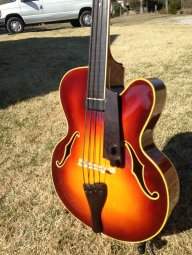
Here are some photos of my V&G Link Removed

I bought it from a guy in Brooklyn who said it had been left unfinished by the original makers when they went out of business, and the varnish is not theirs (whatever). It had a very low bridge. I had the neck brought out and a new board installed, and that got me the sound I believed was in it. It has served me wonderfully in the last 15 years. It doesn’t have the bottom of a full sized bass, but has great tone and projection. Notice the overdesigned socket and saddle I made for it in the late ‘90s when I had a machine shop. Titanium pin! The neck is thin, but not Fender thin; just ideal for me. The top edges are really beat, and the back center-seam is going to need re-gluing one of these days, but overall the bass is low maintenance, and it slides into the back of my Saab without me having to remove the trunk cover! I don't use it for everything, but what it does it does superbly!
Robobass
 
Bob, do you know a source for CF pins that would fit a standard socket set? I should have asked Bob Golihur before I ordered it. Shucks.

Robo that bass is nice and obviously from the same source. The dimensions are very similar. The varnish is not so the story may be true. It looks nice though. I'm not sure mine will ever look that good because of the abuse. Does it have many repaired cracks?

Would I be inconveniencing you if I asked for a few dimensions? I am curious about the neck shim and whether the new angle and overstand is too extreme.

I've lost some edging here and there too. My tuners are single brass, I guess English/French style and obviously original since they were counter sunk into the checks with no signs of other screws or discoloration.
 
Status
Not open for further replies.