As my son says 'dad, call a professional'.
I took the plunge and decided to try and repair/restore a bass on my own with little experience in the process but some knowledge of the concepts and practices.
The bass:
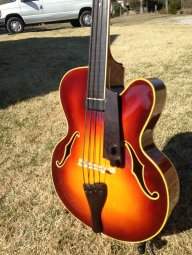
1938 Voight & Gieger (Chicago) 'Thinline' fully carved gamba roundback. Nice deeply carved spruce top/maple back & sides.
The 'Thinline' design was supposed to make this bass more transportable (I guess) so it is strange in it's dimensions. Ribs are 6 - 7" max, neck is EXTREMELY thin both directions (almost as thin as a Fender at the nut), and all the wood is relatively thinner (tighter carving) than most early 20th century basses.
Mensure is a full 42" the way it was previously setup. Cool sounding, very elastic loose bass.
Last night I carefully removed the top over a 2 hour period wetting the seams and easing the old glue out. Worked fine.
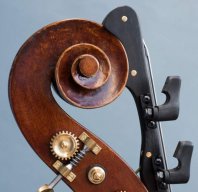
Removed the tuners only to find a crack in the pegbox along the point where the cheek meets the heel.
The top has always had a depression in the wood at the treble foot of the bridge. There are also other old lateral cracks in the table. A previous repair person did a very professional job with a soundpost pad and proper buttons behind all the old cracks.
Here are my questions for anyone with experience:
1. My main reason for removing the top was to solidify all the seams top and back. Once I clean the areas of old glue, what is the best approach to apply new glue before clamping up? Tricks?
2. Is there any technique for either reshaping the top where the sag is at the bridge foot? Or, would reinforcing that area in any way effect tone and volume?
3. Is there any reason why I should maintain the 42" string length? I realize it would effect the 'D' or 'Eb' heel reference but I don't even know for sure what it was originally meant to be. Is there any other way of determining or, does it really matter? My I idea is that I would possibly be able to relocate the bridge away from the dangerous spot in the table by shortening to 41.5" or 41.25".
4. Are 2 piece tuners standard in peg length or vary?
5. The nut is VERY shallow right at the beginning of the board - barely 1 or 2mm. Is that a problem for string height? Should I cut a new nut or wait until it is put back together to test? I noticed a buzz at the 1st & 2nd positions of the G string before I took it apart. I don't remember it being there last I played it 3 years ago. I would think that the angle of the strings to the board would have to be unnaturally high making lower position OK but higher up too far off the board.
I'm sure I'll have more if anyone is so kind as to share expertise.
Thanks in advance.
I took the plunge and decided to try and repair/restore a bass on my own with little experience in the process but some knowledge of the concepts and practices.
The bass:
1938 Voight & Gieger (Chicago) 'Thinline' fully carved gamba roundback. Nice deeply carved spruce top/maple back & sides.
The 'Thinline' design was supposed to make this bass more transportable (I guess) so it is strange in it's dimensions. Ribs are 6 - 7" max, neck is EXTREMELY thin both directions (almost as thin as a Fender at the nut), and all the wood is relatively thinner (tighter carving) than most early 20th century basses.
Mensure is a full 42" the way it was previously setup. Cool sounding, very elastic loose bass.
Last night I carefully removed the top over a 2 hour period wetting the seams and easing the old glue out. Worked fine.
Removed the tuners only to find a crack in the pegbox along the point where the cheek meets the heel.
The top has always had a depression in the wood at the treble foot of the bridge. There are also other old lateral cracks in the table. A previous repair person did a very professional job with a soundpost pad and proper buttons behind all the old cracks.
Here are my questions for anyone with experience:
1. My main reason for removing the top was to solidify all the seams top and back. Once I clean the areas of old glue, what is the best approach to apply new glue before clamping up? Tricks?
2. Is there any technique for either reshaping the top where the sag is at the bridge foot? Or, would reinforcing that area in any way effect tone and volume?
3. Is there any reason why I should maintain the 42" string length? I realize it would effect the 'D' or 'Eb' heel reference but I don't even know for sure what it was originally meant to be. Is there any other way of determining or, does it really matter? My I idea is that I would possibly be able to relocate the bridge away from the dangerous spot in the table by shortening to 41.5" or 41.25".
4. Are 2 piece tuners standard in peg length or vary?
5. The nut is VERY shallow right at the beginning of the board - barely 1 or 2mm. Is that a problem for string height? Should I cut a new nut or wait until it is put back together to test? I noticed a buzz at the 1st & 2nd positions of the G string before I took it apart. I don't remember it being there last I played it 3 years ago. I would think that the angle of the strings to the board would have to be unnaturally high making lower position OK but higher up too far off the board.
I'm sure I'll have more if anyone is so kind as to share expertise.
Thanks in advance.