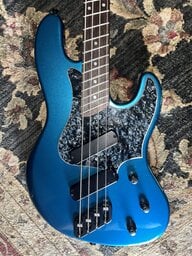
I must admit that when I sing the National Anthem in the shower, it sounds glorious.
The last twilight does gleam better when it's wet.

TalkBass has been independent since 1998. Add your voice.
Create a free account to reply to discussions, view embedded media, and browse with fewer display ads.
Join free Log in
Want zero display ads or expanded classifieds tools? Compare plans.
I must admit that when I sing the National Anthem in the shower, it sounds glorious.
I use a scale with a 13 pound limit that reads in grams, pounds, or ounces. In pounds mode it displays in pounds and tenths, so i just weigh in ounces and divide by 16. I’ve been ounce for ounce in agreement with my local post office when i ship something priority mail. I weigh the package ready to ship then ask what it weighed when the counter minion at the PO weighs it to confirm my (prepaid) postage and it’s always been spot on with the postal scales so i’m happy with trusting what it reads. I check my bass weight by standing it on the rear strap button in the center of my scale and hold it upright between a thumb and forefinger light enough to not effect the weight, and no complaints so far.Also, scales are usually more accurate in the range they are expecting to see. For weighing a bass I would weigh myself and the bass. Then just myself and subtract.

Ugh. Imagine trying to arrange that on a platform like Reverb. What a drag!If it is a real issue I would recommend your purchase being contingent upon an accurate weight measurement. If the seller doesn’t want to then you have a choice. OTBS = close but no cigar.




I think the OP question really merits 2 answers.
First, many people take their basses into the bathroom. It's a thing. If you don't that is your business. Your loss. But most people like they way it sounds in there. That is why producers say the track is "in the can" when they finish mixing it.
Second reason is most (not all but most) bassists like to weigh their basses about once a week and the toilet is where most people first really begin to comprehend gravity. That's why people keep scales near the toilet.
*****Bonus*****
Third answer as a reward for reading. Anyone who boils used strings, sells a free carry bag from an amp, or measures nut width is probably also going to pose in front of the mirror with their bass. The restroom is convenient because it has both a mirror and a scale. So efficiency goals! Play and weigh at the same time.


That’s a very challenging song to sing. But if you pretend the bar of soap is a microphone it feels right.I'm a terrible singer, but of all the songs I CAN sing, I must admit that when I sing the National Anthem in the shower, it sounds glorious.

At least the scale wasn't buried beneath boxes.It is buried behind boxes, for now...

Yeah, I figured a bathroom scale would not be very accurate. I didn't even bother at first to weigh my bass, but eventually did: with me on the scale with/without the bass, and taking the difference.
Measured 10.6 lbs, but will try my postal scale at some point. It is buried behind boxes, for now...
It's easier in Canada. In our measuring system 1 gallon of water = 10lb. I ain't splitting hairs. Most scales have tiny print somewhere saying "not for legal trade"....the disclaimer that it's only guaranteed to be close enough to weigh people, not commercial goods.A good way to test accuracy is by weighing a gallon of water. That's the general weight of instruments and easy to obtain. A gallon of water will weigh about 8.33 lbs.

Not on the tuner itself.Interested in the fish scale method…so those of you using one — you just place the hook under a tuner? No chance of damaging the tuner or headstock that way? Any other way to hang the bass for weighing besides using a tuner?
And NEVER has the TBer who asked for the weight actually bought what I was selling.

To paraphrase the old addage - if you have to ask how much... it's probably too muchAnd NEVER has the TBer who asked for the weight actually bought what I was selling.

I honestly don't see a problem with gebass6's hanging method...
The hook is safely behind the strings, string tension is pulling the peg in the opposite direction of scale, and the bass is hanging straight down.
Just for ha-has, I just picked up my 11+ pound ash PBass by the G peg and it's solid as a rock.
Not to mention, pegs are solid brass...