Working on a preamp for a bass build, and I figured I would share this little snippet, because it was very difficult (for me) to come up with!
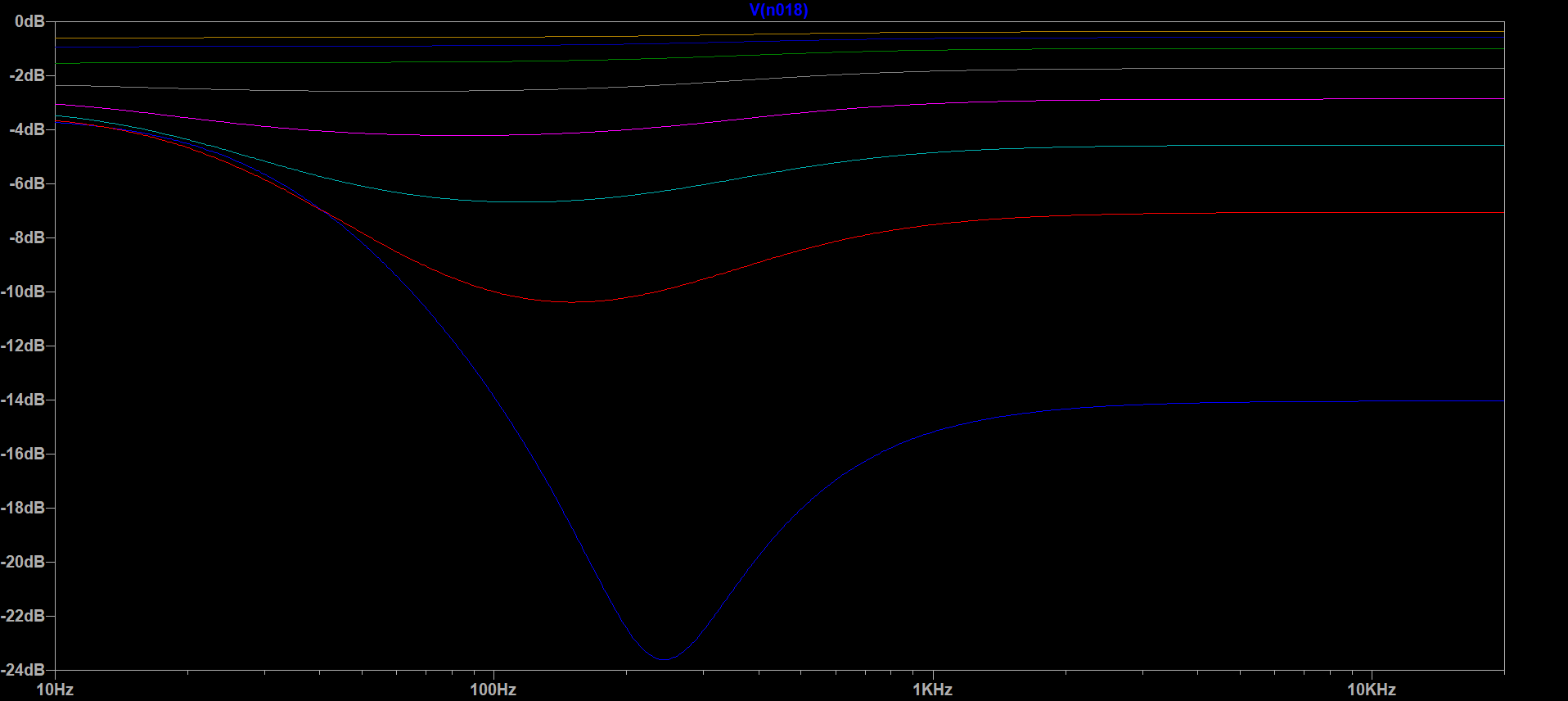
First, for the uninitiated, the 'pulltec trick' refers to a quirk of the vintage "Pulltec EQP-1A" equalizer. Rather than a knob that just goes from 0-10 to boost or cut bass, it has a Frequency switch, and then one knob for bass BOOST, and one for bass CUT. Because the boost and cut aren't exactly matched in frequency and Q, using boost AND cut TOGETHER yields this interesting response curve, wherein the bass is boosted but the mids just above the bump are scooped slightly. Many have found this to be useful sound, with a plump but un-muddy bass sound.

So I thought this would be a useful contour to add as it's own control, separate from BMT. The problem was that, for reasons, I needed it to be dialed in with ONE single-ganged pot. I tried a variety of approaches to blending/panning between it and a dry signal, and a few other things, but I struggled to come up with anything that didn't also require additional Opamp stages or other excessive workarounds. Normally, dual pots or extra active components are fine, but this is onboard, so power and space are a premium.
So here's the original schematic of the Equilux, a clone of the Pulltec available on Pedalpcb.com

Stripping off the buffers and hi-cut portions, and simplifying it to one freq switch set, we get this, the bass boost and cut section

I played with some values, making changes for impedance changes, and suiting it more to my frequency needs, I got to work trying to one-knobify it
Eventually I came to the idea to simply vary the resistance to vground of the high pass and low pass filters that make up the bass cut and boost.
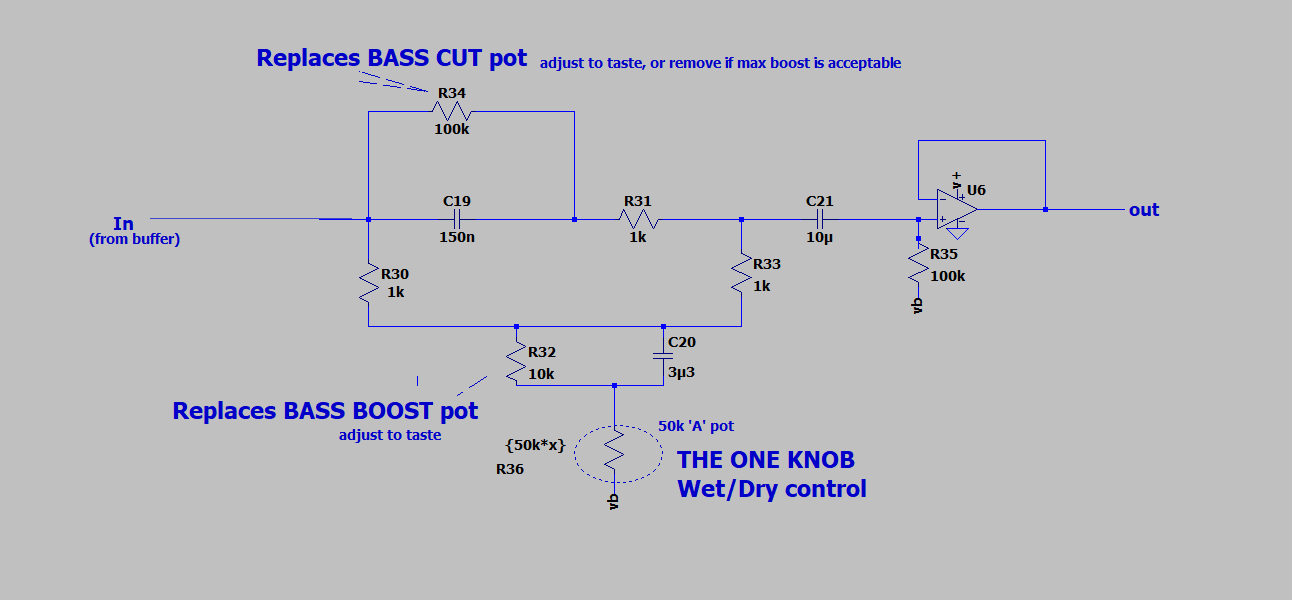
The problem was that it was entirely subtractive as a passive EQ, meaning that it dragged the signal well below unity.. hardly acceptable for a one-knob wet/dry contour knob.
After trying other things, I came back to this idea.. it literally came to me in a dream that I could just tie a master gain to the variable resistance to ground of the wet/dry pot..
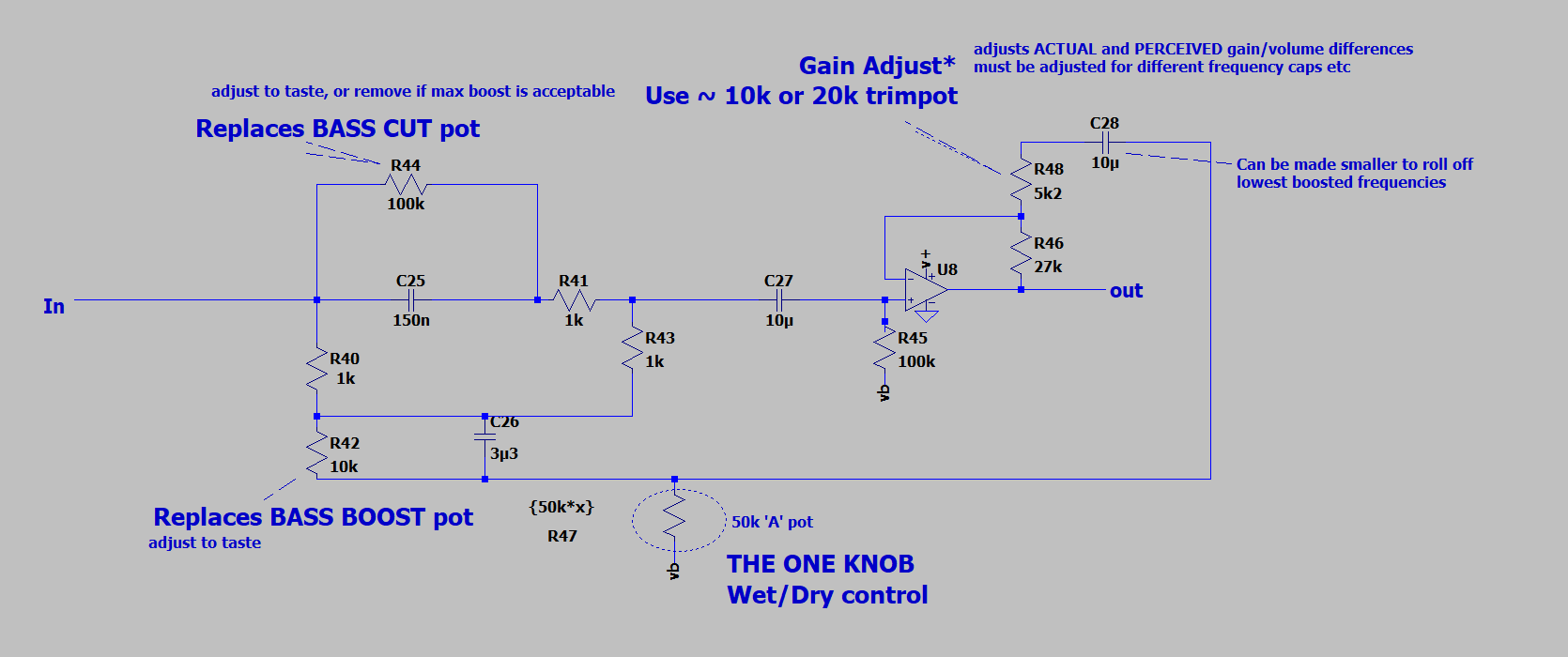
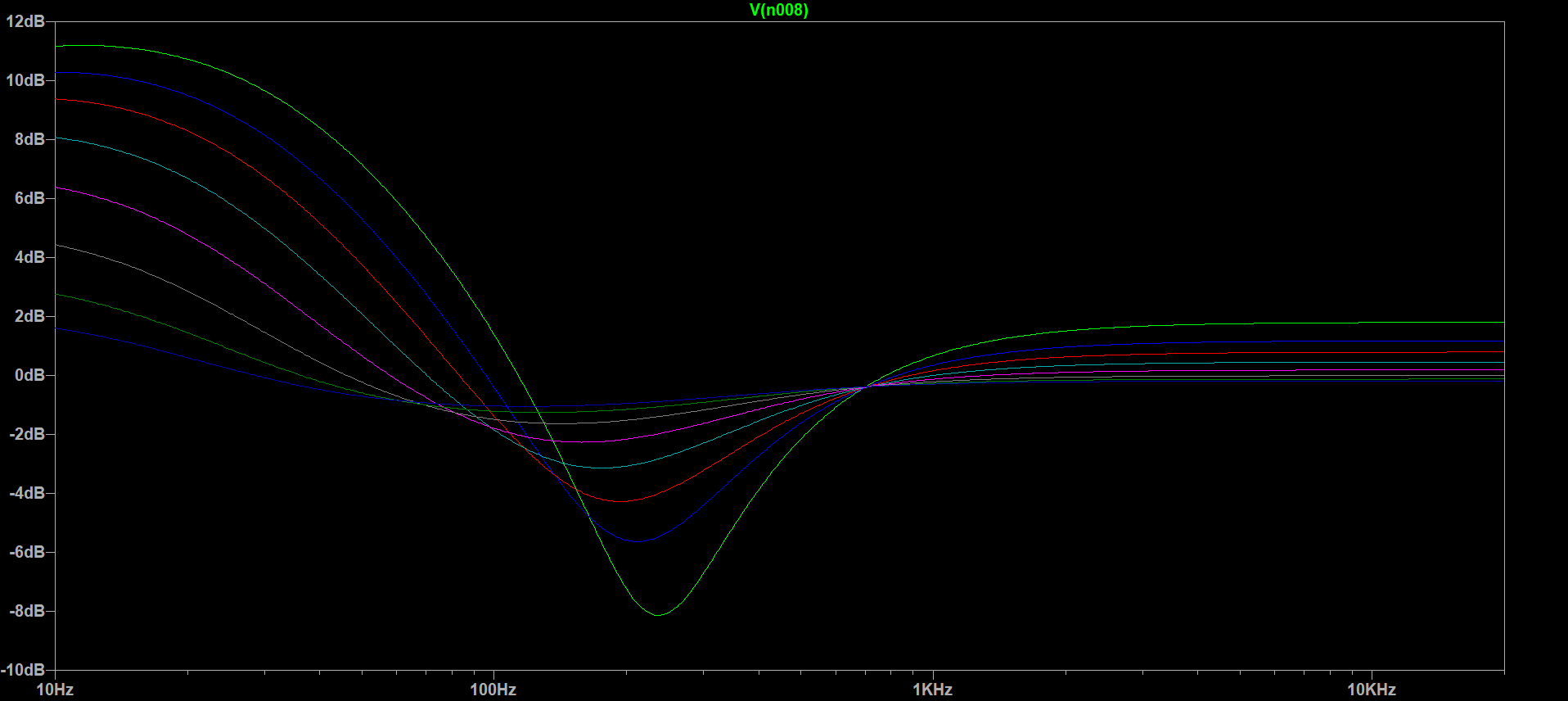
The 'r48' trimpot is necessary to adjust the scale of the gain adjustment. You must do this for different component choices for freq and boost/cut resistors, as well as to adjust the perceived volume depending on the intensity of the scoop or low end lump. I personally find that the higher flat passband should be louder than unity, but its possible to choose a resistance such that it is essentially unity above the dip.
And that's about it! Hope somebody finds this useful, it's a pretty cool sound. It's a trick to find sweet spots where it doesn't just sound like a bedroom mid scoop, but the general curve is pretty nice.. I personally like the scoop to fall around 300hz, with enough lows and lowest mids to stay fat, and enough of the 1k+ for attack, but just a nice little cleanup of the sometimes muddy lower-middle-mids... but you can certainly cut at 500, or 800 for honk-reduction, or even higher if you like a particular kind of modern sound. play around with it, just find a capacitor ratio that works for the bump/scoop relationship, keep that ratio to go higher or lower, then adjust the gain scaling as needed!
I specifically wanted this because I'm NOT a mid-scoop guy (I'm pretty mid-forward if anything). This scratches a nice itch, threading the gap between a slightly-cleaned-up subtle scoop, a fat and defined low end, while still having a good presence.
First, for the uninitiated, the 'pulltec trick' refers to a quirk of the vintage "Pulltec EQP-1A" equalizer. Rather than a knob that just goes from 0-10 to boost or cut bass, it has a Frequency switch, and then one knob for bass BOOST, and one for bass CUT. Because the boost and cut aren't exactly matched in frequency and Q, using boost AND cut TOGETHER yields this interesting response curve, wherein the bass is boosted but the mids just above the bump are scooped slightly. Many have found this to be useful sound, with a plump but un-muddy bass sound.
So I thought this would be a useful contour to add as it's own control, separate from BMT. The problem was that, for reasons, I needed it to be dialed in with ONE single-ganged pot. I tried a variety of approaches to blending/panning between it and a dry signal, and a few other things, but I struggled to come up with anything that didn't also require additional Opamp stages or other excessive workarounds. Normally, dual pots or extra active components are fine, but this is onboard, so power and space are a premium.
So here's the original schematic of the Equilux, a clone of the Pulltec available on Pedalpcb.com
Stripping off the buffers and hi-cut portions, and simplifying it to one freq switch set, we get this, the bass boost and cut section
I played with some values, making changes for impedance changes, and suiting it more to my frequency needs, I got to work trying to one-knobify it
Eventually I came to the idea to simply vary the resistance to vground of the high pass and low pass filters that make up the bass cut and boost.
The problem was that it was entirely subtractive as a passive EQ, meaning that it dragged the signal well below unity.. hardly acceptable for a one-knob wet/dry contour knob.
After trying other things, I came back to this idea.. it literally came to me in a dream that I could just tie a master gain to the variable resistance to ground of the wet/dry pot..
The 'r48' trimpot is necessary to adjust the scale of the gain adjustment. You must do this for different component choices for freq and boost/cut resistors, as well as to adjust the perceived volume depending on the intensity of the scoop or low end lump. I personally find that the higher flat passband should be louder than unity, but its possible to choose a resistance such that it is essentially unity above the dip.
And that's about it! Hope somebody finds this useful, it's a pretty cool sound. It's a trick to find sweet spots where it doesn't just sound like a bedroom mid scoop, but the general curve is pretty nice.. I personally like the scoop to fall around 300hz, with enough lows and lowest mids to stay fat, and enough of the 1k+ for attack, but just a nice little cleanup of the sometimes muddy lower-middle-mids... but you can certainly cut at 500, or 800 for honk-reduction, or even higher if you like a particular kind of modern sound. play around with it, just find a capacitor ratio that works for the bump/scoop relationship, keep that ratio to go higher or lower, then adjust the gain scaling as needed!
I specifically wanted this because I'm NOT a mid-scoop guy (I'm pretty mid-forward if anything). This scratches a nice itch, threading the gap between a slightly-cleaned-up subtle scoop, a fat and defined low end, while still having a good presence.
Last edited: