• TalkBass has been independent since 1998. Add your voice.
    Create a free account to reply to discussions, view embedded media, and browse with fewer display ads.
    Join freeLog in
    Want zero display ads or expanded classifieds tools? Compare plans.

Outlining the harmony

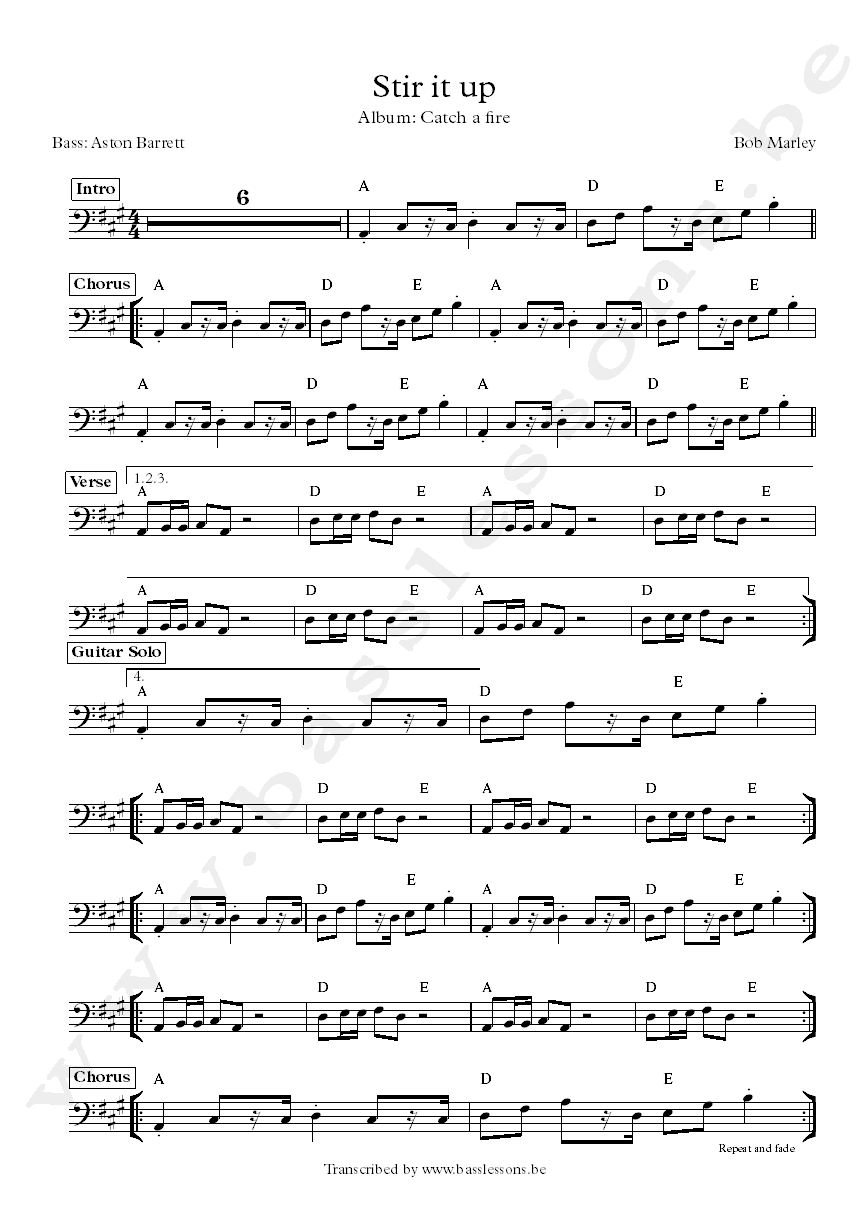
Here is a fun exercise: Who is your favorite bass player? Transcribe the bass line to one of your favorite songs. Take two different highlighters and highlight the 3rds in one color and the 5ths in another color.

Those are examples of times "it is appropriate to play the 3rd and 5th of the chord."

Here is an example by Aston "Family Man" Barrett, to get you started on the path:

81-1.png
 
Root, 3, 5 patterns are used in a lot of different grooves but usually the root falls on the one.
You can have fun sometimes playing the 3 or 5 under a chord or pedaling on the root while the chords change.
I like substitution and inversion and sometimes will use the 3rd under the dominant 7th chord, like if the tune is in C instead of playing a G note under the G chord I'll play B.
You have to mess around with it and see how it sounds and where it fits, some tunes will tolerate this type of change, others are less forgiving but once you have the sound in your head you'll know where to do it and where to stay put and keep it simple.
 
As a bass player, when it is appropriate to play the 3rd and 5th of the chord and not just the root? It's mentioned that a lot of the time, these notes don't support the sound as well. So when is it a good time to play arpeggios?
When? Anytime you are playing over a major chord or major arpeggio, Why? The R-3-5 notes are the basic building blocks of any major chord.

OK - from the top -- The songwriter places a chord at a specific spot in the song so that chord harmonizes the active melody. Harmonization happens when both the melody and the chord contain some of the same notes. The R-3-5 are part of a major chord so......

So we trust that the major chord (arpeggio) has been placed correctly and if we play notes from that (major) chord we two will harmonize and sound good.

So when can you play a R-3-5? As that R-3-5 is the basic foundation of any major chord -- anytime a major chord or arpeggio is active.

But, always that but. Will just a root note and nothing else till the next chord change do the trick. On slow ballads it will. So how many notes are necessary? Long story.
 
Last edited:
  • Like
Reactions: TheIndieKid
First, let's eliminate walking lines and standard "arpeggiated" lines from the discussion, because it's clear in those cases that we actually must play notes other than root and five... and, those lines often follow the guidelines below:

[we're talking major keys]
The third of the I chord is useful as a leading tone to the IV chord.
The third of the IV chord is the sixth of the scale, and that note is useful under both I and IV chords.
The third of the V chord is a leading tone to the I
The third of the ii chord is the fourth of the scale, which can lead to the V chord.
The third of the vi chord is the root of the scale.

In all of the above cases, you see that the thirds can always "lead" to a chord change, so it's generally more appropriate to play thirds leading to the downbeat of a chord change. Obviously there are exceptions, and sometimes those exceptions can become what makes a record memorable.

Since we are almost always playing one note at a time, a big part of the art of bass is choosing the best note at its time. Imagination and experience are invaluable.
 
  • Like
Reactions: TheIndieKid
Here is a fun exercise: Who is your favorite bass player? Transcribe the bass line to one of your favorite songs. Take two different highlighters and highlight the 3rds in one color and the 5ths in another color.

Those are examples of times "it is appropriate to play the 3rd and 5th of the chord."

This is the kind of stuff that gets me on this website. I have to try this tomorrow. Do you have any other exercises like this?
 
Here is a different angle to what notes to play; for a while (and I guess forever since I knew this existed) been exploring 12 tone improvisation, as a way to see if there was some kind of logic to the chaos of venturing outside the key. Beyond the concept that on itself is pretty interesting, there are hundreds of collateral investigations by several musicians about how to leverage these ideas. One that stuck in my mind was this guy's article:

jazztruth: Linear Spectrum

Towards the second half of the page, George explains the idea of "affinity" from the Tonic to all the rest of the 12 tones, depending on the chord type. For example, if this was a Maj7 chord, the degree of dissonance from the tonic would progress like: 1, 5, 3, 7, 2, 6, +4, +1, +5, -3, -7, 4... to his ears. Same process with a 7 or a minor chord.

I would suggest creating something like this, that you like. Clearly, embellishing your playing with the 5th and 3rd is a way, but you may, depending on the context, want to do something more crazier.

I hope this helps
 
Do you have any other exercises like this?

Another thing I have done is jot the scale interval (relative to the root of the chord) below each note of a phrase
My Standing In The Shadows of Motown and Carol Kaye books are full of little numbers I jotted down.

ultimately all 12 notes can be appropriate for a chord
-with proper rhythm, timing, and emphasis, dynamics, etc

but nothing determines a note's appropriates more than stylistic context.
 

Latest posts